


Water Security, From the Ground Up
Water does not follow a single path. A drop of rain can seep into the soil, fill a pond, recharge a well, or flow into a river. How we capture, conserve, and manage that water can shape lives and livelihoods. Across India, communities have traditionally built structures to capture rain, recharge groundwater, and restore rivers and traditional water bodies. Today, as the demand for water grows all around us, it has become even more important to revive community participation for ensuring water security, along with scientific planning, strong institutions and sustained action.
The Government’s approach is to bring these different efforts together to address diverse water challenges. These priorities also find expression in the India International Water Week (IIWW), conceptualised in 2012. Today, IIWW has evolved into a biennial platform where policymakers, researchers, industry leaders and communities come together to exchange ideas and explore solutions for sustainable and climate-resilient water management.
India International Water Week-2026The 9th edition of India International Water Week (IIWW) 2026 is being held from 22–26 September 2026 in New Delhi, with the theme “Climate Resilient Water Management.” The Ministry of Jal Shakti organises India International Water Week.The discussions this year centre on seven sub-themes: Inclusive and Equitable Water GovernanceCollaboration for Optimal Use of Water ResourcesTechnology and Community for Water SecurityWater in Climate-Related RiskInnovative Financing Models for Water Infrastructure and ModernizationSustainable Water Resources ManagementWater for People and Planet 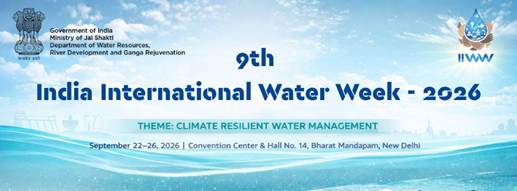 The programme brings together representatives from six Union Ministries and 16 States and Union Territories (UTs). Around 150 countries have been invited to participate, with 11 countries expected to join as partner countries. The event features 49 focused sessions covering various water-sector themes, including ministerial plenaries, a youth forum and dedicated start-up forums. The programme brings together representatives from six Union Ministries and 16 States and Union Territories (UTs). Around 150 countries have been invited to participate, with 11 countries expected to join as partner countries. The event features 49 focused sessions covering various water-sector themes, including ministerial plenaries, a youth forum and dedicated start-up forums. |
Over the past decade, the Government has taken a range of measures to strengthen water conservation and improve water security. Initiatives such as the Jal Shakti Abhiyan, Jal Shakti Abhiyan: Catch the Rain, Atal Bhujal Yojana and Mission Amrit Sarovar have supported these efforts. More recently, Jal Sanchay Jan Bhagidari has strengthened community-led conservation, while NAQUIM 2.0 is providing scientific inputs for area-specific groundwater management. These efforts are also reflected in the country’s groundwater indicators. Total annual groundwater recharge increased from 432 billion cubic metres (BCM) in 2017 to 448.52 BCM in 2025.
In addition to these Government efforts, stories from across India bring the themes of community participation, groundwater recharge, sustainable water management and inclusive governance to life. They show how communities, local institutions and technology are shaping practical responses to water challenges. From groundwater recharge and water-quality monitoring to river restoration and rainwater harvesting, these efforts offer a ground-level view of the ideas and approaches discussed at IIWW 2026.

Community Recharge at Scale
In the Balod district of Chhattisgarh, water conservation has evolved into a community-led effort. Gram Panchayats and local communities have come together across villages to create structures that capture rainwater and support groundwater recharge.
Under Jal Sanchay Jan Bhagidari 2.0, the district created 2.84 lakh recharge structures between June 2025 and May 2026. These included check dams, recharge pits and contour trenches across villages to conserve rainwater.
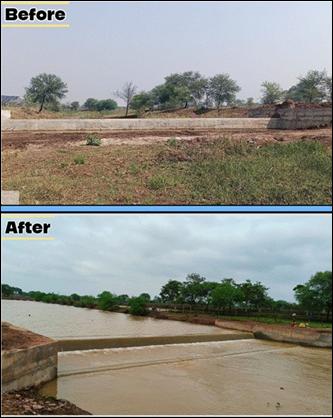
| Check Dam in Balod District, Chhattisgarh |
A notable intervention has been the rejuvenation of the 14.3-km Tawera Nala, a seasonal water channel. More than 6,250 water conservation structures were created along the nala. These interventions are expected to conserve 6.5 crore litres of additional rainwater and improve groundwater levels by an estimated 5–10 feet.
Beyond the number of structures created, the experience demonstrates how water conservation can become a shared responsibility, with communities contributing to efforts to strengthen local water security.
When Women Become Water Managers
In Khowai, Tripura, rural water supply is being strengthened through community participation and local institutions. The district has brought together Panchayats, Self-Help Groups, schools and other local stakeholders to support sustainable water management.
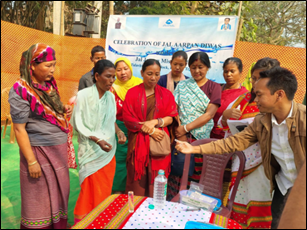
| Women in Khowai, Tripura, attending the Jal Aarpan Diwas event |
More than 6,000 SHG women are engaged in community mobilisation. Through School Water Clubs, SHG women also train students in basic water-quality testing using Field Testing Kits (FTKs). This brings basic water-quality monitoring closer to local communities.
The district has also strengthened monitoring of rural water-supply schemes. Geo-tagged monitoring, third-party quality audits, and regular District Water and Sanitation Mission (DWSM) and District Development Coordination and Monitoring Committee (DISHA) meetings support implementation and accountability. Completed schemes are formally handed over to Gram Panchayats through Jal Arpan.
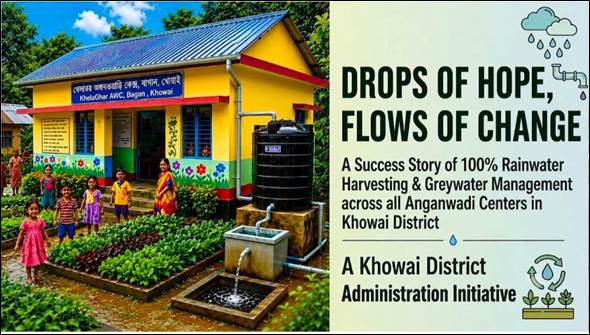
Source sustainability forms an important part of the district’s approach, ensuring the long-term reliability of water sources. Measures include catchment protection, afforestation, groundwater recharge and greywater management. All 860 Anganwadi centres in the district have rainwater-harvesting structures.
From Rivers to Reliable Water
A tap-water connection brings water to a household, but long-term water security also depends on protecting the sources that sustain it. In Muzaffarnagar, Uttar Pradesh, this idea has shaped efforts to link Jal Jeevan Mission implementation with river rejuvenation, water conservation and community participation.
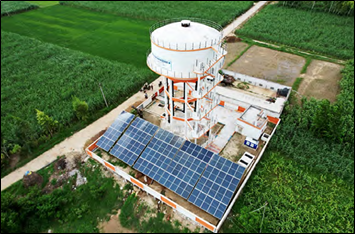
| Water Supply Scheme in Muzaffarnagar, Uttar Pradesh |
Under the “Dhara se Dharohar Tak” campaign, the Ban River was revived across nearly 42 kilometres, while the Sot River was restored across around 17 kilometres. As a result, the groundwater level in Amroha improved. The approach has also been extended to rivers in neighbouring districts, including the Malan in Bijnor and the Hiranyavati in Kushinagar.
Community participation has been central to these efforts. Gram Sabha-based monitoring, Pani ki Pathshala sessions and women-led water-quality testing have encouraged residents to take an active role in protecting their water resources. Jal Seva Aankalan has further strengthened community engagement and accountability.
Where Students Learn To Save Every Drop
For a student, rain can simply mean a break from the classroom. In Odisha, it is becoming a lesson in where water comes from and where it goes. Through the Catch the Rain 2026 campaign, educational institutions are introducing students to groundwater science, hydrological processes and rainwater harvesting.
The learning is being supported by a wider public campaign. Odisha has conducted 968 Information, Education and Communication (IEC) activities, using street plays, folk performances and community programmes to spread awareness about rainwater harvesting and groundwater conservation.
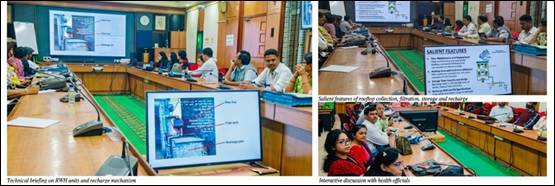
| Discussion on the Importance of Rainwater Harvesting in Health Care Centers |
But the campaign does not stop at awareness. Across the state, 905 structures have been created to harvest rainwater and recharge groundwater. These include 849 rooftop rainwater-harvesting structures that collect rainwater and 56 recharge shafts that help replenish groundwater. In Jajpur, Odisha, 45 recharge shafts have been constructed. The state has also taken up 98 tanks across all 30 districts for renovation and desilting.
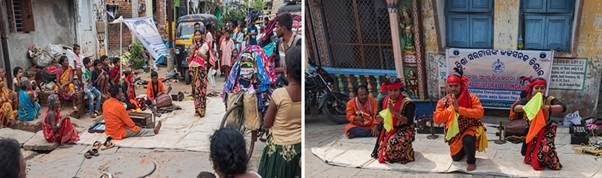
| Community Outreach Programme |
From Local Action To International Coordination
These experiences show that lasting progress depends on community participation, scientific planning, institutional coordination and continued stewardship. This is the larger conversation that India International Water Week 2026 brings together. It is providing a forum for countries and stakeholders to share knowledge, exchange experiences and explore approaches for sustainable water management.