

Aug 29 (Reuters) – A federal judge on Friday ruled that laws that President Donald Trump’s administration used to cancel visas and initiate deportation proceedings against noncitizen college students based on their pro-Palestinian advocacy and criticism of Israel are unconstitutional.The judge, an appointee of Democratic President Joe Biden, said that in the United States, free speech, including the freedom to criticize the government and its leaders, was evidence of the strength of the country’s democracy.
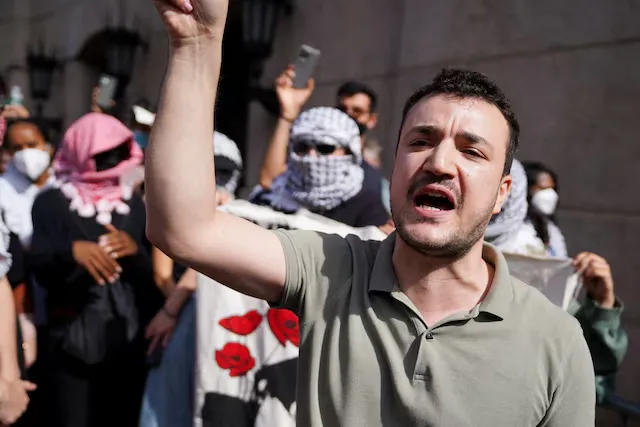
“That strength is diminished when members of our society – citizens and noncitizens alike – must self-censor and ‘behave’ or suffer the government’s retaliation,” she said.The State Department and DHS did not immediately respond to requests for comment.Wise’s ruling focused on how the Trump administration, from March 2025, began revoking visas and detaining non-citizens who engaged in pro-Palestinian advocacy on campus, starting with the arrest of Columbia University graduate Mahmoud Khalil, who is fighting separately to avoid being deported.U.S. District Judge Noel Wise in San Jose, California in a blistering ruling, chastised the U.S. State Department and U.S. Department of Homeland Security for how they had deployed provisions of federal immigration law to target non-citizens for deportation for expressing views they wanted to suppress.
Those arrests formed the basis of a lawsuit that was filed in August 2025 by Stanford University’s student newspaper, The Stanford Daily, which alleged that some of its writers with student visas had refrained from covering pro-Palestinian student protests and topics related to the Middle East conflict as a result of the administration’s policies.The newspaper’s lawyers argued that two provisions of the Immigration and Nationality Act that the administration relied upon to cancel student visas and initiate deportation proceedings violated the U.S. Constitution’s First and Fifth Amendments as applied to constitutionally protected speech.Those laws allowed Secretary of State Marco Rubio to render noncitizens deportable if he personally determined someone’s action “compromises a compelling foreign policy interest” and allowed him to revoke someone’s visa at his discretion.
Wise agreed with the newspaper, saying that when a noncitizen’s speech is the reason behind a visa revocation and deportation determination, “the government is singling out that speech for disfavored treatment based on its viewpoint or content.”Conor Fitzpatrick, whose group Foundation for Individual Rights and Expression represented the student newspaper, in a statement said the ruling “proves that free speech isn’t a privilege, but the inalienable right of every man, woman, and child.”The ruling was similar to a decision last year by Boston-based U.S. District Judge William Young, who similarly found the administration had acted unconstitutionally by adopting a policy of revoking visas, arresting, detaining and deporting foreign students and faculty engaged in pro-Palestinian advocacy.

Wise in her ruling expressed concern the administration had moved on to target people for expressing other types of views it disfavored, saying eventually the “targets may include anyone in the United States who exercises their freedom of speech to simply express opinions the government does not like.””This downward spiral is antithetical to our Constitution that recognizes our right to speak freely,” she wrote. “Here you can simultaneously hate the content of a person’s speech and love the country that cherishes the freedom to allow it.”
Reporting by Nate Raymond in Boston; Editing by Stephen Coates.