

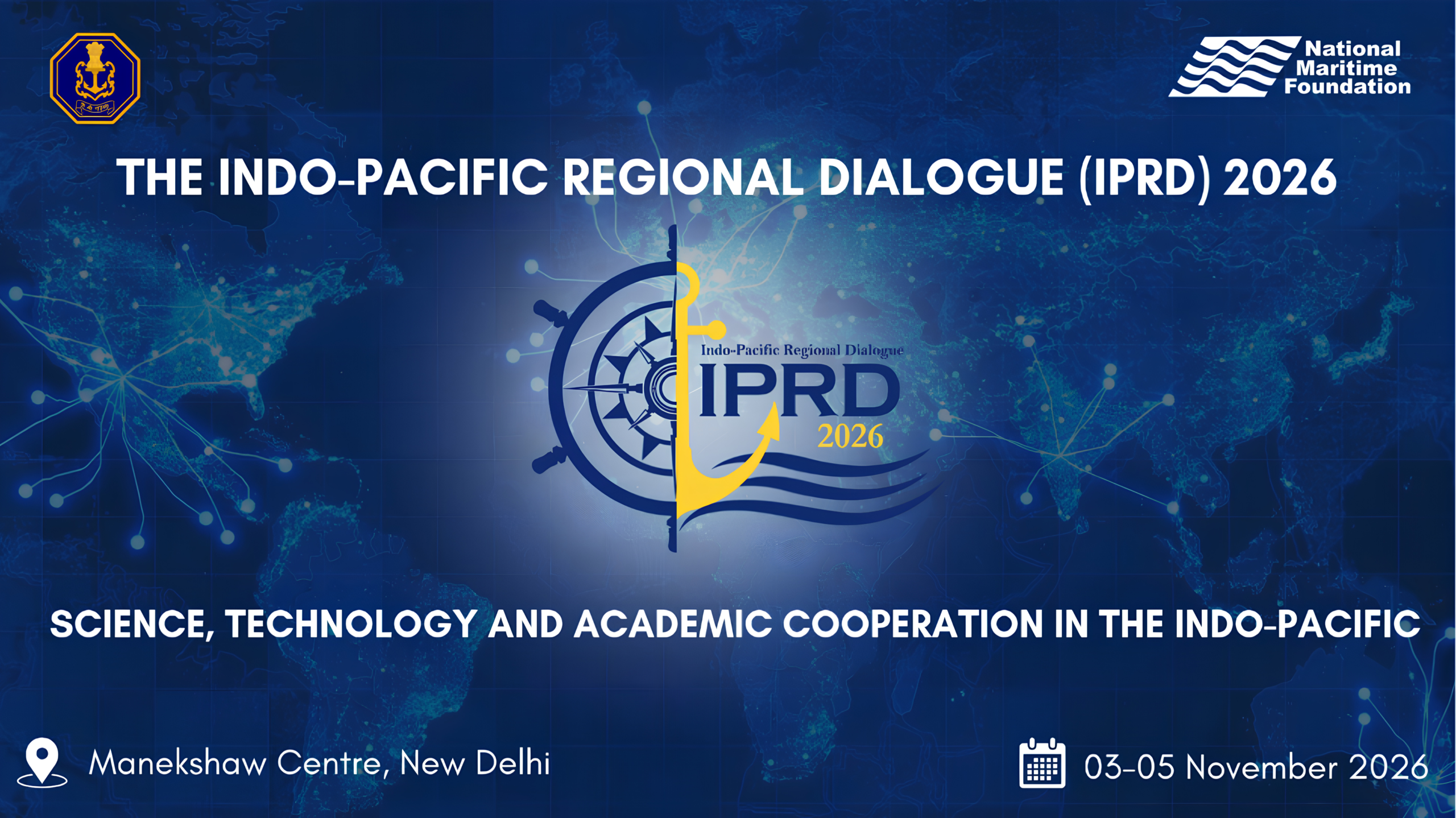
Three-day conference in New Delhi from 03 to 05 Nov 2026 to bring together experts from 18 countries; deliberations to focus on academic networks, maritime science, ocean governance, climate resilience, and emerging technologies
The Indian Navy will conduct the 2026 edition of the Indo-Pacific Regional Dialogue (IPRD-2026), its annual apex-level international strategic dialogue, in New Delhi from 03 to 05 Nov 2026. Organised in association with the National Maritime Foundation (NMF), the Navy’s knowledge partner and principal organiser of the event, this year’s conference will be centred upon the theme ‘Science, Technology and Academic Cooperation in the Indo-Pacific’.
The IPRD is the principal manifestation of the Indian Navy’s annual international outreach at the strategic level. Successive editions of this dialogue have examined selected dimensions of the seven interconnected maritime lines of thrust of the Indo-Pacific Oceans Initiative (IPOI), announced by Prime Minister Shri Narendra Modi at the 14th East Asia Summit in Bangkok in Nov 2019. In the context of India’s maritime vision of MAHASAGAR (Mutual and Holistic Advancement for Security and Growth Across Regions), the IPRD seeks to translate the IPOI’s broad framework for cooperation into specific, actionable proposals.
The choice of this year’s theme reflects a fundamental feature of the contemporary maritime domain: the oceans are interconnected, but the scientific knowledge, technological capabilities and institutions required to understand and manage them remain unevenly distributed. Climate change, maritime trade and supply-chain vulnerabilities, pressure upon marine resources, and threats to critical maritime infrastructure increasingly transcend national boundaries. Effective responses, therefore, require not merely more sophisticated technologies but stronger arrangements for cooperation, information-sharing and the development of human capital. Consequently, IPRD-2026 will examine cooperation beyond the conventional confines of Science, Technology, Engineering and Mathematics (STEM), recognising the essential contributions of the social sciences, life sciences and humanities.
This year’s conference includes five professional thematic sessions spread over three days, which will address ‘Academic Networks, Research, and Human Capital Development’; ‘Maritime Situational Awareness and Protection of Critical Maritime Infrastructure’; ‘Oceanographic Science and Climate Resilience’; ‘Collaborative Approaches to Ocean Governance and Maritime Resilience’; and ‘Transformative Maritime Technologies and Dual-Use Implications’. These deliberations will consider practical pathways for joint research, collaborative technology development, responsible governance, appropriate access to scientific data and stronger institutional partnerships.

The opening day will feature a special session titled ‘Perspectives from the Flag Bridge’, bringing together former naval chiefs from India and Sri Lanka, and a special ambassadorial interaction titled ‘Sahyog Ka Samvaad’. Shri Rajnath Singh, Hon’ble Raksha Mantri, is scheduled to deliver the Commemorative Address on the first day. The three-day programme will also feature ministerial and other special addresses, and contributions from maritime practitioners, scientists, academicians, policymakers and experts from 18 countries across the Indo-Pacific.
In keeping with the IPRD’s emphasis upon solution-oriented dialogue, deliberations of this international conference will concentrate upon the identification of specific, actionable measures at national, sub-regional, and pan-regional levels, which could be thereafter addressed through extant mechanisms for bilateral, trilateral, and plurilateral structures designed to promote comity, cooperation, and collaboration, across the Indo-Pacific.