

Chief Justice of India, Justice Surya Kant to be the Chief Guest
During its 33-year journey, the Commission registered more than 24 lakh cases, including 3,100 suo motu and recommended Rs. 274 crore as relief to the victims of human rights violations
The programme also includes a National Conference on ‘Water as the Elixir of Life: Advancing Human Dignity through the Right to Water’
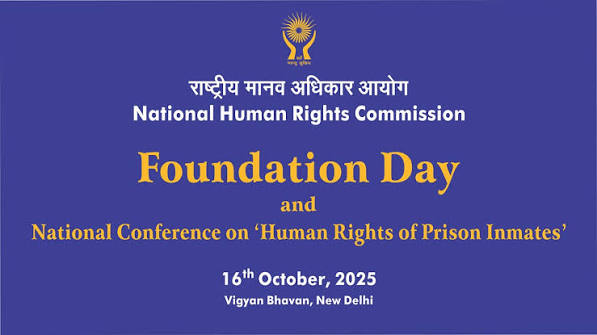
The National Human Rights Commission (NHRC), India is organising a function to celebrate its 33rd Foundation Day at Vigyan Bhawan on 12th October 2026. The Chief Justice of India, Justice Surya Kant will address the event as the Chief Guest in the presence of NHRC, India Chairperson, Justice V. Ramasubramanian, Members, Justice (Dr.) Bidyut Ranjan Sarangi, Smt. Vijaya Bharathi Sayani and Shri Priyank Kanoongo, Secretary General, Shri Piyush Goyal, other senior officers and dignitaries. The Foundation Day celebration provides an opportunity to reflect upon the Commission’s journey and renew its commitment to protect and promote human rights.
The function will be followed by a National Conference on the theme ‘Water as the Elixir of Life: Advancing Human Dignity through the Right to Water.’ The two technical sessions include ‘Protection and Restoration of Water Bodies: Safeguarding the Foundation of the Right to Water’ and ‘Protecting Drinking Water Sources: Ensuring Safe and Sustainable Access to Water for All.’ The Conference will bring together experts and stakeholders, academicians, researchers and members of civil society and human rights defenders to deliberate on the human rights dimensions of access to safe and adequate water, with a focus on advancing human dignity and strengthening water security.
During the 33-year journey since its inception on 12th October 1993, the NHRC, India has been recommending necessary policy reforms, people-centric governance and implementation and regular monitoring on the ground to ensure fairness, transparency and accountability in law enforcement, investigations and welfare schemes/ programmes. It promotes police accountability, prison reforms and protection of the rights of the accused and victims through research, policy advocacy and public awareness. It continues to collaborate with central and state governments, parastatal organisations, academic institutions, NGOs and human rights defenders to protect and promote human rights of all segments of society, particularly the most vulnerable.
The Commission has issued 35 Advisories so far. These include Ensuring the Welfare of Transgender Persons (2.0), Child Sexual Abuse Material (CSAM), Rights of the Widows, People Involved in Begging, Right to Food, Right to Health and Mental Health, Rights of the Informal Workers, Upholding the Dignity of the Dead, Rights of Truck Drivers, Environmental Pollution and Degradation, Advisory for Ensuring the Welfare of Transgender Persons, Advisory to mitigate Deliberate Self Harm and Suicide Attempts by Prisoners and Advisory to Prevent, Minimise and Mitigate Ocular Trauma. Some of the other important interventions of the Commission include recommending amendments to 97 laws that discriminate against persons with Hansen’s disease.

In the last 33 years, the Commission has handled 24,33,716 cases including 3,100 cases of suo motu cognizance. It has recommended monetary relief of more than Rs. 274 crore in 9,085 cases to victims of human rights violations. These cases include 54,673 complaints and 119 suo motu registered during the last year w.e.f. 1st October, 2025 to 30th September, 2026. During this period, the Commission conducted 80 spot enquiries; disposed of 53,733 cases and recommended more than Rs 9.7 crore as monetary relief in 157 cases to victims of human rights violations. The Commission also held two ‘Open Hearings and Camp Sittings’ in Gujarat and Bihar, respectively. The Camp Sittings serve as a platform to hear cases of alleged human rights violations and to expedite justice and ensure speedy redressal for victims. It also serves as a platform to sensitise senior state government officials about the importance of timely submission of reports to the Commission for ensuring expeditious relief to victims. They also facilitated interaction with local NGOs, civil society organisations and human rights defenders.
The 18 Special Rapporteurs and 15 Special Monitors mechanism of the Commission helps it assess human rights conditions across various regions of the country. They conduct visits to shelter homes, prisons, observation homes and similar institutions, compiling reports for the Commission that detail their observations and suggestions for future action.
As part of its continued effort to strengthen the human rights mechanism in the country through collaborative efforts, the Commission organised a Statutory Full Commission Meeting of seven deemed members of the NHRC including six National Commissions and the Chief Commissioner for Persons with Disabilities. It also organised a Conference of State Human Rights Commissions along with Special Rapporteurs and Special Monitors last year.
Multi-stakeholder consultations are intrinsic to the Commission’s functioning. In the last year, it organised two National Conferences including ‘Ensuring Everyday Essentials: Public Services and Dignity for All’ and ‘Human Rights of Prison Inmates.’ The NHRC, India has 12 Core Groups comprising experts, NGOs and senior government functionaries on various human rights-related themes to discuss and help evaluate government schemes and make recommendations for their improvement.
Four core group meetings were organised last year. These were on ‘Human Rights Violations Emerging from Re-verification and Re-assessment of Certificates of Government Employees with Disabilities,’ ‘Tackling Food Adulteration in India: Understanding the Scale, Challenges and Reforms,’ ‘Protecting Migrant Workers’ Rights: Shared Responsibility of Government and the Private Sector’ and ‘Heat Waves and its Mitigation in Urban Areas.’
Further, four ‘Open House Discussions’ were held on ‘Rethinking Beggary: Bridging Gaps between Policy, Practice and Dignity,’ ‘Access to Social Media by Children,’ ‘Measures to Curb Spurious Medicines in India’ and ‘Safeguarding Human Rights Against Digital Arrest Scams.’
The Commission is actively promoting research on diverse aspects of human rights. In the last one year, six research studies were completed. These studies cover a range of topics including Forest rights, condition of Old Age Homes, adoption process, human trafficking, education for persons with disabilities and commercialisation of non-timber forest product.
Last year, six new research studies were commissioned. These are focused on the rights and welfare of children of imprisoned parents; sanitation, human security and human rights; the legal, economic and social barriers to the realisation of human rights for sex workers; violence against elderly women; heat wave vulnerability of urban slum settlements and the rehabilitation needs of trafficked foreigners in need of international protection.
As part of the capacity building efforts, the Commission is partnering with various national academies of All India Services (AIS) in developing customised training modules. Through such initiatives, the Commission sensitises young officers at a cutting-edge level about human rights and its various dimensions. Thus, the NHRC seeks to strengthen human rights awareness and sensitivity among officers in the initial phase of service for a lasting impact.
The NHRC has also collaborated with various institutions to conduct human rights awareness programmes. During the last one year, it organised 66 collaborative conferences, workshops and training programmes and 10 moot court competitions with financial support of over Rs. 136 lakh to various institutions. Additionally, the Commission also organised its on-site winter and summer internships and 06 Online Short Term Internships (OSTIs) providing human rights orientation to 687 students.
The OSTIs have trained hundreds of university-level students from far-flung areas remotely to become human rights ambassadors. The Commission also encourages exposure visits by college students and faculty to its premises, providing them with firsthand insight into its role in promoting and protecting human rights. Last year, 55 institutions with 2,263 students, faculties and officers participated in such visits. Six special human rights training sessions were also organised for officers of different services, including IRPFS, DANIPS and civil servants from Sri Lanka. Besides, the Commission, as part of its annual calendar of activities for human rights sensitisation of security personnel, has been organising annual debate competition for the Central Armed Police Forces.
The NHRC, India has also been playing an active role at international human rights forums, including the Asia Pacific Forum of National Human Rights Institutions, among others, through the participation of its Chairperson, Members and senior officers. It is working tirelessly to build human rights capacities internationally. It has received a remarkable response to its ITEC Capacity Building and experience-sharing programmes to strengthen National Human Rights Institutions (NHRIs) of the Global South in partnership with the Ministry of External Affairs.
So far, the Commission has organised five Capacity Building Programmes, including one in September this year, with the participation of 149 senior functionaries of the NHRIs of 46 countries across Africa, East Asia, Central Asia, South America and the Pacific. The programme underscores NHRC, India’s commitment to strengthening global dialogue on human rights, advancing South-South cooperation and promoting rights-based governance.
The Commission’s efforts to directly engage with civil society in promoting and protecting human rights, through events like human rights photography, quiz and short film competitions, have also received a tremendous response. Its short film competition on human rights received a record 526 entries from across the country last year in various Indian languages with subtitles in English on different aspects of human rights.
The Commission has also been expanding human rights awareness through its various publications apart from the monthly Newsletters. Last year, it released two new publications, including collections of research-based articles on various thematic issues in its annual ‘Journal’ in English and ‘ManavAdhikar: NaiDishayein’ in Hindi.
Several initiatives have been taken to expand its outreach, including linking its HRCNet Portal with all the State authorities and the majority of State Human Rights Commissions. Any person can file online complaints directly and track the real-time status of their complaint on the Commission’s portal. The NHRC, India Mobile App, launched last year, has augmented this facility further, besides providing updates on the Commission’s activities and programmes promoting human rights awareness among the masses.
The live YouTube and Webcast link of the Foundation Day and the National Conference may be accessed at: YouTube https://www.youtube.com/watch?v=LUjeVbvilu8 and Webcast https://webcast.gov.in/nhrc