

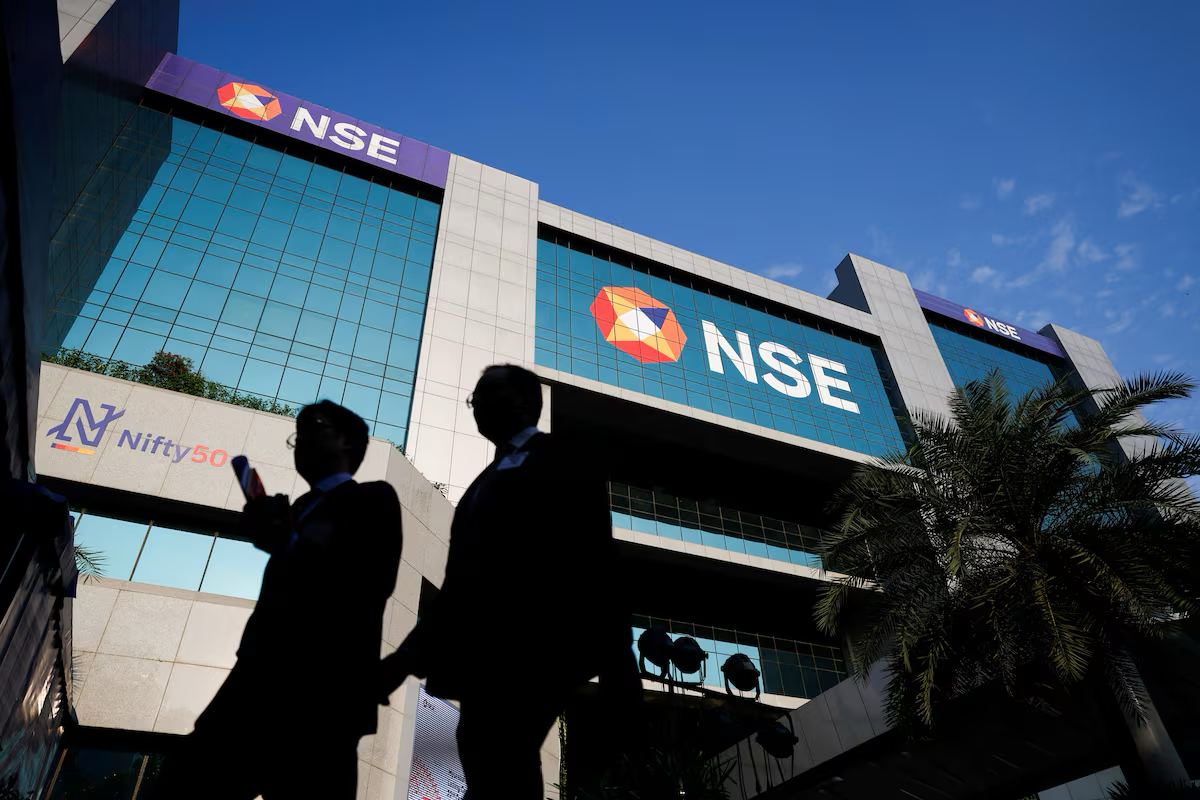
People walk outside the National Stock Exchange (NSE) in Mumbai, India, October 22, 2024. REUTERS
Sept 3 (Reuters) – India’s new closing auction is changing how options traders work, with market participants cutting positions and adding hedges as sharp price swings in the final 15 minutes make closing levels harder to predict, several traders said.
Average daily options turnover, which accounts for most trading in India, fell 20% month-on-month in August as per Jefferies, the first month since the auction was introduced, while some algorithmic traders said they cut activity by 35%-40%. Average daily cash equities turnover on the National Stock Exchange dropped 0.6%.The closing auction session, introduced on August 3, determines official closing prices through a brief end-of-day auction, a mechanism also used in other major markets to improve price discovery.
But its first month in India has exposed problems including differences in index closing levels across the country’s two main exchanges, sharp swings in options prices, limited participation, and that it is prone to manipulation.

Thin turnover under India’s new closing auction for stocks sparks sharp moves
Trading value under closing auction window averaged 1% of day’s trading, except on MSCI index review day
Thin turnover under India’s new closing auction for stocks sparks sharp moves
MSCI
index-linked flows100.0200.0300.0
Reuters spoke to half a dozen large derivatives traders, who raised concerns that low liquidity could leave the auction vulnerable to manipulation.
India’s markets regulator has said the new mechanism is here to stay and operational issues will be reviewed.The NSE recorded $4.1 billion of trades during closing auction amid MSCI rebalancing flows on August 31, much higher than flows on other days that have averaged around $128 million.
When Sensex monthly options expired on August 27, Surat-based trader Rohit Tiwari said his loss ballooned to 388,000 rupees during the auction from about 50,000 rupees before it. The indicative close for the 30-stock index had plunged to 3.3% down during the closing auction, triggered sharp swings in its options premiums.
Tiwari’s loss came despite smaller positions and hedges.He said he also lost 200,000-300,000 rupees on Nifty’s monthly expiry that week.
“My options positions are now much smaller and every trade is accompanied by additional hedging,” said Tiwari.
For Nishant Rakesh, a Noida-based IT-company owner who trades using margin against a portfolio of stocks and bonds, the uncertainty has made the final phase of the trading day feel like a blind bet.He said the period immediately before the auction, followed by the fluctuating price during the auction itself, ‘can cause stop-loss and risk management measures to fail at precisely the point traders most need protection’.
Quantitative trading firms are also pulling back. QCAlpha Advisors has cut expiry-day volumes by 70%-75%, particularly during the auction window, founder Tanmay Kurtkoti said.
“The major issue is opacity,” Kurtkoti said. “I don’t know whether the trades that I push during CAS will get executed.”
Vishal Mehta, chief executive of market analytics platform MarketScanner says he has cut down options positions by 35-40%.
“We can’t have too many open positions after 3 p.m. IST because it opens us up to the risk that our set stop-loss levels can get bypassed”.
Reporting by Vivek Kumar M, Writing by Jayshree P Upadhyay; Editing by Nivedita Bhattacharjee