

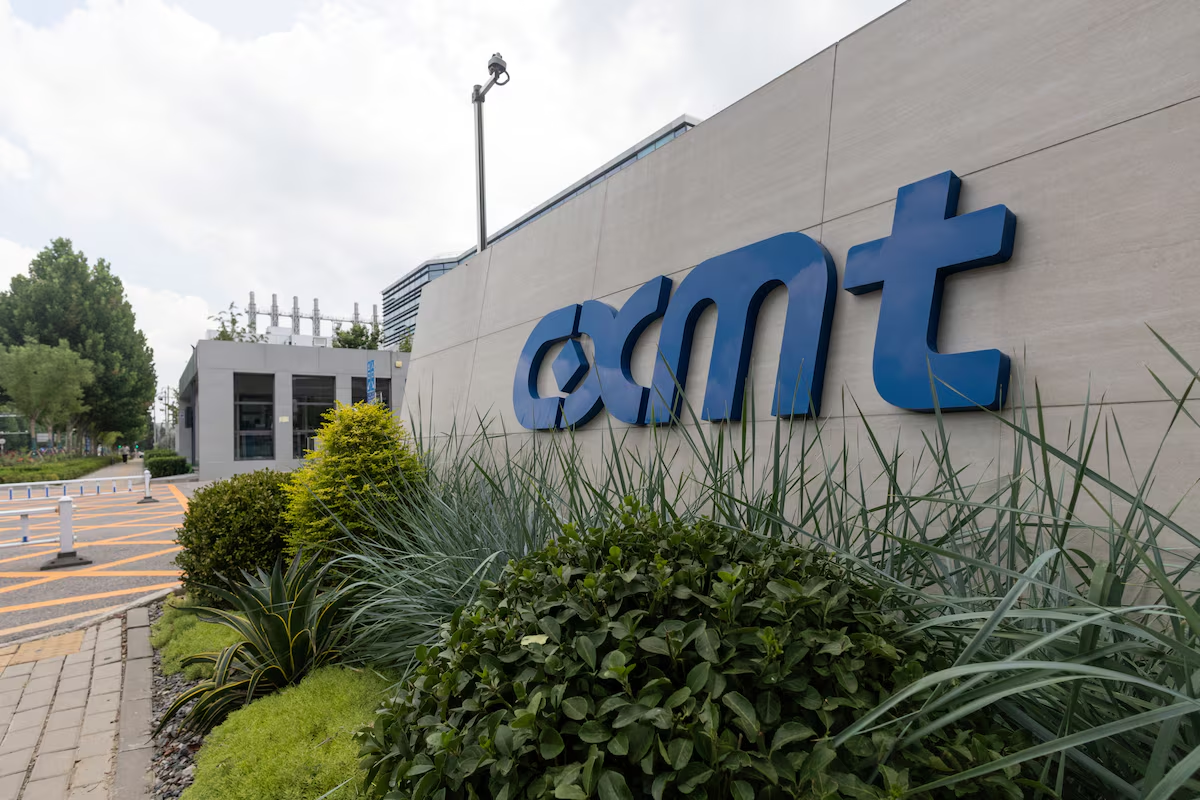
A logo of China’s top memory chipmaker CXMT appears next to the gate of company’s production facility, in Beijing, China, July 29, 2026. REUTERS
Sept 18 (Reuters) – Chinese chipmaker CXMT is preparing to enter the booming flash memory chip market dominated by Samsung Electronics and other foreign rivals, three people with knowledge of the matter said, a move that would broaden its customer base amid a global memory shortage.
The move would also pit the dynamic random access memory (DRAM) chip specialist against domestic rival YMTC, taking it into one of the semiconductor industry’s fastest-growing segments.
Strong demand from artificial intelligence servers has created a global memory shortage that industry executives believe will persist through at least 2027. SK Hynix CEO Kwak Noh-jung said in July that 2027 could be the industry’s worst year from a supply perspective, while TrendForce expects NAND supply tightness to ease only in the second half of next year.

Manufacturers have also prioritized capital spending on DRAM and high-bandwidth memory, or HBM, limiting additions to NAND flash capacity, according to TrendForce, worsening shortages in this segment.
DRAM provides the working memory used by processors, while NAND stores data in phones, computers and data centres.CXMT, also known as ChangXin Memory Technologies, plans to establish a research-and-development production line for NAND flash memory at its new plant in Beijing, according to two of the sources. The company has also set up a research institute in the Chinese capital and projects there include NAND development, one source said.
CXMT has discussed its NAND plans with customers, including a newly established startup that intends to buy its NAND chips for storage products used in AI systems and supercomputers, a third person said, though they declined to identify the company.
The sources declined to be identified publicly because CXMT’s plans are private.
It was not clear when the R&D production line would start operating or whether CXMT intends to move from R&D and trial production to large-scale commercial manufacturing.CXMT, YMTC – also known as Yangtze Memory Technologies – Samsung and the Beijing municipal government did not immediately respond to requests for comment.
Samsung was the world’s biggest NAND supplier by revenue in the second quarter with a 29.3% share, according to research firm TrendForce. SK Hynix ranked second, followed by Micron Technology of the US.
CHINA’S ‘TWIN STARS’ CROSS PATHS
CXMT and YMTC, known in China as the “twin stars” of the country’s memory-chip industry, have largely operated in separate markets. CXMT dominates Chinese production of DRAM, while YMTC is the country’s leading NAND manufacturer.
Those lines have begun to blur. In April, Reuters reported that YMTC had sent low-power DRAM samples to customers as it weighed entry into CXMT’s core market.
While the two firms lag behind larger international rivals and are more exposed to lower-priced products, tight supplies have strengthened their pricing power with some Chinese customers. In some cases, they have charged more than their foreign competitors, Reuters reported in July.
Both companies have emerged as key pillars of Beijing’s drive to build a self-sufficient chip industry and close the gap in strategic technologies like AI.
They grew with backing from China’s national semiconductor fund and local governments. CXMT expanded with backing from Hefei, the provincial capital of Anhui province, in eastern China, while YMTC was built in Wuhan, the provincial capital of central Hubei province, reflecting competition among Chinese local governments to attract strategic industries through investment and incentives.
CXMT, which raised 57.92 billion yuan ($8.6 billion) in July in Asia’s biggest initial public offering this year, plans a second memory-chip plant in Beijing and was in funding talks with a tech manufacturing hub backed by the local government, Reuters reported last month.
YMTC’s parent, CCSH, is also planning a Shanghai listing that aims to raise 33 billion yuan.
Washington’s export restrictions have added urgency to China’s drive to develop domestic memory suppliers. Washington placed YMTC on its Entity List in 2022 and later tightened China’s access to HBM chips that are used alongside AI processors.
Reporting by Reuters staff; Editing by Eduardo Baptista, Miyoung Kim and Thomas Derpinghaus