

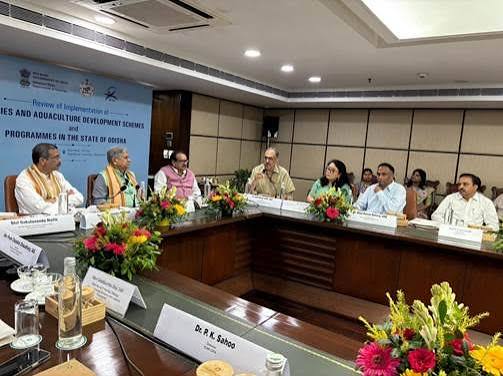
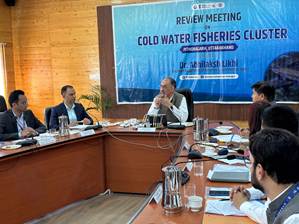
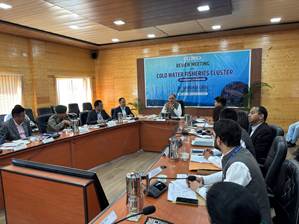
Dr. Abhilaksh Likhi, Secretary, Department of Fisheries, Ministry of Fisheries, Animal Husbandry & Dairying, Government of India, chaired a meeting on the Pithoragarh Coldwater Fisheries Cluster at the Collectorate, Pithoragarh, Uttarakhand, on 19 October 2026. The meeting was attended by trout farmers, officials from the Department of Fisheries, Government of Uttarakhand, representatives of ICAR‑DCFR Bhimtal, NABARD, NFDB, MPEDA, and other stakeholders through physical and virtual modes.
In his opening remarks, the Secretary emphasized the strategic importance of coldwater aquaculture in hilly states, noting that India’s Himalayan belt offers unique ecological conditions for rainbow trout farming. He highlighted that the Government of India has notified coldwater fisheries clusters in Pithoragarh (Uttarakhand), Kullu (Himachal Pradesh), Anantnag (Jammu & Kashmir), and Kargil (Ladakh) to systematically harness these resources.
India’s coldwater fisheries are concentrated in six hilly states and UTs — Uttarakhand, Himachal Pradesh, Jammu & Kashmir, Ladakh, Sikkim, and Arunachal Pradesh. These regions, with their glaciated rivers, high‑altitude lakes, and pristine streams, provide ideal ecological conditions for rainbow trout and other high‑value coldwater species. Under PMMSY, more than 5,600 raceways, 54 hatcheries, 293 cold storages, and 260 feed mills have been sanctioned across these states. Trout production has grown six‑fold in the last decade, reaching nearly 5,000 MT annually, with Uttarakhand achieving its first international export to Nepal in June 2026.
- The Secretary reviewed the progress of coldwater aquaculture initiatives under the Pradhan Mantri Matsya Sampada Yojana (PMMSY), noting that over ₹2,299 crore has been invested in hilly states to strengthen raceways, hatcheries, feed systems, cold storages, and post‑harvest infrastructure. The meeting reviewed the progress of PMMSY projects in Uttarakhand, where ₹317 crore has been invested over the last six years. The state has achieved significant milestones including the establishment of 1,638 raceways, 10 hatcheries, and processing units, along with assured market linkages to the Indo‑Tibetan Border Police (ITBP). The Secretary noted that over 45 MT of trout worth ₹2.10 crore has already been supplied to ITBP posts, strengthening the “Vocal for Local” initiative.
· During the review of cold-water fisheries in Pithoragarh, Uttarakhand, Union Fisheries Secretary Dr. Abhilaksh Likhi emphasised the need to promote eco-tourism, encourage women’s participation in reducing feed costs, and explore the feasibility of establishing cold storage facilities, particularly near airports and railway stations, to enhance export potential.He also directed the Department of Fisheries and the district administration to encourage greater participation of start-ups and entrepreneurs in the cold-water fisheries cluster.

- The Union Secretary further emphasised the need to promote fish-waste utilisation by engaging start-ups and entrepreneurs in the sector.He highlighted the need to undertake a pilot project in collaboration with the Food and Agriculture Organization (FAO) in Munsiyari, Pithoragarh, where women trout farmers have been successfully engaged in trout farming.During the interaction with trout farmers, the need for training and capacity-building support was highlighted. The farmers also called for a revision of the rate for trout supplied to the Indo-Tibetan Border Police (ITBP), citing the high cost of feed.During the interaction, fish farmer Smt. Rekha Joshi shared that she operates a fish outlet specialising in value-added products such as fish balls and fish fingers, generating an income of approximately ₹5,000 per day.
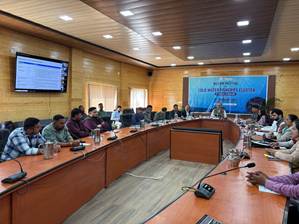
Stakeholders discussed key value‑chain gaps such as seed shortages (15 lakh fingerlings produced against demand of 40 lakh), feed supply constraints, limited productivity (250 kg per raceway against potential of 1,000 kg), and inadequate cold chain logistics. The Secretary stressed the need to bridge these gaps through establishment of mini hatcheries, feed mills, refrigerated vans, cold storages, and disease surveillance laboratories.
The role of ICAR‑DCFR Bhimtal was highlighted in providing scientific support, seed production technologies, and farmer training. The Secretary appreciated DCFR’s contribution in introducing rainbow trout to Munsiyari and supporting the state’s historic export of 5 MT trout to Nepal in June 2026. ICAR‑DCFR Bhimtal presented its role in scientific support, seed production, and farmer training. The Secretary appreciated the convergence of schemes like PMMSY, FIDF, and State programmes such as the Trout Protsahan Yojna, which together are transforming coldwater fisheries into a high‑value commercial enterprise.
The meeting concluded with a call for coordinated action among Government agencies, research institutions, cooperatives, and financial institutions to realize the full potential of coldwater aquaculture in the Himalayan states. The Secretary underlined that with proper convergence of schemes like PMMSY, FIDF, and State programmes, coldwater fisheries can become a driver of rural prosperity, livelihood security, and export competitiveness.