

Table of Contents
A Century of Meritocracy and Inclusion
| On 1 October 2026, the Union Public Service Commission (UPSC) completes one hundred years. Its institutional journey began on 1 October 1926, when India’s first Public Service Commission was constituted – an advisory body whose Chairman and Members were appointed by the Secretary of State in London. Over the century that followed, the Commission evolved in structure, status and responsibilities, becoming what it is today – an independent constitutional body. |
The Road to 1926
The principle that entry into public service should rest on merit rather than patronage took formal shape in 1855, when the Indian Civil Service (ICS) examination was instituted in London, replacing the East India Company’s system of nomination with open competition. For most Indians, however, the door remained nearly impossible to open. The examination was held only in London, in English, and tested candidates on subjects such as Greek and Latin – not because these were needed to govern a district in Bengal or Punjab, but because they favoured those educated in the British system.
In 1862, 21-year-old Satyendranath Tagore, elder brother of Rabindranath Tagore, sailed from Calcutta to England to sit an examination his own country would not let him take at home. He cleared it in 1863 and joined the service in 1864 – the first Indian in what the British called the “heaven-born service”. He served for over thirty years in the Bombay Presidency. Six years after his success, Surendranath Banerjee, Behari Lal Gupta and Romesh Chunder Dutt followed. The maximum age for the examination was, however, progressively reduced from 23 to 19, leaving Indian candidates little time to prepare. By 1919, only 78 of the 1,255 ICS officers were Indian.
Sustained nationalist demands brought gradual change. The Government of India Act, 1919, enacted after the Montagu-Chelmsford Reforms, provided for a Public Service Commission. In 1922, the ICS examination was held in India for the first time, at Allahabad, alongside London. In 1928 the Indian centre moved to Delhi. In 1924, the Lee Commission, chaired by Arthur Hamilton Lee, recommended the immediate establishment of a statutory Public Service Commission. It also proposed that of every ten new entrants, four would be British, four Indian and two Indians promoted from the provincial services – on paper a path to parity, in practice a guaranteed 40 per cent of every intake for the British, by birth rather than by competition.

The Commission was established under the Public Service Commission (Functions) Rules, 1926, framed under Sections 96B and 96C of the 1919 Act. Sir Ross Barker, a member of the Home Civil Service of the United Kingdom, was its first Chairman, assisted by four Members, and the Commission was housed at Metcalfe House, Delhi. Its limited powers drew sustained criticism from leaders of the freedom movement. Yet a permanent recruiting body now existed in India, seated and staffed in India – which is why the Commission dates its history from 1926.
The Constitutional Mandate
On 22 August 1949, Dr. B.R. Ambedkar, Chairman of the Drafting Committee, moved the draft articles on the Union and State Public Service Commissions in the Constituent Assembly. They became Part XIV (Articles 315–323) of the Constitution. In his valedictory address on 26 November 1949, Dr. Rajendra Prasad emphasised that the independence of the Public Service Commissions was essential to ensure impartiality in public appointments and to guard against jobbery, nepotism and favouritism.
| Article | What it provides |
| 315 | Public Service Commissions for the Union and for the States, with provision for a Joint Commission for two or more States |
| 316 | Chairman and Members appointed by the President |
| 317 | Removal or suspension of a Member only by order of the President, after an inquiry by the Supreme Court |
| 318 | Power to make regulations on the conditions of service of Members and staff |
| 319 | Restrictions on holding office after ceasing to be a Member; the Chairman is ineligible for further employment under the Government of India or a State |
| 320 | Functions: conducting examinations for appointment to the services of the Union, and advising on methods of recruitment, promotions and disciplinary matters |
| 321 | Power of Parliament or a State Legislature to extend the Commission’s functions |
| 322 | Expenses of the Commission charged on the Consolidated Fund of India |
| 323 | Annual report to the President; cases where the Commission’s advice was not accepted, with reasons, laid before Parliament |
What the Commission does
- Recruitment by examination: The Civil Services, Indian Forest Service, Engineering Services, Combined Medical Services, National Defence Academy & Naval Academy, Combined Defence Services and Central Armed Police Forces (Assistant Commandants) examinations, among others.
- Recruitment by selection: Interviews and recruitment tests for specialist posts requisitioned by Ministries and Departments.
- Advice to Government: On Recruitment Rules, promotions through Departmental Promotion Committees, induction into the All India Services and disciplinary cases. In 2023-24, it processed the records of 24,581 officers for promotion, and 532 officers were inducted into the All India Services.
- Police leadership: Since 2012–13, pursuant to the Supreme Court’s order of 22 September 2006 in Prakash Singh vs Union of India, the Commission empanels senior IPS officers for appointment as Director General of Police/Head of Police Force in the States.
Landmark Events: 1926–2026
Foundations: 1926–1949
| Year | Milestone |
| 1935 | Government of India Act, 1935 transfers the power of appointment to the Governor-General, provides for a Federal PSC and Provincial PSCs, and makes consultation with the Commission mandatory on recruitment, appointments, promotions, disciplinary cases and service rules. |
| 1937 | Renamed the Federal Public Service Commission (1 April). |
| 1938 | Combined Competitive Examinations begin for several services – the start of unified, multi-service recruitment. |
| 1940 | Indians (625) outnumber Europeans (575) in the ICS for the first time. |
| 1947 | Shri H.K. Kripalani becomes the first Indian Chairman. First examination after Independence held in December; the ICS gives way to the IAS. |
| 1948 | First batch of Indian Foreign Service officers recruited through the combined examination. |
Building the Republic’s Services: 1950–1979
| Year | Milestone |
| 1950 | Federal PSC becomes the Union Public Service Commission on 26 January, with Shri R.N. Banerjee as Chairman. |
| 1950–51 | First regular recruitment to the All-India Services under the Constitution: 29 candidates recommended for the IAS and 31 for the IPS. |
| 1951 | All-India Services Act enacted. |
| 1966 | Indian Forest Service constituted as the third All India Service; first selection in 1967. |
| 1969 | Eighth Schedule languages introduced as options for the Essay and General Studies papers of the Civil Services Examination. |
| 1976 | Golden Jubilee. Applications cross one lakh for the first time. The D.S. Kothari Committee proposes a three-stage examination. |
| 1977 | First Combined Medical Services Examination. |
| 1978 | Commission adopts computers to process applications, answer sheets and records. |
| 1979 | Three-stage Civil Services Examination – Preliminary, Main and Interview – introduced. Eighth Schedule languages formalised in the Main Examination; London centre discontinued. |
Reform and Modernisation: 1985–2010
| Year | Milestone |
| 1985 | Sanctioned strength raised to a Chairman and ten Members. |
| 1988–89 | Satish Chandra Committee recommends more centres, a 200-mark essay, negative marking in the Preliminary Examination and more marks for the interview. |
| 1989 | Optical Mark Recognition (OMR) technology introduced. |
| 1992 | Smt. Rose Millian Bathew Kharbuli becomes the first woman Chairperson. |
| 1993 | Essay paper introduced in the Civil Services (Main) Examination; interview marks raised from 250 to 300. |
| 1994 | Medical Science added as an optional subject. |
| 2000 | Online Recruitment Application (ORA) system launched, following the SAMPERA common application form (1999–2000); by 2010, applications for several examinations were fully online. |
| 2003 | First Central Police Forces (Assistant Commandants) Examination held (12 October). |
| 2005 | New office building, ‘Ayog Sachivalaya’, inaugurated (22 December). |
| 2009 | Foundation Day Lecture series on ‘Governance and Public Service’ inaugurated by President Smt. Pratibha Devisingh Patil (12 November); Indian Corporate Law Service added to the Civil Services Examination. |
| 2010 | UPSC hosts the Conference of Chiefs of Public Service Commissions of SAARC countries (20–22 November). |
Digital, Transparent and Inclusive: 2011–2026
| Year | Milestone |
| 2011 | Civil Services Aptitude Test (CSAT) introduced; Single Window System (1 September). |
| 2013 | Civil Services (Main) restructured: four General Studies papers, including Ethics, Integrity and Aptitude, and one optional subject. First Computer-Based Recruitment Tests. IFoS screening through the CS (Preliminary) Examination. |
| 2015 | CSAT made a qualifying paper (33 per cent). |
| 2017 | Engineering Services Examination becomes three-stage; seven-day online window for representations on questions. |
| 2018 | Query-Based Marks Information System (1 June). |
| 2019 | Dedicated Control Room for year-round monitoring of examinations. |
| 2021 | Women admitted to the NDA & NA Examination for the first time – NDA & NA Examination (II), 2021, held on 14 November 2021. |
| 2022 | Existing four Group A Railway services under the Civil Services Examination unified as the Indian Railway Management Service. |
Developments in 2025 and 2026 are listed in Section 7.
Facts and Figures
The scale of the Commission
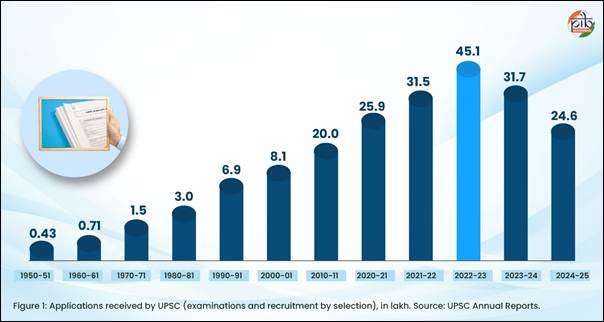
The scale and complexity of the work handled by UPSC have increased significantly over the years, as applications across examinations and recruitment by selection grew from 42,727 in 1950-51 to a peak of 45,10,044 in 2022-23 – an increase of more than a hundredfold. In that year, the Commission conducted 15 examinations (33,51,916 applications) and received 233 requisitions for 4,411 posts under recruitment by selection (11,58,128 applications).
Then and Now
| Indicator | Then | Now | Change |
| Examination centres | 8 (1950) | 86 (2026) | Over 10× |
| Women recommended in Civil Services Examination | 3 of 83 (1952) | 299 of 958 (2025) | About 100× |
| SC candidates recommended in Civil Services Examination | 9 (1955) | 158 (2025) | About 18× |
| ST candidates recommended in Civil Services Examination | 2 (1956-57) | 73 (2025) | About 37× |
| SC applicants, all examinations | 1,713 (1956-57) | 4,51,243 (2023-24) | About 382× |
| ST applicants, all examinations | 82 (1956-57) | 1,47,106 (2023-24) | About 1794× |
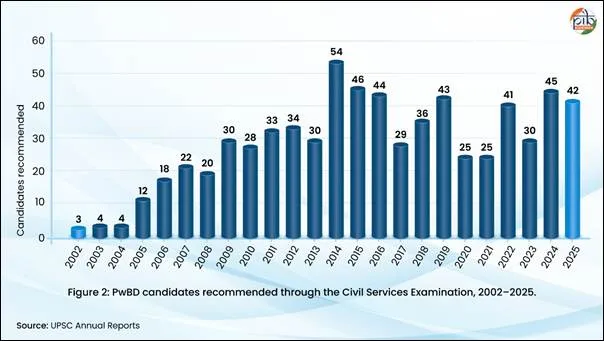
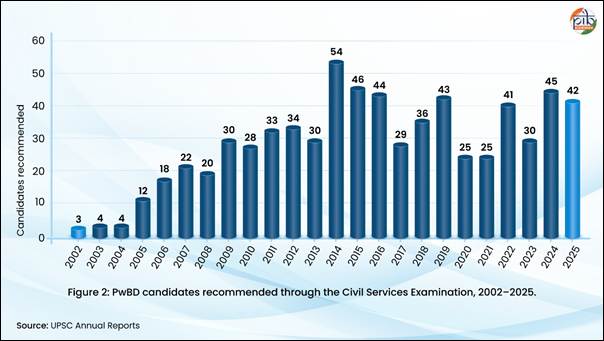
| PwBD candidates recommended in Civil Services Examination | 3 (2002) | 42 (2025) | 14× |
| Disciplinary cases advised on | 53 (1950-51) | 446 (2023-24) | About 8× |
Inclusion in numbers
- Women: Between 1949 and 1951, only one woman was selected for the Indian Foreign Service and two for the IAS. Women made up 3.6 per cent of those recommended in 1952 and 31.2 per cent in CSE 2025, when they also secured 11 of the top 25 ranks.
- Indian languages at the interview: in 1970-71, the Commission informed the Government that the Personality Test could be conducted only in English. The position changed in 1980-81, and candidates may now answer in an Indian language with an interpreter provided by the Commission; 803 chose to do so in 2010-11 and 307 in 2023-24.
Anecdotes
Short stories from the Commission’s century.
| Where the ‘steel frame’ speech was madeMetcalfe House, built in 1835 by Sir Thomas Metcalfe, has a second claim to history. On 21 April 1947, Sardar Vallabhbhai Patel addressed the first batch of civil service probationers there and described the civil services as the “steel frame of India”. The date is now observed every year as Civil Services Day. |
| A Maharaja’s transit houseDholpur House on Shahjahan Road was built in 1920 in the Art Deco style by Maharaja Rana Udaybhanu Singh of Dholpur, as his residence during visits to Delhi. After Dholpur State merged with the Union on 7 April 1949, the building became government property. Three years later, in 1952, it became the Commission’s permanent headquarters. |
| One among eightyIn 1972, Kiran Bedi became the first woman selected by the Commission for the Indian Police Service, a service that had never had a woman officer. Of the eighty vacancies that year, she was the only woman. |
| Forms in the newspaperIn 1989, when slow post made it difficult for application forms to reach remote areas, the Commission printed them directly in newspapers. In 1984, when heavy snowfall cut off Kangra, it extended the application deadline by two weeks for affected aspirants. |
| A sun on a stampOn 8 November 1977, the Posts and Telegraphs Department issued a 25-paise stamp for the Commission’s Golden Jubilee. It showed the sun – symbolising impartiality and equal opportunity for all – with the national tricolour. For the Platinum Jubilee, inaugurated by Prime Minister Atal Bihari Vajpayee on 14 December 2001, the Department of Posts issued a First Day Cover. |
| DID YOU KNOW?The UPSC Museum, opened on 11 November 2016, is free and open to the public on weekdays from 9:30 am to 6:30 pm; a 360-degree virtual tour is available on the Commission’s website.The age limit has travelled a long way. As late as 1988, an expert committee recommended keeping the Civil Services Examination age band at 21 to 26 years. The limits of 32 years for General candidates, 35 for OBC and 37 for SC and ST candidates, with up to ten years more for Persons with Disabilities, were fixed in 2014, when two extra attempts were also allowed.Candidates who had appeared in the Civil Services Examination 2011 were given one more attempt in CSE 2015, whatever their age or the number of attempts already used.The Commission has not always recruited only for the Union. In 1960-61, under Article 320, it agreed to recruit for bodies such as the Delhi Municipal Corporation, the Employees’ State Insurance Corporation and the Territorial Councils of the Union Territories.Open competition lapsed during the Second World War. The London examination was held for the last time in 1939, officers for 1940, 1941 and 1942 were nominated directly, and recruitment through the British Civil Service Commission stopped altogether after 1943.In the draft Constitution, the provisions on Public Service Commissions were numbered Articles 284 and 285 when Dr. B.R. Ambedkar moved them in the Constituent Assembly. |
Case Studies: How the Machinery Works
Every morning in Mumbai, around 5,000 dabbawalas collect nearly two lakh home-cooked lunches and deliver each to the right desk by lunchtime, using nothing more than a colour code chalked on the lid. The Commission solves a comparable problem every year, at far higher stakes: the right question paper must reach the right candidate at the right minute, and every answer must then be judged on merit alone. The following case studies explain how.
Case Study 1: The right paper to the right candidate
A candidate makes only one choice: the city. Within that city, the system allots the venue and the room, so that by the day of the examination every candidate has a unique address – city, venue, room, candidate – known in advance only to the system. Candidates in the same room may be writing different papers – in the Civil Services Main Examination alone, candidates choose from 48 optional subjects – so each sealed packet must carry exactly the papers needed at that venue, sorted room by room.
Case Study 2: Setting a paper no one has seen
Question papers are built from question banks prepared by academic experts who work in anonymity under a strict code of confidentiality. No single expert sets a whole paper, and no expert knows which questions will be used, or when. In constructing a paper, the Commission ensures that it covers the entire syllabus, that its difficulty is balanced, and that no question has been asked in any previous UPSC examination.
The whole apparatus rests on the principle of ‘need to know’: no single person – not even the Chairman – sees the full picture.
Case Study 3: Securing the examination hall
In collaboration with the National e-Governance Division, the Commission piloted AI-enabled facial authentication – matching a candidate’s live image with the application photograph – at select centres in Gurugram during the NDA & NA (II) and CDS (II) Examinations on 14 September 2025. It was implemented at scale at the Civil Services (Preliminary) Examination on 24 May 2026, where face authentication was carried out for all of about 5.50 lakh candidates through invigilators’ mobile phones, taking about 6–8 seconds per candidate.
Ahead of the CS (Preliminary) Examination 2026, a scan of fifteen years of candidate data identified and rejected 569 applicants who had furnished false information to claim extra attempts.
Case Study 4: Recruiting at the speed of need
The Commission has repeatedly scaled up when the nation required it, without lowering its standards. In July 1948, a Special Recruitment Board recruited experienced personnel aged 27 to 45 into the IAS and IPS on the basis of records and interviews. In 1956–57, a special drive screened over 22,000 candidates. In 1958, a Special Recruitment Board selected 197 scientists and technologists – including applicants from overseas – for a national Pool whose strength rose to 500 by 1962. During the 1962 emergency, an Emergency Commission filled 1,353 defence-related posts in two months.
During COVID-19, with train services disrupted, the Commission reimbursed airfare to interview candidates as a one-time measure, requested States to let candidates with e-summon letters move through restricted zones, helped with lodging and transport, and handed each candidate a sealed kit of mask, face shield, sanitiser and gloves.
Case Study 5: Inclusion by design
Access comes first. The Commission introduced scribes for visually impaired candidates in 1994, and today the right to a scribe and extra time is an entitlement for Persons with Benchmark Disabilities, who are also allotted the centre of their choice, may bring an escort, and are assisted by a facilitator at interviews. Women candidates receive fee exemptions. Age relaxations have been extended to those whose preparation was disrupted by events beyond their control – freedom fighters of the Goa liberation (1961–62), Indians displaced by the Bangladesh Liberation War and the Uganda-Zanzibar crisis (1971–72), and Indians affected by the Gulf War (1991).
Fairness follows: an evaluation system, from written papers to the interview board, that is blind to identity. The Commission did not write the policy of reservation, but it built the national platform that implements it, including the Economically Weaker Sections category from CSE 2019 and a separate transgender category in its Online Recruitment Application form from 2020.
Case Study 6: Merit beyond the merit list: Pratibha Setu
Candidates who clear every stage of an examination but narrowly miss the final list are not lost to public service. Under the Public Disclosure Scheme, in force since 20 August 2018 and first used for the Combined Medical Services Examination, 2017, the details of such willing candidates were made available to employers. Revamped and renamed Pratibha Setu on 9 June 2025, it connects them with verified employers, including Ministries, PSUs, autonomous bodies and private organisations.
Recent Updates
| When | Development | Details |
| May 2025 | Universal Registration Number | Revamped portal at upsconline.nic.in replaces One-Time Registration; one persistent identity across all examinations; profiles can be completed in advance. |
| 2025 | Randomised interview boards | Introduced from the Combined Medical Services Examination, 2025, with software setting the calling sequence. |
| 2025 | Email alerts for institutions | Educational and professional institutions can subscribe to alerts on recruitment advertisements by writing to ra-upsc[at]gov[dot]in. |
| From 1 Feb 2026 | Candidate Helpdesk | 30-channel IP-based call centre with two levels of escalation; more than 50,000 calls handled. |
| 2026 | New examination centres | Bhubaneswar (10,656 applications), Kanpur (6,938) and Meerut (5,902) added for CS (P) 2026, taking its centres from 80 to 83; Alwar, Hisar and Kinnaur added for NDA & NA (II) 2026. |
| 2026 | Provisional answer key | Provisional answer key for Civil Services (Preliminary) examination published soon after the examination; representations through the online QPRep portal. |
| 2026 | Online DPC system | Paperless platform for Departmental Promotion Committee proposals from about 101 Ministries, Departments and organisations under development. |
| 2026 | Technology and security | Officers trained in emerging technologies, including AI, through NIELIT; High-Level Network Committee constituted for IT infrastructure and cybersecurity. |
The Commission Today
The Commission is headed by Chairman Dr. Ajay Kumar (since 15 May 2025). Its eight Members are Lt. Gen. Raj Shukla (Retd.), Ms. Suman Sharma, Shri Bidyut Behari Swain, Dr. Dinesh Dasa, Shri Sheel Vardhan Singh, Shri Sanjay Verma, Smt. Sujata Chaturvedi and Smt. Anuradha Prasad. Three of the eight Members are women – a composition that reflects how far the institution has travelled in a hundred years.
| “An institution that has endured for a hundred years does so not because it resists change, but because it knows what must never change.”— Dr. Ajay Kumar, Chairman, UPSC |
For a hundred years, the Commission has carried one of the nation’s most consequential responsibilities: to recognise merit, uphold fairness and ensure that opportunity reaches beyond privilege, geography, language or circumstance. A century ago, the struggle was for the right of Indians to compete. Today, the task is to ensure that this right genuinely reaches every deserving Indian who wishes to serve the nation.
Reference
- Department of Personnel and Training (DoPT)