

Sarnath’s Path to the World Heritage List
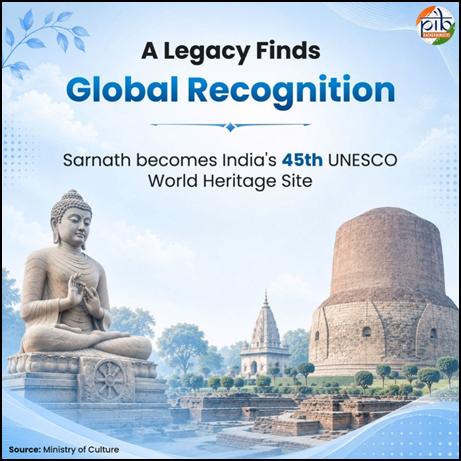
| India’s rich cultural heritage has gained another global recognition with the inscription of the Ancient Buddhist Site of Sarnath on the UNESCO World Heritage List at the 48th Session of the World Heritage Committee in Busan, South Korea. As the place where Lord Buddha delivered his first sermon, Sarnath is one of the four principal Buddhist pilgrimage sites associated with his life. The inscription takes India’s tally to 45 UNESCO World Heritage properties, placing the country sixth globally and second in the Asia Pacific region. It also reinforces India’s identity as the birthplace of Buddhism and its commitment to preserving heritage of Outstanding Universal Value. |
| A Milestone for India’s Heritage |
Heritage is more than a reminder of the past. It shapes the present and guides the future. It reflects the stories, traditions, and values that communities preserve and pass on across generations. Cultural and natural heritage are irreplaceable sources of identity, knowledge and inspiration.
On the evening of 25 July 2026, at the 48th Session of the World Heritage Committee in Busan, South Korea, the Ancient Buddhist Site of Sarnath was inscribed on the UNESCO World Heritage List. With this inscription, India now has 45 World Heritage properties recognised by UNESCO.
This recognition is more than a new entry on the World Heritage List. It celebrates India’s rich cultural legacy, shaped by diverse traditions, remarkable architecture and a long history. It also reinforces the spirit of the World Heritage Convention, which seeks to protect places of Outstanding Universal Value for the benefit of present and future generations across 196 States Parties.
The United Nations Educational, Scientific and Cultural Organization, better known as UNESCO, promotes the identification, protection and preservation of cultural and natural heritage that holds exceptional value for humanity. This commitment is rooted in the Convention concerning the Protection of the World Cultural and Natural Heritage, adopted by UNESCO in 1972.

| As of July 2026, UNESCO’s World Heritage List carried 1,273 properties across 173 countries, comprising 991 cultural, 240 natural and 42 mixed sites. As of October 2024, 196 States Partieshave ratified the World Heritage Convention making it one of the most celebrated and acknowledged conventions by any United Nations Agency. |
The idea of World Heritage is unique because it extends beyond national boundaries. While these sites remain within the territories of individual countries, their significance belongs to all humanity. They are recognised as a shared legacy that deserves collective care and protection for generations to come.
| The Sarnath Story |
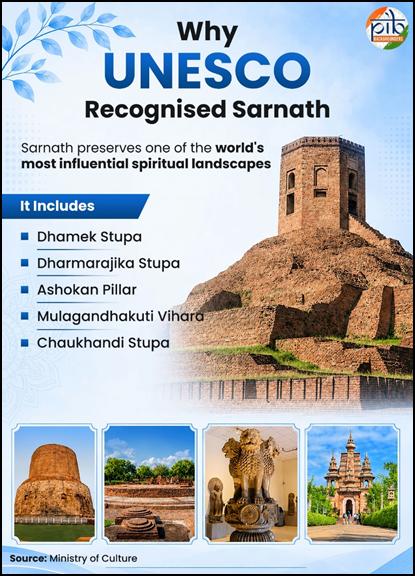
Sarnath holds a special place in Buddhist tradition. Located in Varanasi, Uttar Pradesh, it is one of the four key sites of Buddhist pilgrimage. The UNESCO World Heritage inscription covers two connected components: the Chaukhandi Stupa and the Archaeological Remains of Sarnath. The archaeological complex includes the Dhamek Stupa, Dharmarajika Stupa, Mulagandhakuti Vihara, the Ashokan Pillar and several other ancient remains. Together, they preserve the historic landscape of this ancient site.
Known in Buddhist tradition as Rishipatana, Ishipatana and Mrigadava, Sarnath is the place where Gautama Buddha delivered his first sermon in the 6th century BCE. This sermon, known as Dharmachakra Pravartana or the “Turning of the Wheel of the Law”, marked the beginning of the Buddhist Sangha and the establishment of the principles of the Noble Eightfold Path.
Over the centuries, Sarnath developed through royal, monastic and lay patronage. Numerous stupas, temples and viharas were constructed around the place associated with Buddha’s first sermon and his meeting with his first five disciples. The site reflects nearly sixteen centuries of continuous development. Its monuments date from the pre Mauryan period of the 4th-3rd centuries BCE to the 12thcentury CE, when Sarnath declined and was destroyed. The site remained obscure until its rediscovery in the 18th century.
| The Road to Recognition |
Sarnath’s journey to World Heritage recognition has been a long and careful process. The ancient site was included in India’s Tentative List of World Heritage in 1998.
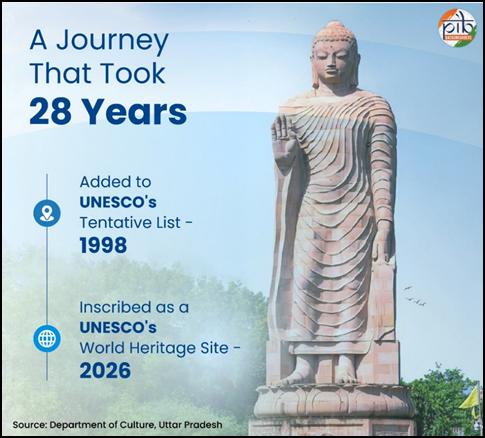
The proposal for its inscription was submitted for consideration by the World Heritage Committee in January 2025. This was followed by an eighteen-month long process involving technical meetings with UNESCO’s advisory bodies and an evaluation mission by ICOMOS to review the worthiness of the proposed property. ICOMOS, acting as one of the advisory bodies of UNESCO, provides evaluations of cultural and mixed properties proposed for inscription. The process culminated in the historic decision taken at the 48th Session of the World Heritage Committee in Busan, South Korea.
The Ancient Buddhist Site of Sarnath was nominated under criteria (iii) and (vi) of the UNESCO World Heritage List (under the framework of the World Heritage Convention).
Criterion (iii) recognizes Sarnath’s enduring spiritual significance as one of the four principal destinations of Buddhist pilgrimage. This is reflected in the many religious buildings and monuments constructed and rebuilt at the site over the centuries.
Criterion (vi) recognizes Sarnath’s direct and tangible association with events in the life of the Buddha that hold outstanding significance for the Buddhist community. These include his first sermon and his meeting with his first disciples after attaining of the Sambodhi (enlightenment) at Bodh Gaya. The numerous structures built at Sarnath over the centuries reflect the continuing importance of these events, the Buddha’s teachings and the concept of Triratna.
The inscription also reflects the wider purpose of the World Heritage Convention. UNESCO seeks to preserve and promote heritage of Outstanding Universal Value for present and future generations.
| Sarnath: A Global Legacy of Peace |
Sarnath is far more than an archaeological site. It remains a global pilgrimage destination for Buddhists from Japan, Thailand, Sri Lanka, Myanmar, Vietnam, South Korea, Cambodia, Mongolia and many other countries. As one of the world’s most revered Buddhist pilgrimage centres, it reinforces India’s identity as the birthplace of Buddhism and serves as a bridge for cultural ties and international engagement with Buddhist nations.
With Sarnath’s inscription, three of the four principal Buddhist pilgrimage sites associated with the life of the Buddha are now included in the UNESCO World Heritage List. These are Lumbini in Nepal, the Mahabodhi Temple at Bodh Gaya in Bihar and Sarnath in Uttar Pradesh. They join other important Buddhist World Heritage sites, including Sanchi, Nalanda and Ajanta in India, Anuradhapura in Sri Lanka, Paharpur in Bangladesh, and Taxila and Takht-i-Bahi in present day Pakistan.
The recognition also reaffirms India’s commitment to protect Sarnath’s Outstanding Universal Value. The Government will manage tourism sustainably and prevent unplanned development within the buffer zone to preserve the site’s authenticity and integrity for future generations.
| Enabling India’s Heritage Success |
Behind every successful nomination lies years of institutional groundwork. India’s approach to World Heritage properties rests on close coordination between central agencies, State Governments, and international bodies.
Ministry of Culture
The Ministry of Culture leads India’s engagement with UNESCO on cultural matters. It implements India’s commitments under UNESCO’s cultural conventions and coordinates nominations for World Heritage Sites and Intangible Cultural Heritage elements. The Ministry also promotes international heritage protection standards and strengthens cultural diplomacy through UNESCO and international cultural cooperation.
Archaeological Survey of India
The Archaeological Survey of India (ASI) is the nodal agency for World Heritage related matters on behalf of the Government of India. It undertakes the conservation and maintenance of 3688 centrally protected monuments, including 28 World Heritage properties. Its work also includes enforcement of two legislations, namely, the Ancient Monuments and Archaeological Sites and Remains Act, 1958 and the Antiquities and Art Treasures Act, 1972 apart from providing visitor facilities such as drinking water, toilets, pathways and landscaping. Conservation and maintenance are carried out regularly, based on the needs of each monument and the availability of resources.
| India’s Growing World Heritage List |
Our heritage is not just built of stones, scripts or ruins. It lives in every whisper of a temple wall, every carving on ancient forts and every folk song passed down through generations. It tells the story of India’s civilisation and reflects the country’s rich cultural and natural legacy.
| Country | World Heritage Sites (as of July 2026) |
| Italy | 62 |
| China | 61 |
| France | 56 |
| Germany | 55 |
| Spain | 50 |
| India | 45 |
| Mexico | 36 |
| United Kingdom | 35 |
| Russia | 33 |
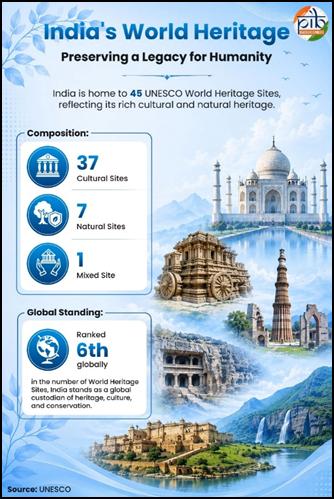
Today, India is home to 45 UNESCO World Heritage properties, comprising 37 cultural, 7 natural and 1 mixed site. This places the country sixth globally and second in the Asia Pacific region.
India’s first entries came in a single year. Agra Fort, along with the Taj Mahal, Ellora Caves and Ajanta Caves, was inscribed in 1983, opening a list that has since grown to cover forts, temples, caves, railways, stepwells, planned cities and national parks.
Last year, the Maratha Military Landscapes of India were inscribed at the 47th Session of the World Heritage Committee, held at UNESCO Headquarters in Paris. With Sarnath’s inscription this year at the 48th Session in Busan, India’s tally now stands at 45 properties, keeping the country in sixth place globally and second within the Asia Pacific region. India’s Tentative List has also grown, now standing at 69 properties, the mandatory first step for any future World Heritage nomination.
List of UNESCO World Heritage sites in India:
| Year | Site | State / UT | Category |
| 1983 | Agra Fort | Uttar Pradesh | Cultural |
| 1983 | Ajanta Caves | Maharashtra | Cultural |
| 1983 | Ellora Caves | Maharashtra | Cultural |
| 1983 | Taj Mahal | Uttar Pradesh | Cultural |
| 1984 | Sun Temple, Konarak | Odisha | Cultural |
| 1984 | Group of Monuments at Mahabalipuram | Tamil Nadu | Cultural |
| 1985 | Kaziranga National Park | Assam | Natural |
| 1985 | Keoladeo National Park | Rajasthan | Natural |
| 1985 | Manas Wildlife Sanctuary | Assam | Natural |
| 1986 | Khajuraho Group of Monuments | Madhya Pradesh | Cultural |
| 1986 | Fatehpur Sikri | Uttar Pradesh | Cultural |
| 1986 | Churches and Convents of Goa | Goa | Cultural |
| 1986 | Group of Monuments at Hampi | Karnataka | Cultural |
| 1987 | Sundarbans National Park | West Bengal | Natural |
| 1987 | Elephanta Caves | Maharashtra | Cultural |
| 1987 | Group of Monuments at Pattadakal | Karnataka | Cultural |
| 1987, 2004 | Great Living Chola Temples | Tamil Nadu | Cultural |
| 1988, 2005 | Nanda Devi and Valley of Flowers National Parks | Uttarakhand | Natural |
| 1989 | Buddhist Monuments at Sanchi | Madhya Pradesh | Cultural |
| 1993 | Humayun’s Tomb, Delhi | Delhi | Cultural |
| 1993 | Qutb Minar and its Monuments, Delhi | Delhi | Cultural |
| 1999, 2005, 2008 | Mountain Railways of India | WB, Tamil Nadu, HP | Cultural |
| 2002 | Mahabodhi Temple Complex at Bodh Gaya | Bihar | Cultural |
| 2003 | Rock Shelters of Bhimbetka | Madhya Pradesh | Cultural |
| 2004 | Champaner-Pavagadh Archaeological Park | Gujarat | Cultural |
| 2004 | Chhatrapati Shivaji Terminus | Maharashtra | Cultural |
| 2007 | Red Fort Complex | Delhi | Cultural |
| 2010 | The Jantar Mantar, Jaipur | Rajasthan | Cultural |
| 2012 | Western Ghats | Karnataka, Kerala, Maharashtra, Tamil Nadu | Natural |
| 2013 | Hill Forts of Rajasthan | Rajasthan | Cultural |
| 2014 | Great Himalayan National Park Conservation Area | Himachal Pradesh | Natural |
| 2014 | Rani-ki-Vav (the Queen’s Stepwell) at Patan | Gujarat | Cultural |
| 2016 | Archaeological Site of Nalanda Mahavihara | Bihar | Cultural |
| 2016 | Khangchendzonga National Park | Sikkim | Mixed |
| 2016 | The Architectural Work of Le Corbusier | Chandigarh | Cultural |
| 2017 | Historic City of Ahmedabad | Gujarat | Cultural |
| 2018 | Victorian Gothic and Art Deco Ensembles of Mumbai | Maharashtra | Cultural |
| 2019 | Jaipur City | Rajasthan | Cultural |
| 2021 | Dholavira: a Harappan City | Gujarat | Cultural |
| 2021 | Kakatiya Rudreshwara (Ramappa) Temple | Telangana | Cultural |
| 2023 | Sacred Ensembles of the Hoysalas | Karnataka | Cultural |
| 2023 | Santiniketan | West Bengal | Cultural |
| 2024 | Moidams – the Mound-Burial System of the Ahom Dynasty | Assam | Cultural |
| 2025 | Maratha Military Landscapes of India | Maharashtra, Tamil Nadu | Cultural |
| 2026 | Ancient Buddhist Site of Sarnath | Uttar Pradesh | Cultural |
| Government’s Initiatives to Promote India’s Rich Cultural Heritage |
India has taken several meaningful steps to protect, restore, and promote its vast cultural and natural heritage. These initiatives reflect the government’s commitment to safeguarding the country’s timeless traditions and historical treasures. India’s rich heritage is being protected through focused efforts in conservation, digitisation, international cooperation, and public participation.
Retrieval of Antiquities
India has repatriated 669 antiquities, including 656 since 2014. The effort involves the Ministry of Culture, ASI, Indian Missions and enforcement agencies. Recently, 657 Indian art objects were handed over by US law enforcement agencies to the Embassy of India. Key returns include the Chola-period Shiva Nataraja, Saint Sundarar with Paravai, and Somaskanda.
Adopt a Heritage
Launched in September 2017 and revamped in September 2023, the Adopt a Heritage 2.0 programme creates a framework for collaboration with private companies, public sector units, NGOs, trusts, and societies.
It focuses on developing and maintaining visitor-friendly amenities at Protected Monuments of National Importance. Support is provided through Corporate Social Responsibility (CSR) and other contributions. The aim is to improve the visitor experience.
| As on March 2026, a total of 30 Memorandums of Understanding (MoUs) have been signed under the Adopt a Heritage 2.0 programme. |
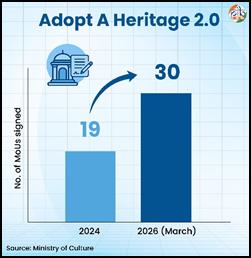
The programme is already demonstrating visible outcomes in terms of improved site management and enhanced public engagement. This is reflected in strong visitor participation at adopted monuments, which collectively recorded a total footfall of 13.59 million visitors during FY 2024–25.
These figures indicate strong visitor interest and suggest that improved amenities, services, and on-site facilitation under the programme are contributing to better visitor experience and higher engagement at adopted heritage sites.
Gyan Bharatam Mission
The Gyan Bharatam Mission, launched in 2025, is the government’s flagship initiative aimed at preserving, digitising, and disseminating India’s vast manuscript heritage. It focuses on preserving ancient knowledge systems recorded in manuscripts. It also makes them accessible for research and public engagement through digital repositories and conservation networks.
The initiative further integrates modern technologies to safeguard these fragile manuscripts and ensure they are globally accessible.
Additionally, the National Manuscript Survey was also launched in March 2026 for identifying, documenting and creating a comprehensive national database of manuscripts. During the survey, more than 1.19 crore manuscripts have been reported. The total number of digitized manuscripts available across the country is over 8 lakh, out of which, more than 4.40 lakh manuscripts are available on Gyan Bharatam portal at present for public access, in view mode which is accessible state-wise.
The National Archives of India is also digitising archival records through Abhilekh Patal. As of February 2026, the portal hosted 18.23 crore pages, 0.73 crore reference media and 0.38 crore digitised records.
National Mission on Monuments and Antiquities
The National Mission on Monuments and Antiquities is implemented under ASI. It plays a crucial role in supporting conservation by building a reliable national database of India’s built heritage and antiquities. The Mission aims to document and create an inventory of all monuments and antiquities in the country, information that directly informs planning, prioritisation and monitoring of conservation work.
| As of March 2026, NMMA has documented 1.84 lakh monuments, including built heritage and sites. It also documented 17.20 lakh antiquities across India. |
| Preserving the Past, Shaping the Future |
India’s cultural heritage is a living legacy that continues to inspire, educate, and connect people across generations. The inscription of Sarnath reflects the country’s sustained commitment to conserving places of exceptional value while strengthening their role in education, cultural exchange, and sustainable development. As India moves forward, protecting its heritage will remain central to preserving its civilisational legacy and sharing it with the world.