

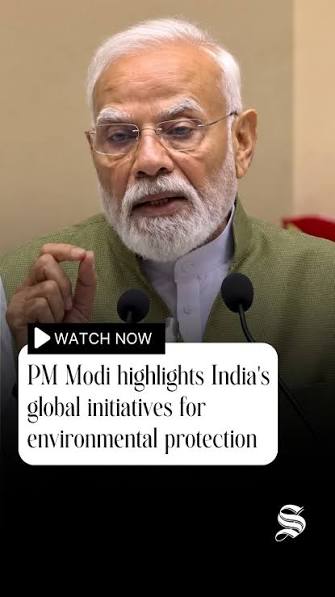
Chief Justice of India Justice Surya Kant ji, my colleague in the Union Cabinet Bhupender Yadav ji, Attorney General of India R. Venkataramani ji, National Green Tribunal (NGT) Chairman Justice Prakash Srivastava ji, all distinguished dignitaries present in this hall, ladies and gentlemen.
For centuries, India has guided the world on the subject of nature and environment. With that ideological commitment, and based on our cultural experiences, India is now also providing solutions to modern climate challenges, while at the same time calling for collective efforts of humanity. I am happy that this NGT conference is carrying forward that mission. For this event, I extend my congratulations and best wishes to all the officials of NGT and all dignitaries associated with it.
Friends,
We all know that often the responsibility for carbon emissions has been wrongly placed on developing countries. Many of my companions from the Global South are present here. But the historical truth is that even today, India’s per capita carbon emissions are less than half the global average. In developed countries, per capita carbon emissions are six times higher than India’s. Six times higher. India presents this fact strongly on global platforms. And I say to every Indian – show your strength too. We have also presented our traditions and their power before the world. On these very subjects, during COP‑21 in Paris, we launched the book Convenient Action – Continuity for Change. We are establishing new benchmarks for environmental protection by taking the world along. Whether it is the vision of One Sun, One World, One Grid, or the International Solar Alliance, CDRI, Global Biofuel Alliance, International Big Cat Alliance, Mission LiFE (Lifestyle for Environment) – each of these platforms is becoming a stage for India’s dedicated commitments on climate and environment.

Friends,
Today’s India is moving forward by weaving its ancient ideas of environmental protection into a modern vision. In the past 12 years, India has made extraordinary progress in every sector related to the environment. Our major focus has been on renewable energy, and this has played a big role in environmental protection. India is the only country in the G20 – I say this before the big leaders of the G20 – the only country that has fulfilled all the commitments it made at the COP‑21 summit in Paris, and has done so ahead of schedule. This is the strength of Hindustan that I am talking about. On every parameter – non‑fossil fuel, solar energy capacity, curbing carbon emissions – India’s performance is today a subject of positive discussion worldwide. Look at the figures. Twelve years ago, India’s solar energy capacity was about 2 gigawatts. Twelve years ago – 2 gigawatts. If there are lawyers here, please note these figures, they may come in handy. Today it has crossed 160 gigawatts. From 2 gigawatts to 160 gigawatts in 12 years. Under the PM Surya Ghar Free Electricity Scheme, we launched the mission to make homes themselves centers of solar power generation. Under this scheme, more than 5 million homes have already installed rooftop solar panels. This is more than the total number of homes in many countries. For this, the government has provided financial assistance of up to 80,000 rupees per household. Under the KUSUM scheme, the government has installed solar pumps in the fields of 3 million farmers. We have also completed the ambitious One Nation, One Grid project. Not only this – LED bulbs in homes have proven successful in saving electricity. Crores of LED bulbs have been distributed to households. And the results of these efforts are before us today. From solar energy alone, India has succeeded in preventing nearly 200 million tonnes of carbon emissions.
Friends,
Along with solar energy, India has also achieved major accomplishments in other clean energy sectors. In the past 12 years, the country’s wind energy capacity has tripled. Hydropower capacity has increased significantly. And now the country is working rapidly on nuclear energy generation. Those who give long speeches on the environment – when I advance nuclear energy work, they will stand in the courts to stop it. A pathway has also been created to bring private players into this sector. Because of these efforts, today India’s non‑fossil energy capacity has nearly quadrupled. India is also promoting technologies like coal gasification for cleaner use of coal.
Friends,
India is now working rapidly in areas like clean mobility and green hydrogen. Just a few days ago, India’s first hydrogen train was launched – and it is the world’s longest hydrogen train. This marks the beginning of a new era of clean mobility.
Friends,
In 12 years, the number of electric vehicles in our country has increased nearly 950 times. 950 times. In the year before 2014, fewer than 3,000 EVs were sold in India. Last year, nearly 2.5 million EVs were sold in India. That means India is embracing the opportunity of the EV revolution with full strength, and this is also helping the environment. On our highways and expressways, modern fast‑track systems have reduced waiting at toll booths. This has stopped the fuel wastage that used to occur at toll booths.
Friends,
Until 2014, in five cities of our country there was less than 250 kilometers of metro network. Lawyers here should note this figure. Before 2014, only five cities had less than 250 kilometers. Today, metros run in more than 20 cities, and India has joined the countries with more than 1,000 kilometers of metro network.
Friends,
With nearly 100 percent electrification of railways, billions of liters of diesel burning has been avoided. The environment has been protected. Just this month, a 3,000‑kilometer‑long Dedicated Freight Corridor was inaugurated. Every train running on it carries loads equal to hundreds of trucks from one place to another. The operation of double‑stack container freight trains is historic in itself. You can imagine how greatly this helps the environment.
Friends,
Today, transportation is happening on about 5,000 kilometers of waterways in the country. This is the most environment‑friendly mobility. A standard inland vessel running on these waterways carries loads equal to dozens of trucks in one journey. This too is greatly helping environmental protection.
Friends,
All these changes in the mobility sector alone are proof that our development is both speedy and sustainable.
Friends,
Today, with the participation of millions of people, unprecedented work is happening in India on water conservation. I am happy that more than 70,000 Amrit Sarovars have been constructed in the country. Under the Catch the Rain campaign, nearly 15 million water harvesting structures have been built, preserving rainwater. Through the Pradhan Mantri Krishi Sinchai Yojana, more than 20 million farmers today are connected with modern irrigation facilities. Initiatives like Per Drop More Crop are also saving water. Shri Anna – that is, millets – are another great successful example. India is promoting the cultivation of millets, which consume less water. In recent years, millet production has increased in the country, and exports have risen to about 150,000 tonnes. This is creating new opportunities for farmers, while also saving water. And because of this model, the world is joining us. Thanks to India’s efforts, 2023 was celebrated as the International Year of Millets.
Friends,
Under the National Mission on Natural Farming, today about 1.25 million hectares in the country have developed 24,000 clusters of natural farming. Not only this, nearly 3,000 varieties of climate‑resilient crops have also been developed in the country. By promoting agro‑forestry, we are also reducing carbon footprints.
Friends,
How wide‑ranging our efforts are can be seen in India’s forest coverage. This too I mention for my lawyer friends. In the past 12 years, our very dense forest cover has increased by more than 22 percent. This is a very big achievement. Under the campaign Ek Ped Maa Ke Naam (One Tree in the Name of Mother), crores of trees have been planted across the country. And this campaign continues.
Friends,
Plastic waste has also been a major challenge for the environment. That is why India has banned single‑use plastic. With the mantra of reduce, reuse, and recycle, we have promoted the circular economy. Today, thousands of tonnes of waste are being recycled every day in India. Through the Gobardhan Yojana, cow dung and other organic waste in villages are being converted into useful resources. Our effort is that waste should not be seen as a problem, but transformed into a resource under the Waste to Wealth model.
Friends,
All these figures are not just India’s development statistics – they are India’s contributions for the future of humanity.
Friends,
Our cultural thought is – “Mata bhumih, putro aham prithivyah” – meaning, this earth is our mother and we are her children. With this thinking, India is working to build a responsible and sustainable future. I am confident that the discussions in this conference, and the new ideas and solutions that emerge from it, may become a great support for future generations. Once again, I extend my many best wishes to all of you for this conference. Thank you very much.