

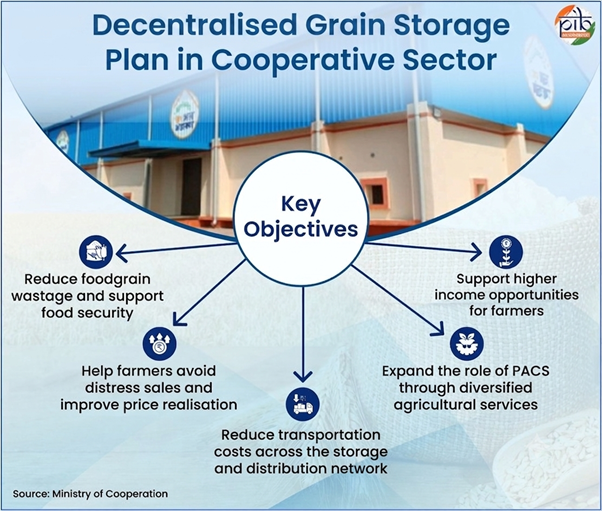
“Strengthening India’s Decentralized Grain Storage”
| India’s expanding agricultural production and food security efforts have increased the importance of decentralised grain storage infrastructure across the country. The Decentralised Grain Storage Plan in Cooperative Sector, launched in 2023, is designed to improve storage, processing, procurement, and distribution systems through Primary Agricultural Credit Societies (PACS). The Plan adopts an integrated, cooperative-led approach by converging existing government schemes. It is supported through institutional coordination and financial support mechanisms. Beginning with pilot projects across 11 states/PACS with 9,750 MT of storage capacity, the initiative has expanded steadily. As of July 2026, godown construction had been completed in 313 PACS across the country, creating more than 1.80 LMT of storage capacity. The framework also emphasises quality standards, transparency and operational viability. |
Building Storage Capacity for a Growing Agricultural Economy
India’s grain storage system has evolved through a combination of traditional storage practices, decentralised local systems, and modern infrastructure. This integrated approach has strengthened food preservation and supported the country’s food security. Traditional storage methods such as earthen bins, underground pits, and mud plastered storage structures continue alongside warehouses and silo-based infrastructure. However, rising agricultural production and expanding food security requirements have increased the need for modern, decentralised storage facilities across the country.
According to the Third Advance Estimates (2025-26), the country’s total foodgrain production is estimated at 376.563 million tonnes which is nearly 18.8 million tonnes (5.3 percent) higher than last year’s production of 357.732 million tonnes. India also operates one of the world’s largest food security programmes under the National Food Security Act, 2013, that covers about 80 crore people. Meeting these requirements depends on a robust network of grain storage facilities. While centralized storage infrastructure managed by the Food Corporation of India (FCI) and State agencies remains important, decentralized facilities are equally essential. The Ministry of Cooperation has highlighted the need for storage closer to production centres. These facilities focus on reducing transportation costs between procurement centres, minimizing foodgrain wastage, and supporting food security.
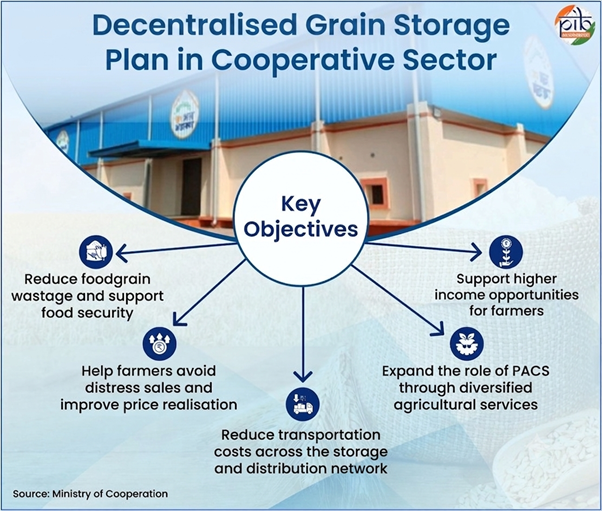
In this context, the Decentralised Grain Storage Plan in Cooperative Sector was rolled out as a Pilot Project on 31 May 2023. The initiative marked an important step towards strengthening decentralised grain storage through cooperatives. Anchored in the cooperative framework, the initiative seeks to:

- reduce foodgrain wastage and strengthen food security,
- provide farmers with greater flexibility to avoid distress sales and secure better price realization,
- reduce transportation costs between procurement centres, warehouses, and Fair Price Shops,
- expand the role of Primary Agricultural Credit Societies (PACS) through diversification of agricultural activities (PACS are village-level institutions that provide short-term credit and financial services to rural borrowers, and facilitate the collection of repayments). And,
- support higher income opportunities for farmers.
Integrated Infrastructure and Convergence Framework
The Decentralised Grain Storage Plan in Cooperative Sector seeks to create integrated agricultural infrastructure at the PACS level. The mechanism operates through the convergence of existing government schemes:
- Agriculture Infrastructure Fund (AIF) scheme – Provides financing and interest subvention support for the creation and upgradation of post-harvest infrastructure.
- Agricultural Marketing Infrastructure scheme (AMI) – Provides back-ended capital subsidy for the construction of foodgrain storage facilities.
- Sub Mission on Agricultural Mechanization (SMAM) – Facilitates the establishment of Custom Hiring Centres and access to agricultural machinery.
- Pradhan Mantri Formalisation of Micro Food Processing Enterprises scheme (PMFME) – Promotes the formalisation and growth of micro food processing units.
The convergence of these schemes enables PACS to evolve into integrated rural service hubs, strengthening agricultural infrastructure, enhancing value chains, and improving farmers’ incomes.
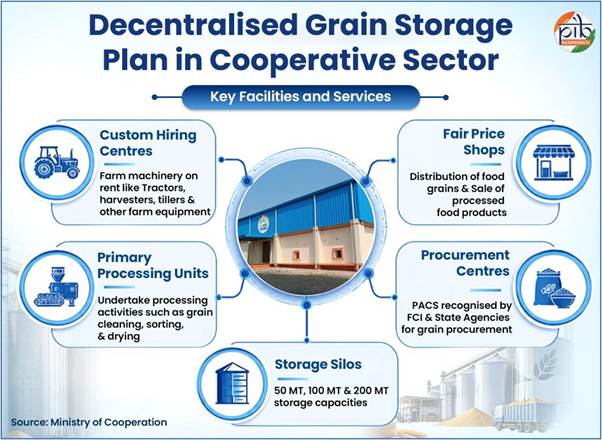
Key facilities and services under the Decentralised Grain Storage Plan in Cooperative Sector include:
- Custom Hiring Centres enable PACS to procure agricultural machinery for rental to farmers. Equipment may include tractors, harvesters, tillers, and other farm machinery.
- Fair Price Shops facilitate grain distribution and the sale of processed food products within local communities.
- Primary processing units undertake processing activities such as grain cleaning, sorting, and drying, thereby improving the quality and marketability of the produce.
- Procurement centres support grain procurement by PACS for State Agencies and FCI.
- The Plan provides for silo-based storage infrastructure of 50 metric tonnes (MT), 100 MT, and 200 MT capacities under the cooperative storage model.
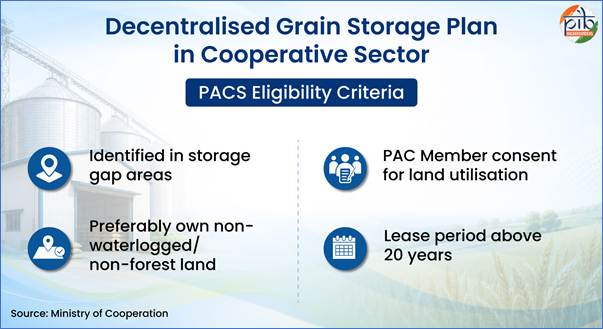
The implementation framework also lays down institutional and eligibility criteria for PACS participating under the Plan.
Selection of PACS and Institutional Framework
According to the “Margdarshika” (Standard Operating Procedure), PACS are identified and approved by District Cooperative Development Committees (DCDCs). PACS are selected in areas with storage demand.
The Plan also sets out land-related conditions for infrastructure development. PACS should preferably have their own land. The land should not be waterlogged or located in forest areas. The Consent of PACS members is required for the utilization of land. For leased land, the lease period should be longer than 20 years.
Implementation Mechanism:
The National Cooperative Development Corporation (NCDC) is the implementing agency of the Decentralised Grain Storage Plan in Cooperative Sector. Implementation is supported through coordination at the national, state and district levels. At the national level, an Inter-Ministerial Committee (IMC) monitors overall implementation of the Plan. The National Level Coordination Committee (NLCC) supports operational coordination among participating institutions and agencies. State Cooperative Development Committees (SCDCs) and District Cooperative Development Committees (DCDCs) support implementation and coordination at the state and district levels.
Financial Support and Project Viability
The Government has taken several measures to improve project viability under the Plan. These include an enhancement of the subsidy under the AMI scheme from 25 percent to 33.33 percent, a reduction in the margin money requirement from 20 percent to 10 percent, and a revision of cost norms for godown construction.
Financial support is also available through interest subvention and credit support mechanisms under eligible schemes. Under the AMI scheme, the National Bank for Agriculture and Rural Development (NABARD) serves as the subsidy-channelizing agency for eligible projects. State Cooperative Banks and District Central Cooperative Banks function as the primary lending institutions for PACS. These institutions are responsible for sanctioning and disbursing credit under the implementation framework.
The Plan also utilizes NABARD’s special refinance facility to reduce the financial burden on participating cooperatives. When combined with the 3 percent interest subvention available under the AIF, the effective loan interest rate for PACS is reduced to 1 percent under the Plan.
FCI has also been authorized to provide assured hiring of eligible godowns created under the Plan, subject to prescribed conditions. This measure enhances the financial viability of storage projects and encourages greater participation by PACS.
Following the operationalization of the structure, implementation progressed through a phased expansion strategy.
From Pilot to Expansion
The Plan has progressed through a phased implementation strategy, beginning with pilot projects and moving towards scaled expansion. Under the pilot phase, godown construction was completed in 11 PACS across 11 states, creating 9,750 MT of storage capacity. The pilot projects were implemented in Maharashtra, Uttar Pradesh, Gujarat, Rajasthan, Madhya Pradesh, Uttarakhand, Tamil Nadu, Telangana, Assam, Karnataka, and Tripura. These pilots have provided an important operational foundation and demonstrated the feasibility of local storage infrastructure at the cooperative level.
Building on this foundation, implementation has expanded significantly. As of July 2026, 1012 PACS or cooperative societies had been identified under the Plan. As of July 2026, construction of godowns had also been completed in 313 PACS, creating more than 1.80 LMT of storage capacity.
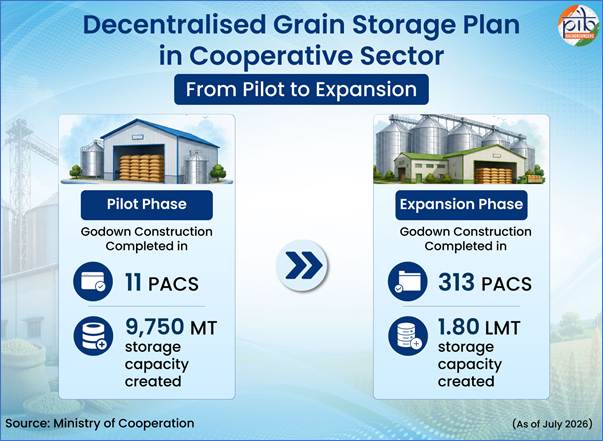
This progress reflects a transition from conceptualization towards scaled execution.
Cooperative Storage in Action: Nerpingalai PACS
| Nerpingalai PACS in Amravati, Maharashtra, has constructed a 3,000 MT warehouse under the Decentralised Grain Storage Plan in Cooperative Sector. The project received support under the Agricultural Marketing Infrastructure (AMI) and Agriculture Infrastructure Fund (AIF) schemes. With NABARD refinance support, the effective loan interest rate for the project was reduced to 1 percent. Around 300 farmers are storing nearly 32,000 bags of soybeans in the warehouse. The society has also provided advances of about Rs. 4.50 crore against the stored produce, helping farmers access liquidity and reduce distress sales. The PACS is expected to earn about Rs. 7.68 lakh annually through rental income and nearly Rs. 54 lakh through annual interest income. The warehouse has improved storage access for farmers in surrounding areas and strengthened the income base of the cooperative society.The initiative has also created local employment opportunities. It demonstrates how decentralised storage infrastructure can support farmer support systems and rural cooperative institutions. 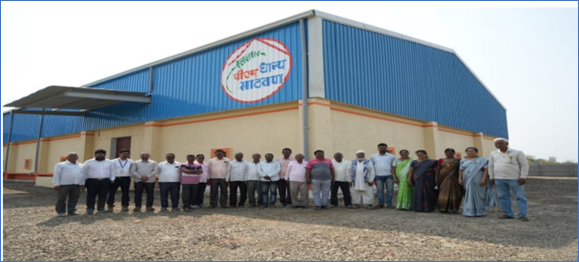 Nerpingali PACS warehouse and society member Source: Ministry of Cooperation Nerpingali PACS warehouse and society member Source: Ministry of Cooperation |
Quality Standards, Branding, and Transparency
The Plan provides uniform branding guidelines for storage infrastructure created under the scheme. Each storage structure must display the approved grain storage logo and the prescribed colour scheme. The objective is to create a recognizable identity for the initiative and strengthen awareness among stakeholders.
Quality Assurance:
The model lays down quality standards for warehouse construction and maintenance. Storage structures should comply with Warehousing Development and Regulatory Authority (WDRA) norms and should be suited to local environmental conditions. Durable, corrosion-resistant materials are to be used in construction, along with proper ventilation systems to prevent spoilage and maintain grain quality.
Regular inspections and quality audits are required to ensure compliance with design specifications and safety standards. PACS members are expected to monitor project progress, while Project Management Consultants (PMC) share updates on construction activities and expenditure to enhance transparency and accountability under the implementation approach.
These measures are intended to ensure that infrastructure created under the Plan remains durable, accountable, and aligned with prescribed quality standards over the long term.
Strengthening India’s Decentralized Grain Storage Network
The Decentralised Grain Storage Plan in Cooperative Sector represents an integrated approach towards improving agricultural infrastructure through cooperatives. By linking storage, processing, procurement, and distribution at the PACS level, the Plan strengthens foodgrain management closer to production centres.
The initiative also reinforces food security, reduces wastage, and strengthens rural cooperative institutions. The phased expansion of the Plan is supported through the convergence of existing schemes, institutional coordination, and financial support mechanisms. The framework reflects a cooperative-led approach towards strengthening decentralized agricultural infrastructure and long-term foodgrain management systems in the country.