
From Awareness to a People’s Movement
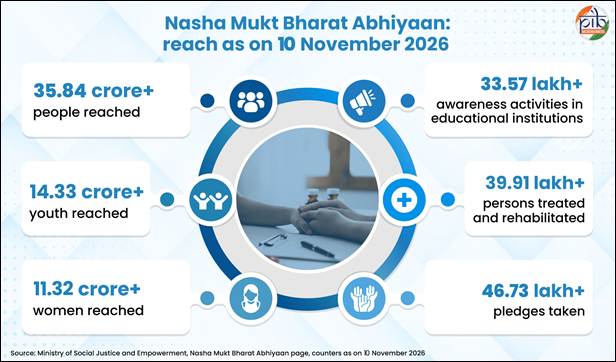
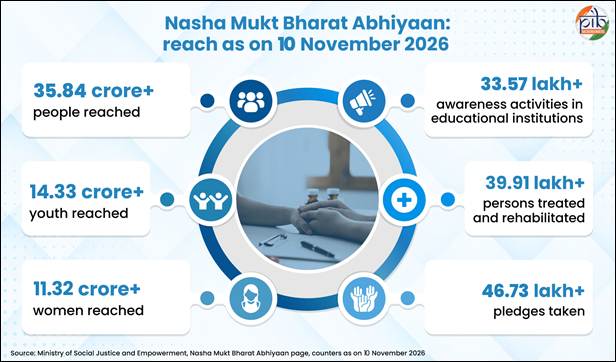
The Nasha Mukt Bharat Abhiyaan was launched on 15 August 2020 across 272 districts. It was extended nationwide to all districts on 15 August 2023. As of 10 November 2026, the campaign has reached over 35.84 crore people. This footprint includes more than 14.33 crore youth and 11.32 crore women. Support services under the National Action Plan for Drug Demand Reduction (NAPDDR) have grown rapidly. Persons seeking treatment and counselling rose from 2.08 lakh in 2020-21 to over 9.11 lakh in 2025-26. As of 10 November 2026, more than 2 lakh citizens have enrolled as Nasha Mukti Mitr.
A Movement of 35 Crore People
Under Article 47, the Constitution of India directs the State to endeavour to prohibit the consumption, except for medicinal purposes, of intoxicating drinks and drugs injurious to health. In 2018, a national survey showed that over 7 crore people in India suffered from substance use disorders, including nearly 1.2 crore children and 58 lakh women. Substance dependence harms individuals, families, and entire communities as a complex psycho-social-medical issue.
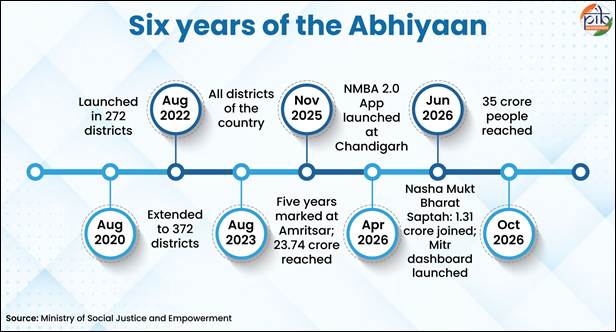
To address this challenge, the Ministry of Social Justice and Empowerment launched the Nasha Mukt Bharat Abhiyaan (NMBA) on 15 August 2020 in 272 districts identified as the most vulnerable to substance use (the use of alcohol, cannabis, opioids and other psychoactive substances). The districts were chosen from the inputs of the Narcotics Control Bureau and the findings of the first National Survey on the Extent and Pattern of Substance Use. It was expanded to 372 districts in August 2022 and extended to all districts of the country with effect from 15 August 2023. It is the flagship awareness programme of the National Action Plan for Drug Demand Reduction (NAPDDR), the Ministry’s scheme for prevention, treatment and rehabilitation. The Ministry describes this six-year change as a shift from organisational involvement to community involvement. States, districts and local stakeholders have taken ownership of the campaign, and that ownership has made it a Jan Andolan (a people’s movement).

NMBA has reached out to more than 35.84 crore people, including over 14.33 crore youth and 11.32 crore women, as on 10 November 2026. More than 33.57 lakh awareness activities have been held in educational institutions. Its outreach has grown from 1.4 crore people in 2021. When the campaign marked five years at Amritsar on 18 November 2025, more than 6 crore people had joined its anniversary events at over 2.10 lakh locations, and it had reached 23.74 crore people.
The Scale of the Challenge
Article 47 of the Constitution directs the State to endeavour to bring about prohibition of the consumption, except for medicinal purposes, of intoxicating drinks and of drugs which are injurious to health. The Ministry has run a scheme for the prevention of alcoholism and substance abuse since 1985-86.
The scale of the task became clear with the first National Survey on the Extent and Pattern of Substance Use in India, conducted by the National Drug Dependence Treatment Centre (NDDTC) of AIIMS, New Delhi, in 2018 and released in February 2019. About 16 crore people consumed alcohol, of whom more than 5.7 crore needed help for harmful or dependent use. About 3.1 crore used cannabis products and 2.26 crore used opioids, with about 25 lakh dependent on cannabis and about 77 lakh needing help for opioid use. More than 7 crore individuals were affected by substance use disorder, including nearly 1.2 crore children and 58 lakh women.
The National Action Plan for Drug Demand Reduction is a Centrally Sponsored Scheme with central sector components. Its two objectives are to reduce drug demand through preventive education, awareness, identification, counselling, treatment and rehabilitation, and to reduce the stigma and discrimination that keep people who depend on drugs from returning to society.
How the Abhiyaan Runs
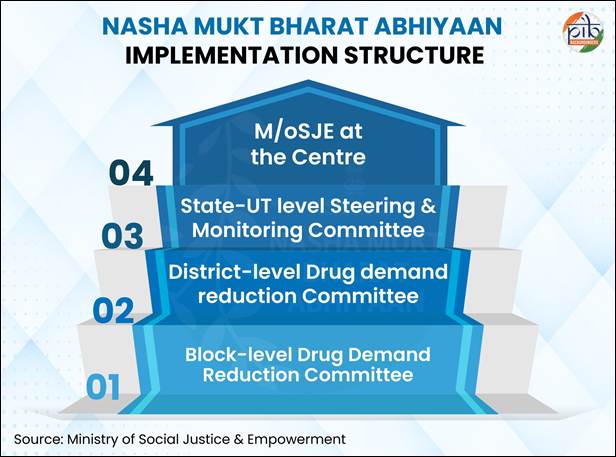
The Hon’ble Home Minister chaired the 9th Apex Level Meeting of NCORD in New Delhi to review the progress of NAPDDR and NMBA. While appreciating the efforts of all stakeholders of the Abhiyaan, it was directed to formulate a three-year action plan aimed at reducing drug demand in the country. To further institutionalise these efforts and ensure effective implementation, a three-tier monitoring and coordination mechanism was suggested. This mechanism comprises:
1. State/UT-level Steering and Monitoring Committee under the Chairpersonship of the Chief Secretary, which will meet quarterly and function as an apex body and a high-level task force with all relevant stakeholders and line departments for overseeing, coordinating, and monitoring all drug demand reduction initiatives in the State/UT.
2. District-level Drug Demand Reduction Committee under the chairpersonship of the District Collector/Deputy Commissioner, which will meet monthly and undertake mandatory quarterly inspections.
3. Block-level Drug Demand Reduction Committee under the chairpersonship of the Block Development Officer, to meet and conduct field inspections monthly.
Role of Three-Tier Committees
The roles of the three-tier committees are as follows:
1. State/UT-level Steering and Monitoring Committee:
• Provide overall oversight for implementation of the State Action Plan under NAPDDR & NMBA
• Ensure achievement of quarterly and annual targets related to awareness generation, treatment, rehabilitation, counselling, capacity building and other relevant areas of action for drug demand reduction in the State/UT.
• Coordinate efforts of Social Welfare, Health, Home, Youth Affairs, Women & Child Development, Higher Education, School Education, Skill Development, Panchayati Raj, Rural Development, Information & Broadcasting, Local NGOs/CSOs and other relevant departments.
• Ensure integration of drug demand reduction activities into existing State/ UT programmes and schemes.
• Review outreach activities conducted in educational institutions, villages, panchayats, wards, vulnerable communities, etc
• Monitor implementation of Nasha Mukt Bharat Abhiyaan (NMBA) and observance of key national events related to substance abuse prevention to reach more and more people.
• Promote engagement of youth clubs, MY Bharat Volunteers, NGOs, spiritual organisations, and other relevant bodies/clubs/groups as Nasha Mukti Mitr (NMM).
• Review availability and functioning of Integrated Rehabilitation Centres for Addicts (IRCAs), District De-addiction Centres (DDACs), Addiction Treatment Facilities (ATFs) and other treatment facilities. Monitor treatment admissions, recovery outcomes, relapse prevention measures and referral mechanisms.
• Address gaps in accessibility and quality of treatment services.
• Identify high-risk districts and approve focused intervention plans.
• Direct special campaigns in emerging hotspot areas.
• Review training programmes conducted for teachers, counsellors, healthcare professionals, law enforcement personnel, and community volunteers.
• Review District performance against performance indicators.
• Ensure timely reporting on the NMBA portal.
• Direct corrective actions for districts showing persistent underperformance.
• Facilitate optimal utilisation of Central and State resources for prevention, treatment and rehabilitation activities.
• Encourage partnerships with NGOs, educational institutions and civil society organisations.
• Any other matter with the permission of the Chair.
2. District-level Drug Demand Reduction Committee
• Prepare and implement a District Drug Demand Reduction Plan aligned with State targets.
• Identify District-specific vulnerable populations and geographical hotspots.
• Coordinate awareness programmes in schools, colleges, universities, workplaces and communities.
• Ensure regular conduct of NMBA activities through departments and partner organisations.
• Strengthen referral linkages between schools, communities, healthcare institutions and treatment centres.
• Facilitate counselling and family support services.
• Monitor the functioning of DDACs, IRCAs, ATFs and other treatment facilities.
• Review admissions, treatment completion rates, follow-up services and rehabilitation outcomes.
• Ensure availability of counselling, detoxification and rehabilitation services.
• Conduct mandatory inspections of
✓ DDACs
✓ IRCAs
✓ Addiction Treatment Facilities
✓ Educational institutions undertaking prevention activities
• Verify service quality, beneficiary records and infrastructure standards.
• Promote awareness and preventive activities in villages, wards and urban settlements.
• Encourage participation of Panchayati Raj Institutions, Urban Local Bodies, Self-Help Groups and faith-based organisations.
• Validate District-level data relating to outreach, treatment and rehabilitation.
• Ensure timely submission of reports through the NMBA portal.
• Review onboarding, deployment and regular activities of volunteers. Ensure regular outreach in identified vulnerable communities
• Facilitate convergence with Skill Development Missions and relevant departments for skilling and livelihood support of recovered persons.
• Review and monitor the progress of skill development and rehabilitation initiatives for the recovered users in the district.
• Any other matter with the permission of the Chair.
3. Block-level Drug Demand Reduction Committee
• Field-Level Monitoring of NMBA Activities
• Monitor implementation of awareness and preventive activities across villages, wards, schools, colleges, and communities.
• Ensure achievement of monthly targets assigned by the District Committee.
• Map villages, urban localities, institutions, and populations vulnerable to substance abuse.
• Maintain updated records of local risk factors and intervention needs.
• Conduct monthly inspections of:
✓ De-addiction and treatment facilities like DDAC, ATF, IRCA, ODIC, etc
✓ Educational institutions conducting awareness activities
• Verify the conduct and quality of activities reported.
• Engage Panchayats, Urban Local Bodies, teachers, ASHA workers, Anganwadi workers, SHGs, youth groups and local leaders.
• Promote community ownership of anti-drug initiatives.
• Facilitate referral of individuals requiring treatment and rehabilitation services.
• Support follow-up and reintegration efforts for recovering individuals.
• Review onboarding, deployment and regular activities of volunteers. Ensure regular outreach in identified vulnerable communities.
• Submit monthly implementation and inspection reports to the District Committee.
• Escalate cases requiring District-level support.
• Monitor compliance of institutions and stakeholders with directions issued by District and State Committees.
• Ensure timely closure of issues identified during inspections.
• Identify recovered persons requiring skill development
• Facilitate enrolment and linkage of recovered persons with available skill development schemes.
• Monitor beneficiary participation and provide regular progress updates to the District Level Committee.
• Any other matter with the permission of the Chair.
States and Union Territories are encouraged to convene State, District and Block committees regularly, and the Ministry reviews implementation through monthly meetings, Chintan Shivirs (consultation meetings with State Governments, Union Territories and other stakeholders) and national conferences.
The Ministry provides Rs. 10 lakh to each district in a financial year as grant-in-aid for campaign activities, with later instalments released against utilisation certificates and progress reports. On the ground, Panchayati Raj Institutions, local leaders, Anganwadi workers, and ASHA workers carry out the work. Volunteers of the National Service Scheme and Mera Yuva Bharat (MY Bharat) take part alongside them.
The Union Budget provides Rs. 333 crore for NAPDDR in 2026-27. The revised estimate for 2025-26 is Rs. 420 crore, against Rs. 268.32 crore spent in 2024-25.
Strength from Spirituality: MoUs with Spiritual Organisations
Spiritual and faith-based organisations, with their influence among the members of the society, have been envisioned as one of the major stakeholders under the Nasha Mukt Bharat Abhiyaan. MoSJE has signed MoUs with Brahma Kumaris, The Art of Living, Sant Nirankari Mission, All World Gayatri Pariwar, ISKCON, Shri Ram Chandra Mission, University of Patanjali, Sivananda Yoga Vedanta Dhanwantari Ashram, Adhyatm Vigyan Satsang Kendra, Chinmaya Mission, Divya Jyoti Jagrati Sansthan, Hare Krishna Movement, and Bosconet (Don Bosco) to leverage their networks for drug awareness. Through community events, school sessions, bike rallies, competitions, mobile vans, awareness runs, counselling, and meditation sessions, these organizations have reached over 7.72+ Crore people across the country. MoU with more organisations is underway.
The Sixth Year: Targets, Tools and Data
After August 2025, the Ministry set result-based targets for the campaign in six areas. They are training and capacity building of Nasha Mukti Mitr; evidence-based information, education and communication material; targeted intervention for vulnerable and at-risk groups; new faith-based and spiritual partners; coordination with line ministries; and quality de-addiction, treatment, rehabilitation and telemedicine services.
NMBA 2.0 App
The first NMBA mobile application was built to collect data on the Abhiyaan’s activities and show it on the NMBA Dashboard at the district, State and national levels. The NMBA website carried information on the Abhiyaan, the outreach dashboard, NMM registration and the e-Pledge.
The upgraded NMBA 2.0 App was launched on 24 April 2026 at the Chintan Shivir in Chandigarh. Citizens can take the e-Pledge on it, read awareness material, reach the helplines, and find the nearest de-addiction centre.
Monitoring Treatment
The NAPDDR Management Information System records every beneficiary at the supported facilities: registration, clinical assessment, substance use pattern, diagnosis, treatment and follow-up. The Project Monitoring Unit inspects centres through surprise visits, and the continuation of a project and the release of its grant depend on a satisfactory inspection report. Every organisation that receives a grant must be registered on NITI Aayog’s NGO Darpan portal and recommended by its State or Union Territory, and accreditation of grant-in-aid institutions is under way through the National Accreditation Board for Hospitals.
Data for Targeting
The First National Survey, titled “Magnitude of Substance Use in India”, findings of which were published in 2019, gave estimates of substance use at the national level and at the State level. The survey covered about 2 lakh households in 186 districts across all 36 States and Union Territories, and more than 4.73 lakh people aged 10 to 75 were interviewed. A second method, respondent-driven sampling, reached more than 70,000 people dependent on illicit drugs in 123 districts. The second National Survey, entrusted to NDDTC, will give district-level estimates for the first time, with results expected in 2027.
Schools and the Helpline
The life skills modules, developed by the Ministry for students of classes 6 to 11, equip teachers to teach life skills and drug education and to reach parents. The national toll-free helpline has been running since 1 March 2017, first as 1800-11-0031 and now as 14446. It offers tele-counselling round the clock and refers callers to the nearest supported facility. It has received 5.10 lakh calls till date. It is integrated with two other national helplines. MANAS, the Narcotics Control Bureau’s round-the-clock toll-free helpline 1933, lets citizens report drug-related issues by call, SMS, chatbot, email or the web. Tele-MANAS, under the National Tele Mental Health Programme launched on 10 October 2022, widens access to mental health counselling and care.
Citizens as Nasha Mukti Mitr
Youth involvement has brought new perspectives, energy, and creativity to the Nasha Mukt Bharat Abhiyaan, playing a pivotal role in its success. As part of strengthening grassroots participation under the Abhiyaan, a Nasha Mukti Mitr (NMM) initiative has been launched to enable citizens to contribute actively towards drug demand reduction efforts. They are individuals who voluntarily register to support the Government’s efforts towards drug demand reduction and creating a drug-free society. Any citizen can enrol as a Nasha Mukti Mitr through the NMBA Portal and receive a certificate and the NMBA badge based on their level of participation. NMMs:
• Spread awareness about the ill effects of substance abuse.
• Encourage people, especially youth, to stay away from drugs and other addictive substances.
• Help connect individuals or families affected by substance use with appropriate counselling, treatment and rehabilitation services.
• Participate in and organise NMBA awareness activities, campaigns, pledges and community outreach.
• Act as community-level change agents against substance abuse.
• Promote the pledge, the NMBA logo, the mascot and the helpline 14446 in their communities.
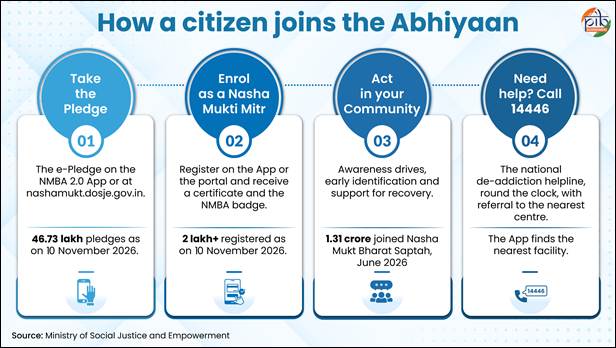
The Ministry’s Abhiyaan page recorded more than 2 lakh registered Mitr as on 10 November 2026. A Personal Dashboard launched on 17 June 2026 lets each Mitr track his or her own activities, access the IEC Material, and take the NMBA e-pledge.
The Nasha Mukt Bharat Saptah, observed from 17 to 26 June 2026 under the theme “Nasha Mukt Bharat Abhiyaan, Viksit Bharat Ki Pehchaan”, drew 1.31 crore participants through pledge drives, rallies, competitions, street plays and yoga sessions. It closed at Haridwar with the extension of the MoU between the Department and the All World Gayatri Pariwar. The Ministry’s Abhiyaan page recorded more than 46.73 lakh pledges as on 10 November 2026.
| Join the Abhiyaan |
| Take the e-Pledge at https://nashamukt.dosje.gov.in/epledge or on the NMBA 2.0 App. Register as a Nasha Mukti Mitr at https://nashamukt.dosje.gov.in/nasha-mukti-mitr. For help for yourself or a family member, call the National De-addiction Helpline 14446. |
Treatment and Recovery
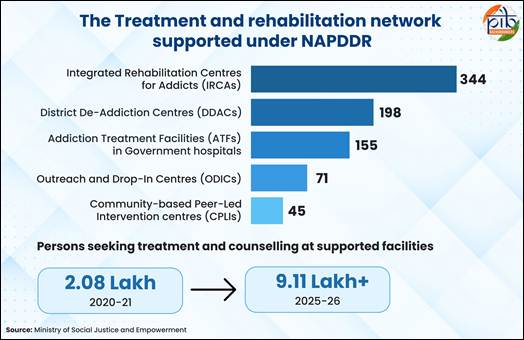
Under NAPDDR, the Ministry supports a network of facilities of five kinds. There are 344 Integrated Rehabilitation Centres for Addicts (IRCAs), 71 Outreach and Drop-In Centres (ODICs), 45 Community-based Peer-Led Intervention centres (CPLIs), 198 District De-Addiction Centres (DDACs) and 155 Addiction Treatment Facilities (ATFs) in Government hospitals.
• IRCAs provide inpatient treatment, counselling and rehabilitation. ODICs screen, assess and counsel, and refer people to treatment. CPLIs work through youth volunteers on early prevention among vulnerable adolescents.
• DDACs bring the services of an IRCA, an ODIC and a CPLI under one roof at the district headquarters.
• ATFs are set up in Government hospitals through NDDTC, AIIMS, which was entrusted with 150 of them, and through the Lokopriya Gopinath Bordoloi Regional Institute of Mental Health, Tezpur, for the North Eastern States.
The Ministry’s Abhiyaan page recorded 39.91 lakh persons treated and rehabilitated as on 10 November 2026. The number of persons seeking treatment and counselling at supported facilities rose from 2.08 lakh in 2020-21 to more than 9.11 lakh in 2025-26, and more than 6.68 lakh recovered users have taken the NMBA e-pledge.
| A Recovery at AIIMS Guwahati |
| Amit (name changed), a 31-year-old graduate from Kamrup Metropolitan district in Assam, reached the emergency department of AIIMS Guwahati after a heroin overdose. At AIIMS Guwahati, he was started on opioid substitution therapy, treated for Hepatitis C, and taken through relapse prevention therapy, with his family’s support, and the hospital’s Addiction Treatment Facility carried his care after discharge. He found work within two to three months of recovery and has stayed free of substance use for over a year. His medication is now being reduced under supervision. |
Jammu and Kashmir: A Model with Potential for Replication
In Jammu and Kashmir, the campaign has reached more than 1.26 crore people, including 72.26 lakh youth and 54.04 lakh women, and 11,152 Nasha Mukti Mitr have joined, as on 02 November, 2026. The Ministry supports an Integrated Rehabilitation Centre for Addicts, 3 ODICs, 2 CPLIs, 6 DDACs and 21 ATFs in the Union Territory, and the helpline has taken more than 11,000 calls from it.
Reviewing the Union Territory’s social welfare schemes on 22 October 2026, the Secretary, Ministry of Social Justice and Empowerment, described its coordinated, whole-of-government campaign against drug abuse as a model with potential for replication across the country. Under the Nasha Mukt J&K 100 Days Abhiyan, Addiction Treatment Facilities attended to more than 66,500 outpatients. Government Medical College, Srinagar presented a “Circle of Care” that follows a person from admission through treatment, rehabilitation, reintegration and long-term monitoring, and a proposed Rehabilitation and Socio-Economic Reintegration Scheme for Drug Abuse Victims, 2026, sets out a three-year recovery framework.
The Road Ahead
The second National Survey on the Extent and Pattern of Substance Use will give the country its first district-level estimates, with results expected in 2027. NAPDDR itself is being restructured after Chintan Shivirs and regional consultations with State Governments, non-governmental organisations, grant-in-aid institutions, experts and the line ministries and departments for health, education and prisons, and an expert committee is revising its guidelines.
Speaking at the third National Conference of the heads of the Anti-Narcotics Task Forces of the States and Union Territories in September 2026, the Union Home Minister said the country will collectively uproot the drug trade by 31 December 2029. He placed the protection of young people within the vision of Viksit Bharat by 2047. The Abhiyaan is the demand side of that resolve: informed communities, early prevention, accessible treatment and reintegration with dignity.
Six years on, the Abhiyaan has grown from a campaign in 272 districts into a movement of 35 crore people, with more than 2 lakh enrolled NMMs and a treatment network of five kinds of facilities across the country. The helpline 14446 remains the first door for anyone who needs help.
References
Ministry of Social Justice and Empowerment:
https://www.pib.gov.in/PressReleasePage.aspx?PRID=2326763
https://www.pib.gov.in/PressReleasePage.aspx?PRID=2247770
https://www.pib.gov.in/PressReleasePage.aspx?PRID=2282425
https://www.pib.gov.in/PressReleasePage.aspx?PRID=2191297
https://www.pib.gov.in/PressReleasePage.aspx?PRID=2281067
https://www.pib.gov.in/PressReleasePage.aspx?PRID=2293976
https://www.pib.gov.in/PressReleasePage.aspx?PRID=2273549
https://www.pib.gov.in/PressReleasePage.aspx?PRID=2237623
https://www.pib.gov.in/PressReleasePage.aspx?PRID=2255464
https://www.pib.gov.in/PressReleasePage.aspx?PRID=2291282
https://www.pib.gov.in/PressReleasePage.aspx?PRID=2155555
https://www.pib.gov.in/PressReleasePage.aspx?PRID=2261469
https://www.pib.gov.in/PressReleasePage.aspx?PRID=2291288
https://www.pib.gov.in/PressReleasePage.aspx?PRID=2307945
https://www.pib.gov.in/PressReleasePage.aspx?PRID=2274105
https://www.pib.gov.in/PressReleasePage.aspx?PRID=2278199
https://www.pib.gov.in/PressReleasePage.aspx?PRID=2295740
https://www.pib.gov.in/PressReleasePage.aspx?PRID=2327570
https://www.pib.gov.in/PressReleasePage.aspx?PRID=2326852
https://www.pib.gov.in/newsite/PrintRelease.aspx?relid=188688
https://www.pib.gov.in/PressReleasePage.aspx?PRID=2285464
https://www.pib.gov.in/PressReleasePage.aspx?PRID=1897001
https://www.pib.gov.in/PressReleasePage.aspx?PRID=2334758