

Strengthening Worker Protection
| India’s social security framework has expanded through wider EPFO coverage, digital reforms and welfare initiatives. EPFO provides provident fund savings, pension and insurance benefits to eligible members. The increase in the mandatory coverage wage ceiling from ₹15,000 to ₹25,000 is expected to bring over 51 lakh additional employees within its ambit. Digital initiatives aim to simplify registration, withdrawals and claim settlement. Beyond EPFO, initiatives such as e-Shram, and schemes like PM-SYM and the Pradhan Mantri Samajik Sahayata Yojana extend support to unorganised workers and vulnerable groups. These measures strengthen access to social protection across employment categories and stages of life. |
Social Security as a Pillar of Worker Protection
 As economies evolve, employment patterns and sources of livelihood continue to change. The expansion of informal, gig and platform-based work, along with variations in income and employment continuity, makes social security increasingly important for workers and their families. Social security provides protection against income loss and other contingencies across different stages of life. It also strengthens financial security during retirement and periods of vulnerability.
India has significantly expanded the reach of social protection in recent years. Social protection coverage increased from 19% in 2015 to 68.4% in 2026. This expansion has brought more than one billion people within the social protection framework.
For Indian workers, social security provides financial security beyond their working years. The Employees’ Provident Fund Organisation (EPFO) plays an important role by administering provident fund, pension and insurance schemes for eligible workers. It is a statutory body under the Ministry of Labour and Employment and one of the world’s largest social security institutions. Its schemes help workers build retirement savings, access pension benefits and secure financial support for their families.

Three Pillars of EPFO-led Social Security
EPFO social security architecture includes provident fund savings, pension benefits and insurance protection.
- Employees’ Provident Funds Scheme, 2026 (EPF)
The new EPF 2026 introduced under the Social Security Code, 2020 (Code) replaced the erstwhile Employees’ Provident Fund Scheme, 2026. The EPF 2026 enables members to build retirement savings through contributions and accrued interest. It also permits partial withdrawals for specified purposes, including housing, higher education, marriage and medical treatment, subject to prescribed conditions.
- Employees’ Pension Scheme, 2026 (EPS)
The new EPS 2026 under the Code replaced the erstwhile Employees’ Pension Scheme, 1995. The EPS 2026 provides monthly pension benefits to eligible members on superannuation, retirement or disability. It also provides pension benefits to eligible dependents of deceased members, including spouses, children and other eligible family members.
- Employees’ Deposit Linked Insurance Scheme, 2026 (EDLI)
The new EDLI 2026 under the Code replaced the erstwhile Employees’ Deposit Linked Insurance Scheme, 1976 and provides insurance protection to eligible EPF members in the event of death while in service. The scheme offers insurance benefits of up to ₹7 lakh, without requiring members to pay a separate insurance premium.
Expanding EPFO Coverage Across the Workforce
Over the years, EPFO has expanded its reach alongside India’s growing formal workforce. Its progress is reflected in wider membership, institutional coverage and pension support.
EPFO’s contributing membership has increased significantly over the period. Contributing members rose from 3.49 crore in 2014-15 to approximately 7.98 crore (as on 16 September, 2026). This represents an increase of approximately 4.49 crore contributing members over the period.
As of September 2026, 7.68 lakh establishments are contributing to EPFO. This provides a broad institutional base for extending social security coverage to eligible workers.
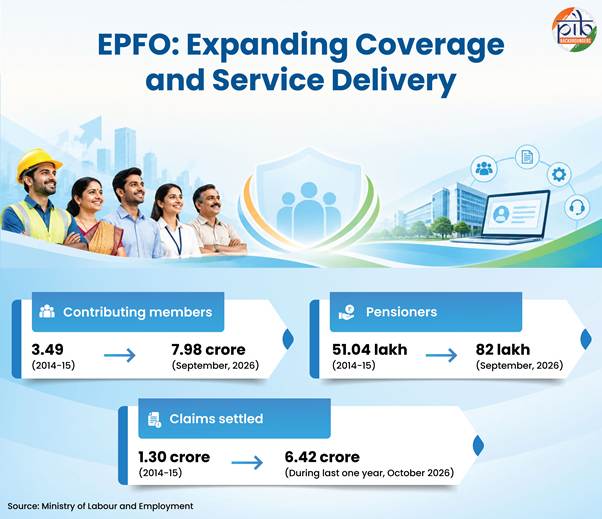
Pension support has expanded alongside membership. EPFO paid pensions to 51.04 lakh pensioners during 2014-15. Till September 2026, around 82 lakh pensioners are receiving pension benefits. This represents an increase of over 31 lakh pensioners.
The scale of social security benefits has also grown substantially. 1.30 crore claims were settled during 2014-15. In the last one-year period (as of October, 2026), EPFO settled 6.42 crore claims. This reflects the increasing scale of services delivered to EPFO members and beneficiaries.
Strengthening EPFO through Digital and Service Reforms
EPFO is strengthening social security delivery through wider coverage, simplified claim settlement and digitalisation. Reforms also focus on improving compliance, reducing administrative procedures and facilitating access to provident fund and pension services.
Wage Ceiling Revision
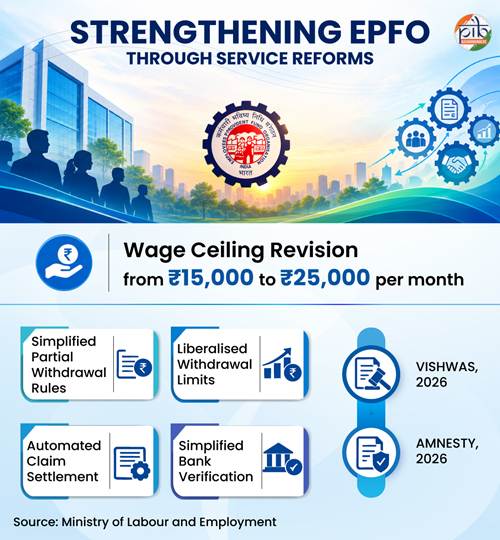
Extending Coverage: The wage ceiling for mandatory EPFO coverage was last revised in September 2014, from ₹6,500 to ₹15,000 per month. In September 2026, a further increase to ₹25,000 per month was approved. The revision is expected to extend mandatory coverage to over 51 lakh additional employees. It reflects changes in wage levels and the expansion of formal employment over the intervening period. The revised ceiling broadens the pool of employees eligible for mandatory coverage, subject to applicable statutory provisions.
Streamlining PF Withdrawals and Accelerating Claim Settlement
Simplified Partial Withdrawal Rules: EPFO has consolidated 13 provisions governing partial withdrawals into three categories: Essential Needs, Housing Needs and Special Circumstances. Essential Needs cover expenses related to illness, education and marriage. This categorisation simplifies the withdrawal framework, facilitating easier access to provident fund savings for eligible members.
Liberalised Withdrawal Limits: Employees can make partial withdrawals from their PF savings to meet specific financial needs during their working years. This allows them to access savings without withdrawing the entire accumulated balance.
EPFO has simplified these provisions by allowing up to 10 withdrawals for education and 5 for marriage. Earlier, both purposes shared a combined limit of 3 partial withdrawals. The revised framework, introduced in October 2025also permits eligible members to withdraw up to 75% of their PF balance. This includes employee and employer contributions, subject to applicable conditions. The minimum service requirement has been standardised at 12 months.
Automated Claim Settlement: EPFO increased the auto-settlement limit for eligible advance claims to ₹5 lakh. This enables faster processing of eligible withdrawals without manual intervention.
Simplified Bank Verification: EPFO removed the requirement to upload cheque-leaf images or attested bank passbooks for eligible online claims. This reduces the paperwork and simplifies the claim process.
Strengthening Compliance and Ease of Doing Business
VISHWAS, 2026: The scheme facilitates one-time settlement of eligible disputes involving damages or penalties under the EPF & Miscellaneous Provisions Act, 1952, and the Code on Social Security, 2020. It reduces litigation and encourages voluntary compliance through a digital, time-bound process. The scheme covers cases involving challenged damage or penalty orders, pending or partial recovery, issued notices awaiting final orders, and cases where notices are yet to be issued.
- Eligible pre-14 June 2024 defaults attract reduced monthly damage rates of 0.25%, 0.50% or 1%, depending on the delay period.
- Employers must pay applicable statutory interest and undertake not to pursue further appeals on settled disputes.
- The scheme covers cases at different stages, subject to exclusions for fraud, misappropriation, deliberate falsification and fully recovered damages. Applications are submitted online through the EPFO Employer Portal.
AMNESTY, 2026: It is a one-time scheme launched by the EPFO to help establishments regularise their provident fund PF trusts. It covers trusts recognised under the Income Tax Act, 1961, but lacking formal exemption under the EPF & MP Act, 1952, or the Code on Social Security, 2020. The scheme is open until 28 December 2026.
- Eligible establishments can obtain exemption retrospectively, from the trust’s establishment up to the prescribed cut-off date. The scheme also waives specified minimum employee strength and fund requirements.
- Eligible trusts must have deposited statutory contributions and credited interest to members’ accounts at rates equal to or higher than the applicable EPF rate. Subject to these conditions, proceedings initiated solely because the formal exemption was missing will be withdrawn, and no new proceedings will be initiated on this ground.
Simplifying Registration with Digital Access
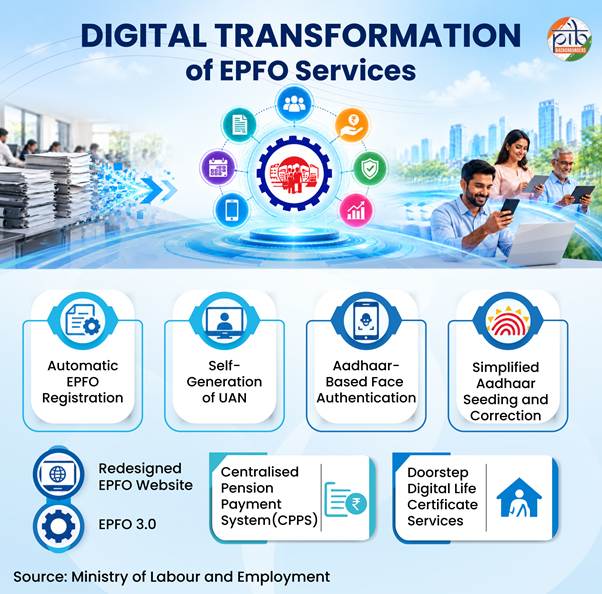
Automatic Registration: Since February 2020, eligible public and private limited companies and One Person Companies can avail the facility of automatic EPFO registration through the Ministry of Corporate Affairs portal. This facility operates through the SPICe+ and AGILE-PRO forms. This form combines various services like PAN/TAN/Director Identification Number/GSTN, etc.
Self-Generation of Universal Account Numbers (UAN): Since November 2019, workers have been able to generate their UAN independently. This facility supports enrolment in EPFO’s social-security schemes. In April 2025, EPFO introduced UAN generation and activation through Aadhaar-based Face Authentication Technology. Available through the UMANG mobile application, this facility enables contactless and secure digital access. As of October 2026, 1.74 crore self-generated UAN have been reported. In addition to this, EPFO transactions on the Umang Application since January 2017 till 21 October are ~709 crore, reflecting the scale of digital access to EPFO services.
| The UAN is a unique, permanent number assigned to an EPFO member, linking their provident fund accounts across different establishments. It facilitates the portability of provident fund accumulations when members change jobs, subject to verification of their details in the UAN database by the employer. |
Simplified Aadhaar Seeding: Since August 2025, EPFO members have been able to seed or correct Aadhaar details through the UAN Member Portal. Employers can approve requests directly when Aadhaar and UAN profile details match. Mismatched details can be referred online to the EPFO office for rectification. If the employer is unavailable, members can seek assistance through the concerned EPFO office’s Public Relations Officer.
Digital Transformation of EPFO Services
Centralised Pension Payment System (CPPS): CPPS enables pension disbursement through any bank branch across India. Pensioners can receive their pensions without transferring Pension Payment Orders (PPOs) between offices when changing locations or bank branches. This benefits specially the pensioners who move to their hometown after retirement. In addition, the system also supports pensioners by reducing the need to visit the branch for any verification at the time of commencement of pension.
Doorstep Digital Life Certificate Services: EPFO has partnered with India Post Payments Bank (IPPB) to provide doorstep Digital Life Certificate services to EPS pensioners. EPFO bears the cost of ₹50 per certificate, making the service free for pensioners. The initiative particularly benefits elderly pensioners in rural and remote areas. It supports timely pension continuity, faster initiation of family pensions and improved accuracy under CPPS.
Redesigned EPFO Website: On 1 November 2025, EPFO launched its redesigned website at epfo.gov.in. The mobile-responsive portal provides a unified interface for employees, employers and pensioners. It offers easier access to passbooks, claim forms, pension services, profile updates and scheme information. Separate login options and the “EPFO and You” section help users locate services quickly. YouTube videos explain services such as checking PF balances, applying for advances, submitting pension applications, filing Electronic Challan-cum-Returns (ECR), registering establishments and activating UANs. The shorter domain and improved navigation simplify access across devices.
EPFO 3.0 – Core Banking-Based Transformation: EPFO 3.0 modernises services through industry-standard core banking capabilities.
- It integrates a core banking solution with cloud-native, API-first and microservices-based modules for account management, enterprise resource planning, compliance and customer services. Its phased implementation is designed to ensure secure, scalable and uninterrupted services.
- The initiative reduces paperwork, accelerates claims and provides a unified platform for member services.
- Risk-validated claims are designed for automatic processing without manual intervention, potentially reducing settlement time from up to 20 days to under 3 days.
- Planned capabilities include instant withdrawals, multilingual self-service and seamless payroll-linked contributions. The framework is intended to support EPFO’s services for over 30 crore members.
Beyond EPFO: India’s Wider Social-Security Framework
India’s social security framework extends beyond EPFO through multiple schemes and institutional mechanisms supporting vulnerable groups and workers across employment categories. These initiatives combine social assistance, pension support, statutory protections and digital platforms to widen access to social security.
Pradhan Mantri Samajik Sahayata Yojana
The Yojana provides social assistance to eligible elderly persons, widows, persons with disabilities and bereaved families. It has been revised from the existing National Social Assistance Programme (NSAP) in October, 2026. The scheme will continue from 2026–27 to 2030–31. The following are the benefits offered by the sub-schemes under NSAP:
- The disability pension scheme provides monthly assistance of ₹375 to beneficiaries aged below 80 years and ₹625 to those aged 80 years and above. The benchmark disability threshold has been reduced from 80% to 40%, and the minimum age criterion has been removed, extending eligibility from birth.
- The old age pension scheme grants a monthly pension of ₹200 to persons aged 60-79 years and ₹500 to those aged 80 years and above.
- The widow pension scheme offers a monthly pension of ₹300 to widows aged 40-79 years and ₹500 to those aged 80 years and above.
- The family benefit scheme provides one-time financial assistance of ₹20,000 to eligible households upon the death of the primary breadwinner aged 18-59 years.
It consolidates nine existing central labour laws relating to social security into a unified legislative framework. The code provides for social security benefits covering provident fund, pension, insurance, maternity benefits, gratuity and other forms of worker protection. Its provisions extend to organised and unorganised workers, including gig and platform workers.
The Code provides for gratuity to eligible fixed-term employees on a proportionate basis after one year of service, subject to applicable conditions. It also recognises gig and platform workers within the social security framework and provides for schemes for their welfare, supported by a social security fund.
Women-centric provisions include maternity benefits of up to 26 weeks for eligible women, the option of work from home where the nature of work permits and crèche facilities in establishments meeting prescribed conditions. The Code also provides for digital and simplified compliance mechanisms to facilitate implementation and access to social security benefits.
e-Shram: An Integrated Platform for Unorganised Workers
Launched in August 2021, e-Shram created India’s first Aadhaar-seeded National Database of Unorganised Workers. Each registered worker receives a UAN. The portal recorded 31.89 crore registrations as of August 2026. The e-Shram One-Stop Solution, launched in October 2024, integrates 15 social security and welfare schemes. It also connects workers with the National Career Service for jobs, Skill India Digital Hub for skilling and apprenticeship, and myScheme for identifying eligible government schemes.
Pradhan Mantri Shram Yogi Maandhan (PM-SYM)
PM-SYM is a voluntary and contributory pension scheme for eligible unorganised workers aged 18–40 years, with monthly incomes of up to ₹15,000. It provides a minimum assured pension of ₹3,000 per month after attaining 60 years of age, subject to prescribed conditions. Monthly contributions range from ₹55 to ₹200, depending on the age of enrolment, with an equal contribution from the Central Government. The scheme supports old-age income security for workers in the unorganised sector, which contributes around 50% of India’s GDP.
Towards Universal Social Security
India’s social security framework continues to expand through wider EPFO coverage, digital service delivery and reforms in labour welfare. Initiatives across provident fund, pensions, insurance and social assistance support workers across formal and informal employment. Simplified compliance and technology-enabled platforms are further strengthening access to benefits. Together, these measures contribute to a more inclusive and accessible social security system.
References
Ministry of Labour and Employment
https://www.pib.gov.in/PressReleaseDetail.aspx?PRID=2311292®=48&lang=1
https://pmvbry-cdn.epfindia.gov.in/wp-content/uploads/2025/08/Annual-Report-2024-25.pdf
https://pmvbry-cdn.epfindia.gov.in/wp-content/uploads/2025/08/71.pdf
https://pmvbry-cdn.epfindia.gov.in/wp-content/uploads/2025/08/61.pdf
https://mis.epfindia.gov.in/ChartDashboard/
https://pmvbry-cdn.epfindia.gov.in/wp-content/uploads/2025/08/61.pdf
https://www.pib.gov.in/PressReleasePage.aspx?PRID=2227132&lang=1®=6
https://www.pib.gov.in/PressReleasePage.aspx?PRID=2136592&lang=2®=3
https://www.pib.gov.in/PressReleasePage.aspx?PRID=2209767&lang=1®=6
https://www.pib.gov.in/PressReleasePage.aspx?PRID=2118168&lang=2®=48
https://www.pib.gov.in/Pressreleaseshare.aspx?PRID=2109829®=48&lang=2
https://www.pib.gov.in/PressReleasePage.aspx?PRID=2178522&lang=2®=48
https://www.linkedin.com/pulse/epfos-new-website-simpler-faster-mobile-friendly-epfoofficial-ahxsc
https://pmvbry-cdn.epfindia.gov.in/wp-content/uploads/2025/12/Draft_Minutes_of_114_EC.pdf
https://pmvbry-cdn.epfindia.gov.in/wp-content/uploads/2025/12/EC_meeting_Agenda_114.pdf
https://www.pib.gov.in/PressReleasePage.aspx?PRID=2291296&lang=1®=1
https://shramsuvidha.gov.in/
https://www.pib.gov.in/PressReleaseIframePage.aspx?PRID=2108082®=48&lang=2
https://www.pib.gov.in/PressReleaseIframePage.aspx?PRID=2051703®=48&lang=2
https://dge.gov.in/sites/default/files/2026-09/1186_English.pdf
https://www.epfo.gov.in/about-us/
Cabinet
https://www.pib.gov.in/PressReleaseIframePage.aspx?PRID=2310811®=48&lang=2
https://www.labour.gov.in/static/uploads/2026/09/4f607a88c5342aeb980c6b999997caab.pdf
PIB Backgrounder
https://www.pib.gov.in/FactsheetDetails.aspx?Id=150473®=3&lang=2
https://www.pib.gov.in/PressReleaseDetail.aspx?PRID=2303053®=48&lang=1
https://static.pib.gov.in/WriteReadData/specificdocs/documents/2022/mar/doc202232127301.pdf