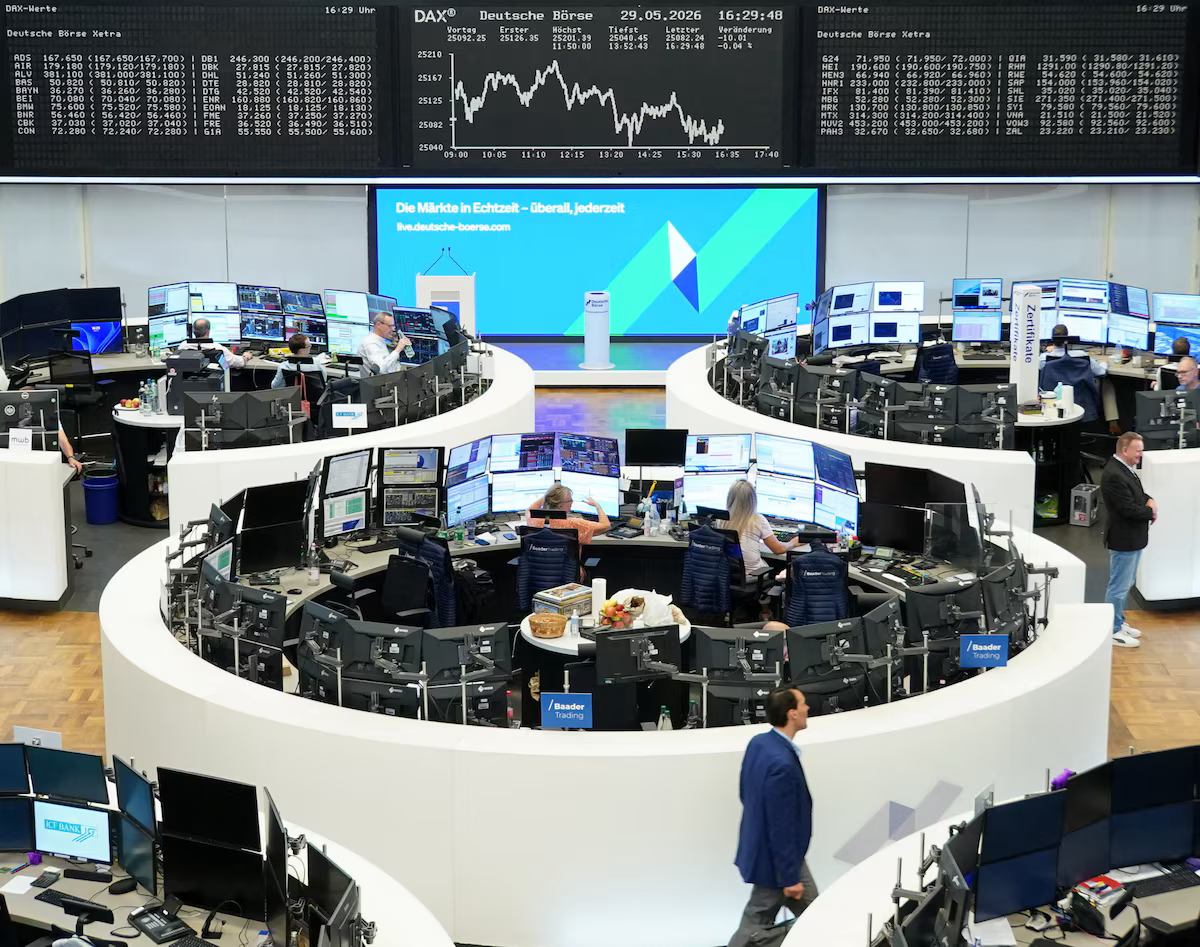
The German share price index DAX graph is pictured at the stock exchange in Frankfurt, Germany, May 29, 2026. REUTERS
June 1 (Reuters) – A look at the day ahead in European and global markets from Wayne Cole.
It seems investors are concluding no news is good news when it comes to the Gulf peace talks. President Trump had said he was meeting last Friday to decide on whether to sign off on an extension to the ceasefire, but since then it’s been silence, well apart from comparing himself to Elvis.
Defence Secretary Hegseth did pop up to say the U.S. could restart attacks on Iran if a suitable deal was not agreed. Indeed, news came Monday that U.S. forces had struck Iranian targets over the weekend, while Iran said it had targeted an air base used in what it called a U.S. attack and Kuwaiti defences were reported to be intercepting missile and drone strikes.
As it is, shipping through the Strait of Hormuz remains at a trickle with eight vessels heading outbound on May 30, and only two of those tankers. Pre-war the daily average was 136 or so.
Commodity analysts have for some time been warning that mid-June would be when global oil inventories would be so run down that actual shortages would emerge, so the clock is ticking. Yet Brent is well under $100, even after rising 2.5% today to $93.40.
Asian share markets are too focused on AI to care, and who can blame them? South Korea’s main index climbed 28% in May, while Taiwan added 15% and the Nikkei 12%. Samsung Electronics was up 10% on Monday alone as it began shipping a new type of faster chips.

The boom in tech was clear in some truly astounding trade numbers from South Korea where exports were up 53% in May on a year earlier at almost $88 billion. Exports of semiconductors rose 169% and computers 291%.
And yet the Korean won is not far from all-time lows, suggesting Korea’s dollar earnings are staying in dollars and not being converted. Presumably much of that is held in Treasury paper, so the AI boom is indirectly helping the U.S. administration fund its massive budget deficit. Swings and roundabouts.

Nvidia boss Jensen Huang kicks off the Computex trade show in Taipei on Monday with a speech about AI in which he is expected to tout his company’s latest products as well as the mountain of investment he’s planning for Taiwan.
Key developments that could influence markets on Monday:
– EU unemployment for April, EU PMIs, German retail sales
– US ISM manufacturing survey for May, US PMI
By Wayne Cole; Editing by Sonali Paul