High in the hills and valleys of Northeast India, where rivers carve their own stories and forests breathe with ancient rhythm, a quiet revolution is unfolding. Here, change doesn’t arrive with grand announcements. Instead, it moves in the soft clatter of segregated bins, the hum of village-run recycling units, and the determined footsteps of citizens who refuse to let their lands drown in waste. Across the region, from bustling market towns to remote hamlets, communities are rewriting the narrative of waste management with startling resolve. What was once an overwhelming challenge is now becoming a canvas for innovation: plastic transformed, compost pits doubling as livelihood sources, groups pioneering recycling networks, and municipalities redefining what a clean city can truly look like.
Across the Northeast: Stories of Change
Whether reclaiming decades-old dumpsites, restoring rivers, reinventing festivals, or turning citizens into custodians of public spaces, Northeast India reflects a deeper shift: waste is no longer being pushed out of sight, but responsibly brought into systems that value reuse, recovery, and respect for nature. Among many inspiring efforts across the region, some notable stories act as a testament to the Northeast’s ability to turn obstacles into opportunities and waste into a catalyst for positive change.
North Lakhimpur Leads Assam’s Urban Green Revolution
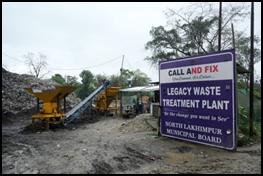
North Lakhimpur in Assam has become a standout example of scientific waste management under Swachh Bharat Mission-Urban 2.0, turning decades of environmental neglect into a model of urban renewal. The North Lakhimpur Municipal Board cleared 79,000 metric tonnes (MT) of legacy waste from the Chandmari dumpsite. The intervention freed 16 bighas of land, with another 10 bighas now set to be transformed into an Urban Forest and Urban Retreat Zone. The revival of the nearby Sumdiri River has further restored local biodiversity, bringing back birds, fish, and aquatic life.
To strengthen daily waste management, the city now processes its 36–42 ton per day (TPD) of municipal waste through modern systems. Japisajia, Assam’s first integrated hub combining a Material Recovery Facility (MRF) and a Waste-to-Compost (WTC) Plant handles recycling, segregation, and composting in one place. The MRF operates with a 100 TPD capacity across 7,000 sq. ft, feeding recyclables back into the circular economy, while the WTC unit converts 25 TPD of wet waste into organic compost for local farmers. Together, legacy waste clearance, integrated processing facilities, and ecological restoration have made “Swachh Lakhimpur” a benchmark for sustainable urban development in Assam.

Shared Responsibility, Cleaner Streets: Mizoram Shows the Way
Aizawl has sharpened its sanitation drive with a creative, people-powered push: the Adopt-a-Dustbin Scheme. Launched on 5 June 2025, World Environment Day, the initiative forms a key part of the city’s Comprehensive Plan for Municipal Solid Waste Management.

The idea is simple but powerful: residents, shop owners, institutions, NGOs, youth groups, and community bodies “adopt” public dustbins placed across the city, taking responsibility for keeping the bins and their surroundings clean until municipal teams collect the waste. The response has been striking—95 dustbins have been adopted across 75 locations, ranging from markets and footpaths to residential and institutional areas. Many adopters have gone beyond the basics, adding signboards, beautifying spaces, and spreading awareness. By rooting sanitation in shared ownership, Aizawl has transformed routine waste management into a community-driven movement, demonstrating that the city’s civic spirit is one of its greatest strengths.
A Community-Led Waste Turnaround in Arunachal Pradesh
Roing, in Arunachal Pradesh’s Lower Dibang Valley, has turned a mounting waste crisis into a community-led success story. In 2022, the Roing Municipal Council partnered with local Self-Help Group (SHG) Green Roing to launch a Public-Private Partnership (PPP) model – based solid waste management model aimed at protecting public health and the region’s fragile landscape.
Starting with a 12-member team collecting household waste, the initiative targeted plastic-heavy dumping spots, barricading them to prevent further dumping. Street plays, awareness drives, and education campaigns helped bring residents on board with segregation and responsible disposal. The effort soon scaled up with a privately run Material Recovery Facility, processing around three tons of waste each month. Recyclables from homes, roads, and drains are sold to generate income for SHG members, making the system self-sustaining.
A striking symbol of Roing’s turnaround is the Waste to Wonder Butterfly Park at Eze Park, built from recycled materials, including 10,000 plastic bottles. Together, innovation, community ownership, and environmental stewardship have made Roing a model for sustainable waste management in towns across Arunachal Pradesh.

Guarding the Waters: How Tripura Is Stopping Waste at the Source

Tripura’s Urban Local Body (ULB) has taken a decisive, hands-on approach to protect its local water bodies from solid waste pollution. All drains leading into the waterbody have been fitted with wired mesh barriers and manual cleaning systems to trap waste before it enters the aquatic ecosystem. Infrastructure has been matched with intensive public outreach. Through ward-level campaigns, community meetings, and targeted drives, residents were educated on responsible waste disposal, idol-immersion norms, and the long-term impacts of water pollution.

To tackle persistent dumping directly into water bodies, the ULB organised repeated clean-up drives and door-to-door awareness campaigns. Backed by active citizen participation, these sustained efforts have significantly reduced pollution, demonstrating how municipal systems and civic participation together can safeguard urban water ecosystems.
From Tradition to Transformation:
Nagaland’s Zero-Waste Hornbill Festival
Nagaland’s 26th Hornbill Festival rewrote the rules for large celebrations, emerging as a zero-waste, zero-plastic national model. Single-use plastics—straws, plates, cups, and bags were completely banned and replaced with banana-leaf plates, bamboo straws, and bagasse cutlery, preventing over one million plastic items and cutting nearly 50 MT of CO₂ emissions.

Strict vendor checks ensured compliance, while segregated bins, clear signage, and trained volunteers made responsible waste disposal effortless. Dry waste went for recycling; wet waste was composted onsite and shared with local farmers. Refillable water stations replaced bottled water, visitors were encouraged to carry their own utensils, and 42 clean toilets ensured comfort. By sourcing locally and keeping materials in circulation, Hornbill proved that sustainability isn’t a compromise; it’s a celebration in itself.

The Strength of Steady Change
The success across Northeast India underlines a powerful truth that sustainable waste management is not built by infrastructure alone, but by trust, participation, and persistence. Cities reclaimed land and water bodies, communities took charge of streets and drains, festivals went zero-waste without losing soul, and small towns turned waste into livelihoods and public pride. Together, these efforts go beyond individual achievements and create a model that other cities can follow. By choosing cooperation over enforcement and collaboration over compliance, the Northeast shows that cleanliness is not a one-time result, but a shared habit, carefully built and collectively sustained.