
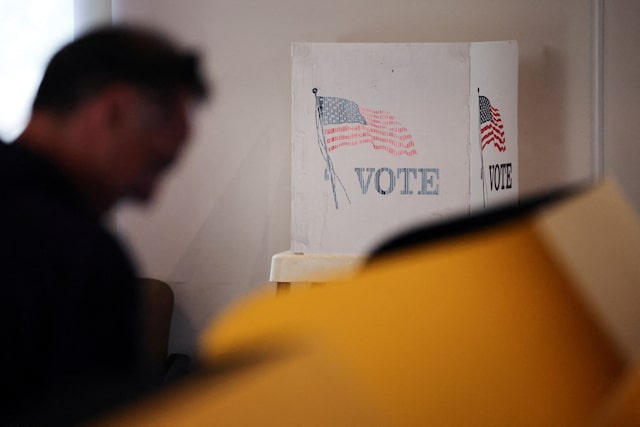
WASHINGTON, July 11 (Reuters) – The White House spent months looking for ways to bypass a federal election agency and use emergency powers to force changes to voting machines, before President Donald Trump ousted its leaders on Thursday, four people familiar with the matter said.
Some officials were frustrated with what they saw as the Election Assistance Commission’s slowness in updating guidelines for states on voting machines, the sources said, while some also wanted it to add a proof-of-citizenship requirement to its national mail voter registration form and address other election-related priorities of the administration.
Democratic lawmakers criticized the firings as an attempt to increase its control over U.S. elections, which are the purview of the states, and as undermining election integrity ahead of November’s midterm elections, when control of Congress will be at stake.
Trump fired the bipartisan federal agency’s two Democratic commissioners and allowed its lone Republican commissioner to resign, Reuters reported on Thursday. The agency’s fourth commissioner departed in April.
It was not immediately clear why Trump decided to force the commissioners out at this time or if they will be replaced. The agency remains operational, but without a quorum it cannot take up any new business, such as implementing changes to voting procedures or the national mail voter registration form.
“The administration from the start has been working across all agencies and local partners to safeguard elections from fraud and abuse, and investing in a strong infrastructure to sustain that mission especially in the midterm elections,” the White House said in a Friday statement when asked about the discussions on sidestepping the commission.
Trump and his allies have pressed Congress to adopt nationwide voting changes and argued that some voting systems require upgrades, as Trump continues to falsely claim that the 2020 election was stolen from him.
In a Thursday statement confirming the firings, the White House cited a Supreme Court decision in June that granted the president more power to fire members of independent agencies.
“(The president) reserves the right to remove individuals that may not be totally aligned with the important task of securing America’s elections,” the statement said.
Senate Minority Leader Chuck Schumer, a New York Democrat, called the dismissals a “brazen attempt to seize control of our elections before a single vote is cast” in the midterms.
“He is gutting the independent agency that certifies voting systems and helps election officials run secure elections,” Schumer said.
OFFICIALS DISCUSSED PROPOSAL FOR NATIONAL EMERGENCY
As early as last fall, White House officials reviewed a recommendation from the Office of the Director of National Intelligence to declare a national emergency and create a federal task force that could compel states to address vulnerabilities in voting systems, without going through the elections commission, according to the four sources.
The ODNI did not respond to a request for comment.
The agency at that time was finalizing its probe of voting machines it had seized from Puerto Rico.
ODNI officials concluded that there were flaws in the Puerto Rico machines that they believed could exist elsewhere, two of the sources said. Election experts have said the U.S. territory, which does not vote in presidential elections, lags the states in implementing the latest voting system guidelines.
The report was never published and the recommendation was never acted upon, but complaints about the elections commission continued, the two sources said.
During the same period, the two sources said, officials from the Department of Homeland Security, ODNI and the White House met with the commission’s leaders to discuss their concerns, including flaws that they believed could have contributed to abnormalities in 2020 — claims that have been widely debunked.
The elections commission is responsible for setting guidelines for states on voting machine systems. Some Trump officials have argued internally that there are states operating with outdated software, three of the sources familiar with the conversations said, and felt the agency was moving too slowly to push for updates.
Election administration experts said the commission often moves slowly in its work because voting systems are complex, the technology is evolving, and policy changes involve extensive public feedback.
“The voting system guidelines haven’t been updated too frequently because the process takes a long time,” Matt Weil, vice president of governance at the Bipartisan Policy Center and a former commission staffer, said in an interview. “So yes, there is slowness, but that is not a bug, that’s a feature of the system.”
The remaining commission staff can still test and certify equipment, as well as publish research and reports and distribute federal grant money, according to two people familiar with the process.
Congress approved $45 million for the commission in fiscal year 2026 for grants to states to improve election systems. Since 2018, the commission has distributed more than $1.4 billion for election administration, according to the Congressional Research Service.
Reporting by Erin Banco and Bo Erickson; Editing by Colleen Jenkins and Edmund Klamann.