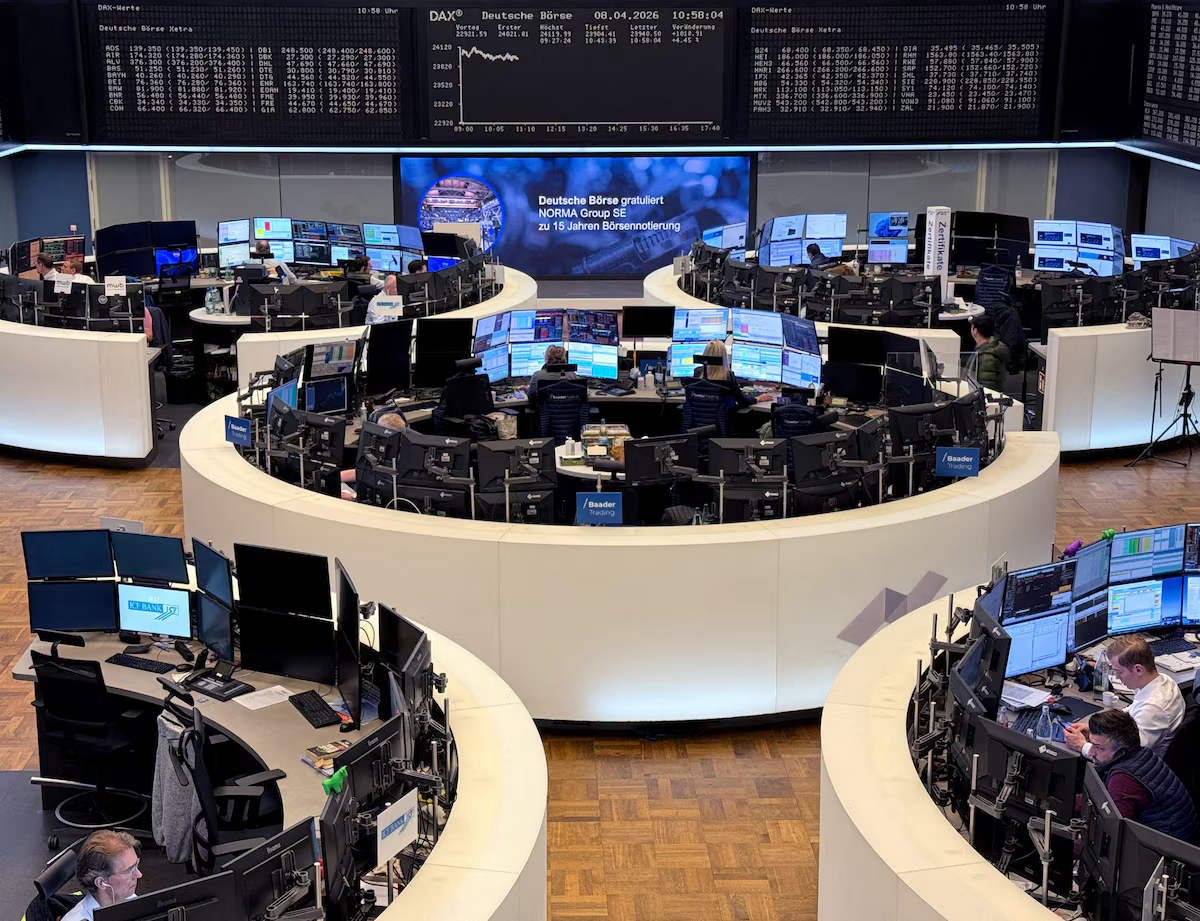
The German share price index DAX graph is pictured at the stock exchange in Frankfurt, Germany, April 8, 2026. REUTERS
April 9 (Reuters) – A look at the day ahead in European and global markets from Wayne Cole.
It’s the day after and reality is intruding into market hopes of peace and prosperity in the Middle East. Asian stocks and Wall St futures are off, though they hold most of yesterday’s celebratory gains, and the dollar flat.
Treasuries failed to match the gains made in European bonds, with Fed members sounding in no hurry to cut rates and some flirting with tightening.
Iran is questioning the point of talks with the U.S. due on Saturday when Israel is still attacking in Lebanon, while the 10-point and 15-point plans put forward by the two sides have virtually no point in common. Reportedly, the English translation of Tehran’s plan doesn’t even match the Farsi version.
Crucially, the Strait of Hormuz is not fully open and ships are not sailing through freely as some U.S. officials are claiming. A glance at any ship tracking site shows vessels still crowding both sides of the strait, with only a handful moving through, and then via Iran’s “toll” gate at the north of the narrow channel.
On average around 138 vessels a day used to transit before the war, now it’s 10 or less. Iran’s Revolutionary Guards are testing the limits of their newfound power over the waterway, insisting tankers have to be checked and approved, for a paltry fee of $1 a barrel or $2 million for a VLCC.
That is to be paid in yuan or crypto, a no-no for those worried about the possible end of the petrodollar. It’s also a major headache for shipowners who, even if they were willing to pay, would be breaking many various sanctions from many various countries by doing so.
Then there’s the little matter of freedom of the seas, a foundation block of global trade. If Iran can charge ships for passing through Hormuz, then why can’t China charge for the Taiwan strait, or Yemen for the Bab el-Mandeb. South Africa could even slap a fee on the Cape of Good Hope and Chile the Cabo de Hornos. It would give free rein to tolling the world’s seaways, and another link broken in the supply chain.
Key developments that could influence markets on Thursday:
– U.S. personal spending, income and core PCE inflation for February, weekly jobless claims, third release of Q4 GDP
– German industrial output for February
– IMF Managing Director Kristalina Georgieva delivers curtain-raiser speech ahead of the IMF/World Bank spring meetings
By Wayne Cole; Editing by Kate Mayberry