Enhancing Productivity through Farm Mechanization
The Sub-Mission on Agricultural Mechanization (SMAM) expands access for small farmers, women, and disadvantaged groups through targeted mechanization support nationwide. Special emphasis has been placed on underserved and North-Eastern States to address regional disparities in access to farm machinery and technology. Since its inception, Rs. 9,404.47 crore has supported the distribution of 21.61 lakh agricultural machines to individual farmers across India. Over 40,928 drone demonstrations covering 40,918 hectares were conducted with Rs.52.5 crore financial support, promoting precision agriculture adoption nationwide.
Strengthening Agriculture through Farm Mechanization
Farm mechanization plays a critical role in enhancing agricultural productivity in India. It involves using machines, equipment, and modern technologies for agricultural operations across the crop production cycle. These operations include land preparation, sowing, irrigation, plant protection, harvesting, and post-harvest management. By reducing dependence on manual labour and animal power, mechanization enables timely and efficient farm operations. It lowers production costs and improves the quality of agricultural practices.
To promote farm mechanization in India, the Sub-Mission on Agricultural Mechanization (SMAM) was launched in 2014–15. It is a Centrally Sponsored Scheme under the Rashtriya Krishi Vikas Yojana (RKVY). SMAM aims to “reach the unreached” by extending the benefits of mechanization to underserved sections. It includes small and marginal farmers, including women, Scheduled Castes (SC), Scheduled Tribes (ST), Farmer-Producer Organizations (FPOs), Self-Help Groups (SHGs), and rural entrepreneurs.
The scheme promotes the establishment of Custom Hiring Centres (CHCs). These are units comprising a set of farm machinery, implements, and equipment meant for hiring by farmers. It also supports the development of hubs for hi-tech and high-value agricultural equipment, and the distribution of farm machinery. Awareness generation through demonstrations and capacity-building initiatives is also undertaken. Special focus is placed on regions with low farm power availability and on addressing structural constraints such as small landholdings and high capital costs through affordable rental services via CHCs. Additionally, SMAM supports the performance testing and certification of agricultural machinery. Targeted Information, Education, and Communication (IEC) activities are undertaken to enhance adoption among stakeholders.
The Rashtriya Krishi Vikas Yojana (RKVY), launched in 2007, is a flagship scheme that incentivizes states to increase public investment in agriculture and allied sectors. It provides states with flexibility and autonomy to design and implement projects tailored to local needs. The schemes encompass a broad range of interventions, including crop production, infrastructure development, mechanization, and value addition. In 2017-18, the Scheme was restructured as the RKVY-RAFTAR (Remunerative Approaches for Agriculture and Allied Sector Rejuvenation), with an increased focus on strengthening both pre-and post-harvest infrastructure.
Strategic Pillars of SMAM for Enhancing Farm Productivity
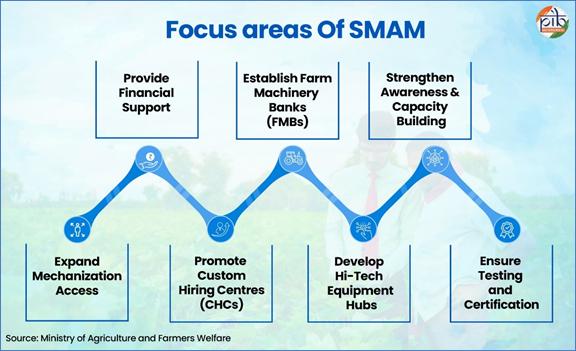
The Sub-Mission on Agricultural Mechanization (SMAM) is designed to promote inclusive and efficient farm mechanization by improving access to modern agricultural equipment, reducing drudgery, and enhancing farm productivity.
- Promotion of Agricultural Mechanization through training, testing, demonstration, and post-harvest mechanization: Enhances farm productivity and efficiency by improving access to modern agricultural technologies. It further strengthens post-harvest infrastructure for processing, storage, value addition, and crop residue management by promoting agricultural mechanization.
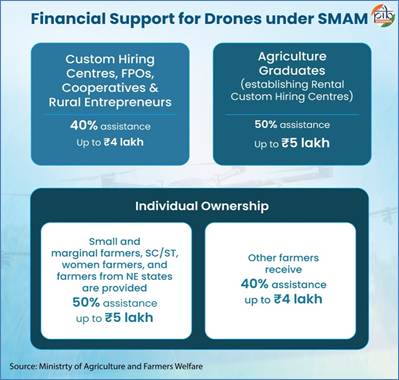
- Financial Assistance for the Procurement of Agricultural Machinery and Equipment: Provides subsidy support for individual ownership of agricultural machinery through the Direct Benefit Transfer (DBT) system. It covers 40% of the machine cost for general beneficiaries and 50% for SC/ST farmers, small and marginal farmers, and beneficiaries in North-Eastern states. Small and marginal farmers receive Rs 2,000 per hectare for mechanized services, including drones, through CHCs, SHGs, and FPOs.
- Establishment of Farm Machinery Banks (FMBs) for Custom Hiring: Enhances farm mechanization through 80–90% financial support for SHGs, FPOs, and local institutions to acquire agricultural machinery. Financial assistance for CHCs is available at 40 percent of the project cost for projects up to ₹250 lakh, while FMBs receive 80 percent support for projects up to ₹30 lakh.
- Establishment of Hi-Tech and High-Productivity Equipment Hubs: Equipped with advanced, high-capacity machinery for crop-specific operations to improve operational efficiency and access to high-value equipment.
- Promotion of Agricultural Mechanization in the North Eastern Region (NER): Provides enhanced support in North-Eastern states through region-specific interventions, including up to 100% subsidy for small machinery and 95% support for Farm Machinery Banks.
Powering Farm Mechanization: The Financial Backbone of SMAM
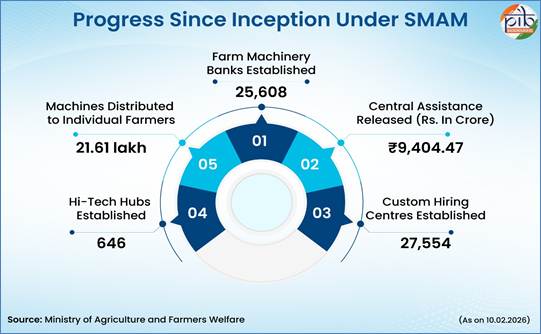
Under SMAM, from 2014–15 to 2025–26, central assistance of ₹9,404.47 crore has supported the distribution of 21.61 lakh machines to individual farmers. Additionally, it supported the establishment of 27,554 Custom Hiring Centers,646 Hi-tech Hubs, and 25,608 Farm Machinery Banks. Under SMAM, the number of beneficiaries for individual farm machinery ownership increased from 2.07 lakh in 2020–21 to 2.32 lakh in 2024–25, reflecting an overall expansion in scheme coverage.
The scheme follows a cost-sharing arrangement between the Central and State Governments. For most states, the funding pattern is 60:40, while for North-Eastern and Himalayan states, it is 90:10. In the case of Union Territories, assistance is provided as 100 percent Central funding. This differentiated funding structure facilitates broader mechanization adoption across diverse regional contexts.
Innovation in Action: How SMAM is Scaling Drone-Based Farming
The Sub-Mission on Agricultural Mechanization (SMAM) encourages the use of drones to improve agricultural operations. With financial support of ₹52.50 crore under the scheme, the Indian Council of Agricultural Research (ICAR) has promoted drone adoption through large-scale field demonstrations across the country.
During 2023–24 to 2025–26, ICAR, in collaboration with State Agricultural Universities and Krishi Vigyan Kendra (KVKs), conducted 40,928 Kisan Drone demonstrations across covering 40,918 hectares. These demonstrations focused on the application of nutrients, fertilizers, and agro-chemicals in accordance with prescribed standard operating procedures.
To facilitate widespread adoption, SMAM provides financial assistance for drone procurement and demonstrations. Eligible institutions such as ICAR institutes, KVKs, and State Agricultural Universities receive 100 percent financial support of up to ₹10 lakh per drone for these activities. Farmer-Producer Organizations (FPOs) are eligible for grant support of up to 75 percent. In addition, agencies utilizing drones through service models are supported with a contingency expenditure of ₹6,000 per hectare.
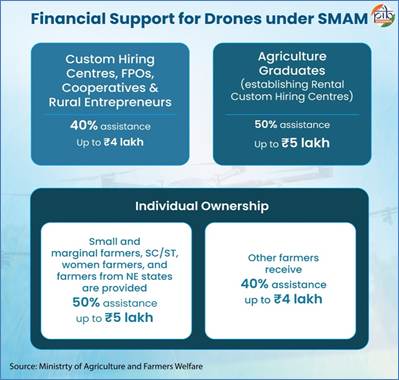
Further, SMAM places a strong focus on inclusivity, earmarking 30 percent of total funds for women farmers. This provision aims to enhance their access to agricultural machinery and promote greater participation in mechanized farming systems.
Bridging Gaps, Boosting Growth: The SMAM Effect
SMAM has emerged as a key intervention in strengthening agricultural productivity, efficiency, and inclusiveness. By focusing on small and marginal farmers, women, SC/ST communities, and underserved regions, the scheme has helped bridge critical gaps in mechanization through subsidies, Custom Hiring Centre, Farm Machinery Banks, and targeted regional support. Its emphasis on training, demonstrations, post-harvest management, and emerging technologies such as drones reflects a forward-looking approach to modernizing agriculture. By creating institutional infrastructure, SMAM has contributed to reducing labor drudgery, improving the timeliness of operations, and supporting higher farm productivity.
References
Ministry of Agriculture and Farmers Welfare
https://agriportal.cg.nic.in/agridept/CentralScheme/2.3%20smam%20gl.pdf
https://farmech.dac.gov.in/Content/New_Folder/Revised_SMAM_Guidelines_%282025%29_With_Covering.pdf
https://www.pib.gov.in/PressReleasePage.aspx?PRID=2146927®=3&lang=2
https://agriwelfare.gov.in/sites/default/files/rkvy_inro.pdf
https://farmech.dac.gov.in/Content/New_Folder/Revised_SMAM_Guidelines_%282025%29_With_Covering.pdf
https://www.pib.gov.in/PressReleasePage.aspx?PRID=2225993®=3&lang=1
https://sansad.in/getFile/loksabhaquestions/annex/184/AU1307_PlCuP7.pdf?source=pqals
https://sansad.in/getFile/loksabhaquestions/annex/187/AU2869_rYAp4R.pdf?source=pqals
https://sansad.in/getFile/loksabhaquestions/annex/184/AU4030_u5gVDd.pdf?source=pqals
https://sansad.in/getFile/loksabhaquestions/annex/187/AU2910_hr4mIN.pdf?source=pqals
https://sansad.in/getFile/annex/270/AU1621_FVTLGW.pdf?source=pqars
Ministry of Finance
https://www.indiabudget.gov.in/economicsurvey/doc/echapter.pdf
Ministry of Rural Development
https://sansad.in/getFile/loksabhaquestions/annex/186/AU2540_lhHekv.pdf?source=pqals
PIB Backgrounder
https://www.pib.gov.in/PressReleasePage.aspx?PRID=2248987®=3&lang=2