
A Thousand Years of Deep-rooted Faith and Civilisational Pride
Key Takeaways
|
Introduction
सौराष्ट्रे सोमनाथं च श्रीशैले मल्लिकार्जुनम् ।
उज्जयिन्यां महाकालम्ॐकारममलेश्वरम्”
This opening verse of the Dwadasha Jyotirlinga Stotram places Somnath in Gujarat, at the very beginning of the twelve sacred Jyotirlingas, signifying its place in India’s spiritual- heritage. It reflects the civilisational belief that Somnath is the foundation of Bharat’s spiritual geography. Located at Prabhas Patan near Veraval in Gujarat, Somnath is not merely a place of worship but a living symbol of India’s civilisational continuity.
For centuries, Somnath drew the reverence and prayers of millions. It was repeatedly targeted by invaders whose intent was destruction, not devotion. Yet, Somnath’s story is defined by the indomitable courage, faith and resolve of crores of dedicated followers.
Swabhiman Parv: A National Expression of Collective Pride
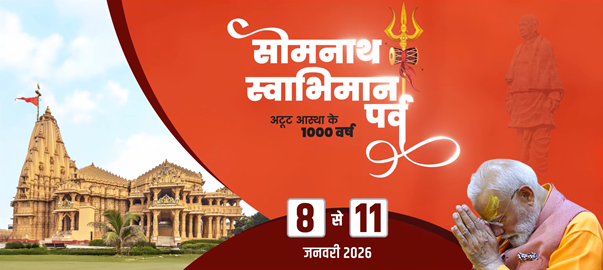
The Somnath Swabhiman Parv is being organised from 8 January to 11 January 2026 as a national commemoration marking one thousand years since the first recorded attack on the Somnath Temple in January 1026.
The observance has been conceived not as a remembrance of destruction, but as a tribute to resilience, faith and civilisational self-respect. Over centuries, Somnath was repeatedly targeted by invaders whose objective was demolition rather than devotion. Each time, however, the temple was rebuilt through the collective resolve of devotees like Devi Ahilya Bai Holkar. This unbroken cycle of revival has made Somnath a powerful symbol of India’s civilisational continuity.
The year 2026 also coincides with seventy-five years since the present Somnath Temple was reopened to devotees on 11 May 1951, following Independence. These two milestones together form the foundation of the Somnath Swabhiman Parv.
During the four-day Parv, Somnath has been transformed into a centre of spiritual activity, cultural reflection and national remembrance. A central feature of the observance is the 72-hour Akhand Omkarchanting, symbolising, unity and collective faith. Alongside this, devotional music, spiritual discourses and cultural programmes are being organised throughout the temple town.
The Somnath Swabhiman Parv stands as a collective expression of pride, remembrance and confidence in India’s Sanatan civilisational journey.
Historical Context: A Millennium of Resilience
The historical roots of Somnath extend deep into ancient Indian tradition. Prabhas Tirtha, where Somnath is located, is associated with Lord Shiva and the worship performed by Chandra, the Moon God. According to tradition, Chandra worshipped Lord Shiva here and was relieved of his curse, giving the site immense spiritual significance.
Over centuries, Somnath witnessed multiple phases of construction, each reflecting the devotion, artistry and resources of its time. Ancient accounts describe successive temples being built here, using different materials, symbolising renewal and continuity. The most turbulent phase of Somnath’s history began in the eleventh century.
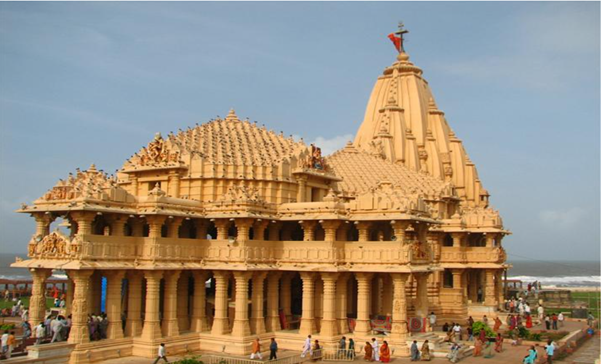
In January 1026, Somnath faced its first recorded attack by Mahmud of Ghazni. This marked the beginning of a long period during which the temple was repeatedly destroyed and rebuilt over the centuries. Despite this, Somnath never ceased to exist in the collective consciousness of the people. The cycle of the temple’s devastation and revival is unparalleled in world history. It demonstrates that Somnath was never merely a structure of stone, but a living embodiment of belief, identity and civilisational pride.
On Kartak Sud 1, Diwali day i.e. 12 November 1947, Sardar Vallabhbhai Patel visited the ruins of Somnath and expressed his determination to rebuild the temple. His vision was rooted in the belief that the restoration of Somnath was essential to restoring India’s cultural confidence. The reconstruction was undertaken with public participation and national resolve. The present temple, built in the Kailash Mahameru Prasad architectural style, was consecrated on 11 May 1951 in the presence of the then President Rajendra Prasad. The ceremony marked not just the reopening of a temple, but the reaffirmation of India’s civilisational self-respect.
Hon’ble Prime Minister Narendra Modi attended the programme held on 31 October 2001, marking 50 years since the rebuilt Somnath Temple was reopened in the year 1951. The occasion highlighted the pivotal role played by Sardar Vallabhbhai Patel, K. M. Munshi and several others in the reconstruction of the temple. The programme also coincided with the 125th birth anniversary of Sardar Vallabhbhai Patel and was attended by the then Prime Minister Atal Bihari Vajpayee, the then Home Minister Lal Krishna Advani, and other dignitaries.
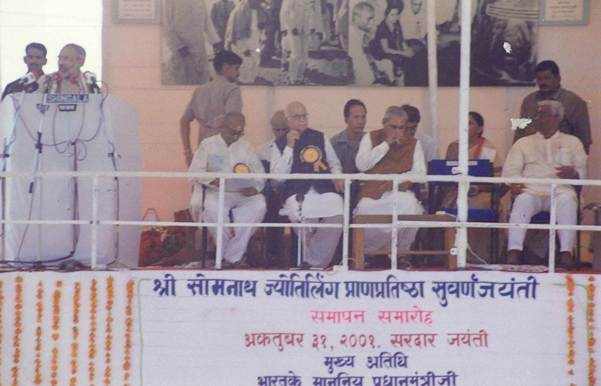
In 2026, the nation marks 75 years since the historic ceremony of 1951, which signified not only the reopening of the Somnath Temple but also the reaffirmation of India’s civilisational self-respect. Seven and a half decades later, Somnath stands rejuvenated, reflecting the enduring strength of our collective national resolve.
Somnath Temple: Grandeur, Faith and Living Heritage
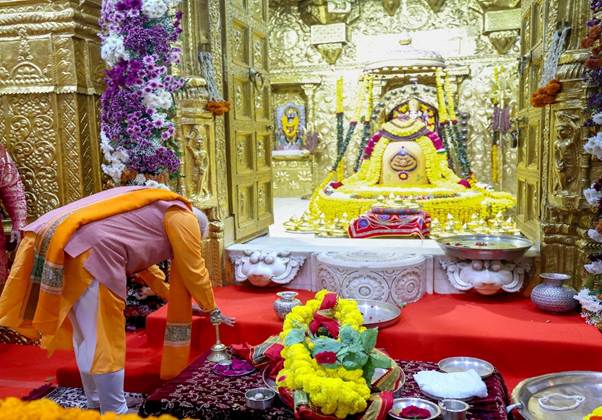
Somnath is revered as the first among the 12 Aadi Jyotirlingas of Lord Shiva. The present temple complex comprises the Garbhagriha (sanctum sanctorum), Sabhamandap (assembly hall) and Nrityamandap (dance hall), rising majestically alongside the Arabian Sea. The temple is crowned by a 150-foot Shikhar, with a 10-tonne Kalash at its summit. The Dhwajdand (flagpole), standing 27-foot tall, marks the temple’s unwavering identity. The complex is adorned with 1,666 gold-plated Kalash and 14,200 Dhwajas, symbolising generations of devotion and craftsmanship.
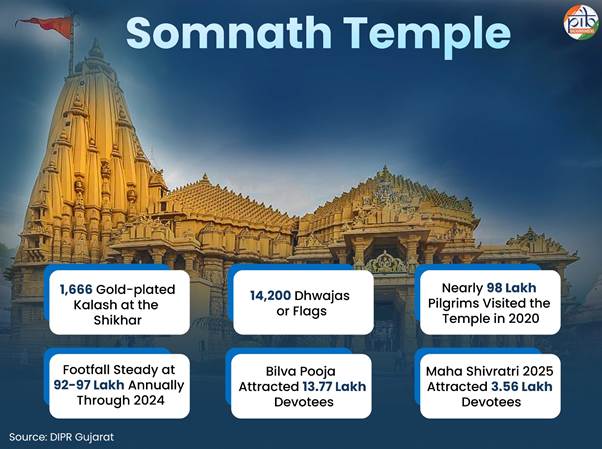
Somnath continues to be a centre of active worship. Annual footfall remains consistently high, ranging between 92 and 97 lakh devotees (Nearly 98 lakh Pilgrims visited the temple in 2020). Rituals such as Bilva Pooja attract over 13.77 lakh devotees, while Maha Shivratri 2025 witnessed 3.56 lakh devotees. Cultural initiatives have played an important role in connecting devotees with Somnath’s history. The Light and Sound Show, launched in 2003 and enhanced in 2017 with narration and 3D laser technology, has attracted over 10 lakh visitors in the last three years. Programmes such as the Vande Somnath Kala Mahotsav have revived dance traditions dating back nearly 1,500 years. Under the leadership of Prime Minister Narendra Modi, who also serves as the Chairperson of the Shri Somnath Trust, Somnath has entered a new phase of revival. Governance reforms, infrastructure upgrades and heritage preservation efforts have strengthened the temple’s role as a spiritual and cultural centre.
Spiritual Build-up and Padayatra
Ahead of the Somnath Swabhiman Parv, Somnath has witnessed an atmosphere of unique spiritual enthusiasm. Saints from Girnar Tirthkshetra and other sacred centres undertook a Padayatra from Shankh Chowk to the Somnath Temple.
The procession resonated with the sound of Lord Shiva’s beloved Damru, traditional instruments and devotional music. Nearly 75 drummers of the Siddhivinayak Dhol Group participated, creating a rhythmic and spiritually charged environment. Chants of “Har Har Mahadev” echoed across the temple precincts.
Saints and distinguished participants offered their prayers with profound reverence. The Padayatra was welcomed with floral showers, transforming the temple complex into a scene of divine grandeur. Devotees in attendance experienced a deep sense of spiritual fulfilment.
Women Empowerment and Sustainability at Somnath
Declared a “Swachh Iconic Place” in 2018, Somnath has adopted innovative sustainability practices. Temple flowers are converted into vermicompost nourishing 1,700 Bilva trees. Plastic waste is transformed into paver blocks under Mission LiFE, with 4,700 blocks produced monthly. Rainwater harvesting systems treat nearly 30 lakh litres of sewage water per month.
A Miyawaki forest of 7,200 trees, spread over 72,000 square feet, absorbs about 93,000 kilograms of carbon dioxide annually. Purified Abhishek water is bottled as Somgangajal, benefiting over 1.13 lakh families as of December 2024.

Somnath has also emerged as a strong centre of women empowerment. Out of 906 employees of the Somnath Temple Trust, 262 are women. The Bilva Van is managed entirely by women. 65 women are engaged in prasad distribution and 30 women are engaged in temple dining services. Overall, 363 women receive employment, earning approximately ₹9 crore annually and, reflecting the economic self-reliance and dignity emanating from the temple complex.
Prime Minister’s Visit and Associated Events
The Somnath Swabhiman Parv is attaining national significance with the visit of Prime Minister Narendra Modi between 8 to 11 January 2026.
On 10 January 2026, the Prime Minister is set to be in Somnath and participate in key spiritual events marking the Swabhiman Parv. In the evening, he will take part in the Omkar Mantra chanting at the temple premises, joining the ongoing 72-hour Akhand Omkar chanting – which symbolises continuity of faith, unity and civilisational strength. On the same evening, the Prime Minister will also witness the drone show organised as part of the Swabhiman Parv celebrations.

On 11 January 2026, the Prime Minister will lead the Shaurya Yatra, a symbolic procession organised as part of the Somnath Swabhiman Parv. The Shaurya Yatra represents courage, sacrifice and the indomitable spirit that preserved Somnath through centuries of adversity. Following the Yatra, the Prime Minister will offer prayers at the Somnath Temple.
Later, Prime Minister will address the gathering at Somnath, where he will reflect on the civilisational importance of the temple, the significance of the Swabhiman Parv and the enduring message of faith, resilience and self-respect associated with Somnath.
The Prime Minister’s participation in these events underscores the national importance of Somnath Swabhiman Parv and reinforces the commitment to preserving and celebrating India’s spiritual and cultural heritage. The visit also highlights Somnath’s role as a living and enduring symbol of India’s civilisational continuity and collective confidence.
Conclusion
Somnath Swabhiman Parv reaffirms India’s civilisational confidence. It honours resilience over destruction, faith over fear. Standing on the shores of Saurashtra, the Somnath Temple continues to inspire Indians all over the world, reminding everyone that while forces of destruction fade into history, faith rooted in righteousness, unity and self-respect endures forever. The following Sanskrit verse, shared by Prime Minister Narendra Modi, highlights the spiritual essence of Somnath:
आदिनाथेन शर्वेण सर्वप्राणिहिताय वै।
आद्यतत्त्वान्यथानीयं क्षेत्रमेतन्महाप्रभम्।
प्रभासितं महादेवि यत्र सिद्ध्यन्ति मानवाः॥
Meaning – Lord Shiva, in his form as Adinath, for the welfare of all beings, manifested this sacred and supremely powerful region known as Prabhas Khanda through his eternal principle. Bathed in divine radiance, this holy land is the place where human beings attain spiritual perfection, virtue, and liberation, Moksha.