
“Beneath Every Harvest Lies Healthy Soil”
| Soil is a strategic national resource that supports agricultural productivity, food security, and rural livelihoods in India. National initiatives are promoting scientific soil management through soil testing, balanced nutrient use, and climate-resilient farming practices. The Soil Health Card Scheme has generated over 25.89 crore cards, supporting informed nutrient management. The National Mission on Natural Farming has expanded to 18,786 clusters covering 8.80 lakh hectares. Public outreach efforts, including the Khet Bachao Abhiyan, are encouraging wider adoption of sustainable practices. Digital platforms, geospatial mapping and artificial intelligence are improving soil assessment and advisory services, strengthening productivity, resilience and long-term agricultural sustainability. |
Soil as a Strategic National Resource
Soil forms the very foundation of India’s agricultural systems, supporting crop production, sustaining ecosystems, and securing livelihoods. More than 46 percent of the workforce is employed in agriculture and allied activities. As a result, soil health has a direct influence on rural incomes, food systems, and overall economic stability.
According to the Land Use Statistics 2022-23, the total reported area of India is 306.65 million hectares, of which nearly 59 per cent is under agriculture. This highlights the critical role of soil in sustaining productivity and meeting the nutritional needs of a growing population. Healthy soil enables higher yields and reduces dependence on external inputs. In this context, soil security and sustainability are vital for achieving the Sustainable Development Goals (SDGs) 2030. This is particularly important for those related to zero hunger (SDG 2) and climate action (SDG 13).
Recognising this strategic importance, India has expanded its focus on sustainable soil and land management. National efforts span climate resilience, natural farming, soil mapping, and digital agriculture. Initiatives such as the National Mission for Sustainable Agriculture (NMSA) and the National Mission on Natural Farming (NMNF) promote resilient and resource-efficient agricultural practices. The Soil Health Card Scheme further supports informed nutrient application through soil testing and advisory services. These efforts reflect the journey of soil science evolving from traditional farming practices to modern scientific approaches.
Alongside institutional interventions, recent awareness initiatives such as the “Khet Bachao Abhiyan” are also strengthening public engagement. This is helping in soil conservation, balanced use of fertilisers and sustainable agricultural practices.
Soil Diversity: Foundation of Agricultural Strength
India’s varied climate, geology, and relief have resulted in a wide range of soils that support region-specific agricultural practices. These soils differ in composition and fertility, enabling diverse cropping patterns and improving resilience across regions.
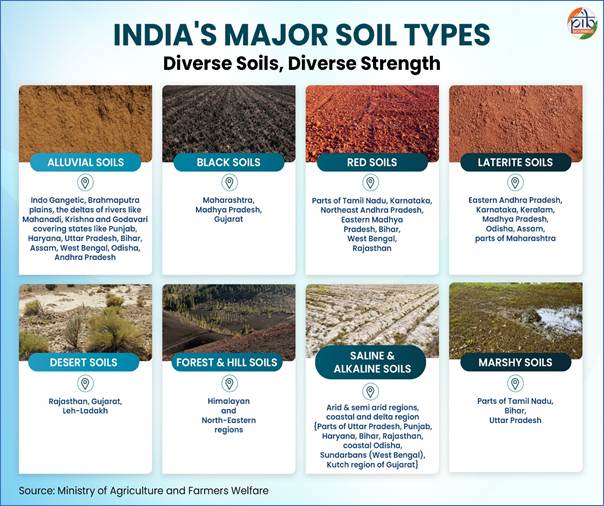
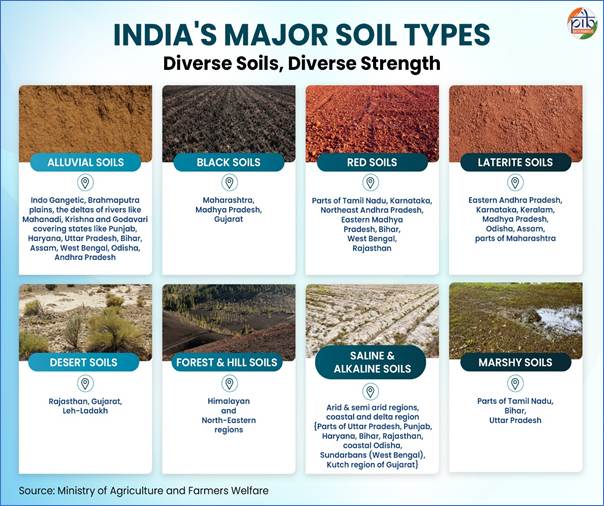
Alluvial soils are found in the Indo-Gangetic and Brahmaputra plains and the deltas of rivers like Mahanadi, Krishna and Godavari covering states like Punjab, Haryana, Uttar Pradesh, Bihar, Assam, West Bengal, Odisha, Andhra Pradesh. These soils are fertile and widely distributed across river plains. Black soils in Maharashtra, Madhya Pradesh, and Gujarat are clayey, retain moisture, and are rich in lime and calcium. Red soils are spread across parts of Tamil Nadu, Karnataka, north-east Andhra Pradesh, eastern Madhya Pradesh, Bihar, West Bengal, and Rajasthan. These soils vary in colour due to iron content and are generally porous and low in key nutrients.
Laterite soils are predominantly found in Eastern Andhra Pradesh, Karnataka, Kerala, Madhya Pradesh, Odisha, Assam, and parts of Maharashtra. They develop under conditions of high rainfall and intense leaching, which removes soluble nutrients from the soil. Desert soils, in Rajasthan, Gujarat, and Leh-Ladakh, are characterised by their sandy texture, low moisture retention, and the presence of soluble salts. Forest and hill soils are distributed across the Himalayan and North-Eastern regions, varying according to altitude, climate, and vegetation cover.
Saline and alkaline soils are found in the arid and semi-arid regions, coastal and delta regions or areas with prolonged poor drainage and waterlogging. These include parts of Uttar Pradesh, Punjab, Haryana, Bihar, Rajasthan, coastal Odisha, the Sundarbans of West Bengal, Kutch region of Gujarat. These soils are characterised by surface salt accumulation, which can affect crop productivity. Marshy soils occur in parts of Tamil Nadu, Bihar, and Uttar Pradesh, where prolonged waterlogging results in high organic matter content. Such wide range of soil types across the country reflects India’s diverse agro-climatic landscape and underpins varied cropping systems.
Soil and Climate Action: Building Resilience
Soil plays a critical role in climate change mitigation and adaptation by acting as a significant natural carbon sink. Soils absorb carbon dioxide from the atmosphere and store it as soil organic carbon. This process is facilitated by vegetation growth, roots, and soil microorganisms. The stored carbon can remain in the soil for long periods, helping reduce greenhouse gas concentrations in the atmosphere. In addition, higher soil organic carbon levels improve soil structure, enhance moisture retention capacity, and increase nutrient availability. This further strengthens soil fertility and resilience to climate variability. Moreover, carbon farming is emerging as an important component of climate-smart agriculture. It focuses on removing atmospheric carbon and storing it in soils through sustainable land management practices.
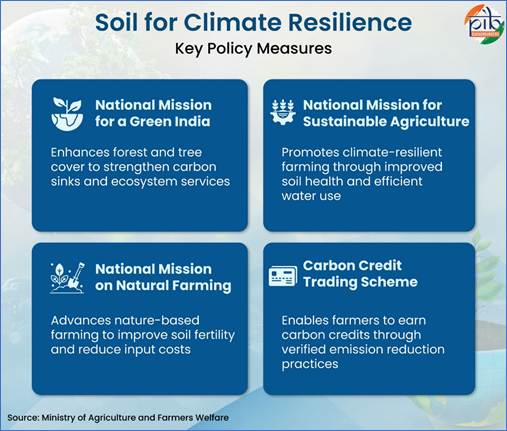
In this context, government interventions support practices that increase soil organic carbon and enhance long-term carbon storage. These include the National Mission for a Green India, National Mission for Sustainable Agriculture, National Mission on Natural Farming, and the Carbon Credit Trading Scheme. Their interventions align closely with the principles of carbon farming.
National Mission for a Green India
The National Mission for a Green India (GIM) is one of the initiatives under the National Action Plan on Climate Change (NAPCC). It addresses climate change through actions that enhance ecosystem services, particularly carbon storage in forests and trees. Forests play a vital role in climate mitigation by absorbing carbon dioxide and improving natural carbon sinks. The mission focuses on increasing and improving forest and tree cover, including on-forest and degraded lands. This strengthens carbon sinks and supports India’s climate commitments. In pursuance of India’s commitments under its Nationally Determined Contribution (NDC), the mission aims to create an additional carbon sink of 2.5-3.0 billion tonnes of CO₂ equivalent by 2030. As per the India State of Forest Report (ISFR) 2023, an additional carbon sink of 2.29 billion tonnes of CO2 equivalent was created between 2005 and 2021, demonstrating significant progress towards this goal. These interventions also enhance soil and biomass carbon while improving ecosystem resilience.
| National Action Plan on Climate Change (NAPCC)
NAPCC provides a comprehensive framework to address climate change while facilitating sustainable development. It promotes actions that deliver both developmental benefits and climate outcomes, with a focus on adaptation and mitigation. The Plan is implemented through eight national missions. These missions cover areas such as solar energy, water, green India, agriculture, ecosystems and knowledge systems, providing a comprehensive framework for climate action. |
National Mission for Sustainable Agriculture
Sustainable agriculture strengthens climate resilience while improving soil health, resource efficiency, and long-term farm productivity. To advance these objectives, in 2014-15, the National Mission for Sustainable Agriculture (NMSA) was launched as a key component of NAPCC. It focuses on promoting sustainable farming through improved soil health, efficient water use and adoption of climate-resilient practices. The mission facilitates farmers through financial assistance and incentives to adopt better soil management and water conservation measures. Since 2014-15, Rs.2,119.84 crore has been released under Rainfed Area Development, covering 8.50 lakh hectares and benefiting 14.35 lakh farmers through Integrated Farming System. These interventions are enhancing soil organic carbon and supporting practices aligned with carbon farming.
National Mission on Natural Farming
The National Mission on Natural Farming, launched in 2024, promotes sustainable agricultural practices through scientifically informed approaches that strengthen soil health and enhance climate resilience. The mission focuses on reducing farmers’ input costs while encouraging safe, environmentally responsible food production. It represents a shift towards nature-based farming systems that improve soil organic carbon and support long-term farm viability.
- The mission has expanded significantly, with 18,786 clusters covering 8.80 lakh hectares and over 18.19 lakh farmers enrolled as of March 2026. This reflects the growing adoption across States.
- Capacity building remains a key component. 33,676 trained Community Resource Persons and a wide network of training institutions support knowledge dissemination on natural farming bio-inputs at the grassroots level.
- The mission also contributes to the development of local input systems through Bio-input Resource Centre (BRC) and certification mechanisms. Bio-input Resource Centres are local facilities that supply ready-to-use natural farming inputs such as Beejamrit and Jeevamrit to farmers. They also provide training and demonstrations to farmers to adopt natural alternatives to chemical fertilisers and pesticides. This encourages farmers to adopt sustainable practices while strengthening the overall agricultural ecosystem.
Carbon Credit Trading Scheme
Carbon markets create financial incentives for activities that reduce, avoid, or remove greenhouse gas emissions. The Carbon Credit Trading Scheme, adopted in 2023, enables farmers and organisations to undertake greenhouse gas mitigation activities. It also enables them to earn tradable carbon credit certificates through voluntary carbon markets (VCM). Each carbon credit represents one metric tonne of carbon dioxide equivalent that is reduced, avoided, or removed. Verified standards such as the Verified Carbon Standard (VCS) and Gold Standard provide frameworks for measuring and validating emission reductions in agriculture. By adopting sustainable, eco-friendly practices and obtaining proper verification, farmers can generate carbon credits. They can further sell them to entities seeking emission offsets, thereby enabling climate mitigation while creating an additional income stream.
Integrated Approaches to Soil Health and Fertiliser Management
Soil Health and Fertility Scheme, launched in 2015, promotes scientific soil management by assessing soil nutrient status and guiding farmers on balanced fertiliser use. It provides Soil Health Cards with crop-specific recommendations to improve soil health and productivity. Training and demonstration programmes further support farmers in adopting the judicious use of chemical fertilisers. This includes secondary and micronutrients, along with organic manures and bio-fertilisers. The School Soil Health Programme further extends this effort by engaging students. Students participate in soil sample collection, testing, and preparation of Soil Health Cards. This enables them to support advisory services for farmers.
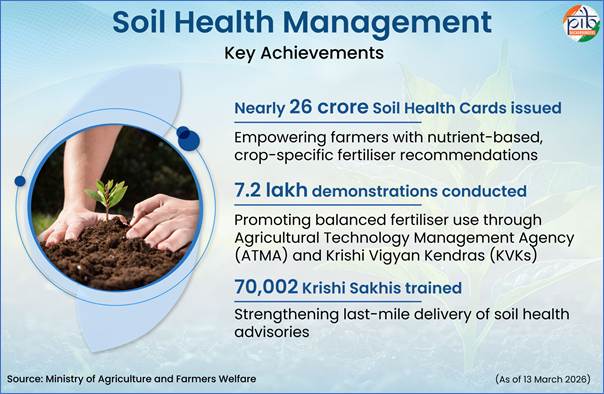
As of 13 March 2026, a total of 25.89 crore Soil Health Cards have been generated since inception. Around 7.17 lakh demonstrations have been conducted to promote balanced fertiliser use. These demonstrations were conducted through advisories supported by the Agricultural Technology Management Agency (ATMA) and Krishi Vigyan Kendras (KVKs). In addition, 70,002 Krishi Sakhis have been trained to support the dissemination of soil health advisories at the grassroots level. The School Soil Health Programme has registered 4,430 schools and 1,29,167 students in 2025-26.
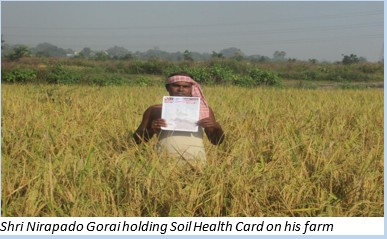
From Soil Testing to Higher Yields: A Farmer’s Experience Shri Nirapado Gorai, a farmer from Dhanbad district, Jharkhand, adopted Soil Health Card recommendations on his 3-acre farm. Prior to this, his nutrient management practices relied largely on nitrogen and phosphorus, with limited use of other essential nutrients. Based on the soil health advisory, he shifted to balanced fertiliser application, including potash and lime. He also applied urea in split doses at different stages of crop growth. This transition reduced fertiliser costs from Rs.1,910 to Rs.1,190 per acre, resulting in savings of Rs.720 per acre. At the same time, paddy yield increased from 1,000 kg to 1,320 kg per acre, along with visible improvement in plant health. Reflecting on the change, he observed less infestation of disease and insect pests. He observed that this was probably due to the judicious use of nitrogenous fertilisers and application of potash. |
Balanced Nutrient Management
India has taken significant steps to improve fertiliser management through reforms that promote efficiency and transparency.
The Nutrient Based Subsidy (NBS) scheme links subsidy support to the nutrient content of fertilisers, encouraging balanced nutrient application. Under this scheme, the government provides subsidies on 28 grades of Phosphatic and Potassic (P&K) fertilisers, including Diammonium Phosphate (DAP), to farmers at subsidised prices through fertiliser manufacturers and importers. The subsidy rates are notified separately for the two major cropping seasons. The Kharif season rates are applicable from 1 April to 30 September, while the Rabi season rates apply from 1 October to 31 March.
Aadhaar-linked Point of Sale (PoS) devices authenticate beneficiaries and enable real-time tracking of fertiliser sales. Under the Direct Benefit Transfer in Fertilisers system, subsidies are released based on actual sales through PoS devices. Fertiliser subsidy disbursements totalled Rs.6.77 lakh crore between 2022-23 and July 2025.
Neem-coated urea slows nitrogen release, improves nutrient-use efficiency, and reduces diversion for non-agricultural purposes. The Government mandated a 100 per cent neem coating on all domestically produced urea.
The Integrated Fertiliser Management System further strengthens monitoring and logistics, ensuring better control over fertiliser availability and use.
Khet Bachao Abhiyan: Promoting Balanced Fertiliser Use
To further strengthen balanced fertiliser use, the Government intensified awareness efforts through the Khet Bachao Abhiyan. The campaign promoted scientific nutrient management practices among farmers.
Led by Indian Council of Agricultural Research (ICAR) and the DA&FW, the campaign involved the entire National Agricultural Research, Education and Extension Systems (NAREES) and was held during June 1-30, 2026. It promoted soil test-based nutrient management so as to reduce overdependence on chemical fertilisers through camps, demonstrations, and farmer outreach activities. The campaign also raised awareness of alternative agricultural practices in low-rainfall conditions.
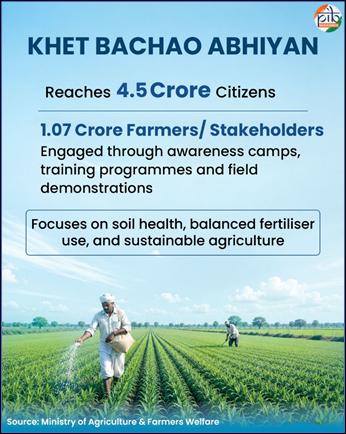
A total of 99,489 interaction meetings and events, 25,178 awareness camps were organised. In addition, 6,721 training programmes and 96,227 field demonstrations on green manuring and bio-fertilisers were conducted to promote balanced nutrient management. The campaign strengthened grassroots participation through 4,916 Janpratinidhi Sammelans, including fertiliser and input dealers. These activities directly engaged around 1.07 crore farmers/other stakeholders, and about 4.5 crore citizens through social media.
These reforms and awareness initiatives are strengthening balanced fertiliser use, improving nutrient efficiency, and supporting long-term soil sustainability.
Building a Digital Soil Ecosystem
India is advancing towards a data-driven approach to soil management by integrating geospatial mapping, digital platforms, and artificial intelligence.
Geospatial Soil Mapping and Resource Assessment
The Nationwide Soil Resource Mapping project, implemented by the Soil and Land Use Survey of India (SLUSI), is generating high-resolution soil profile maps. They combine satellite imagery with field observations to create village-level soil inventories. The inventories support scientific land use planning and informed crop selection.
As of September 2024, around 29 million hectares had been mapped. The target is 142 million hectares of agricultural land. To accelerate this effort, Rs.1,076 crore was provided to six States. These include Uttar Pradesh, Madhya Pradesh, Rajasthan, Maharashtra, Tamil Nadu, and Andhra Pradesh. The support is strengthening the creation of reliable soil resource datasets across regions.
Integrating Soil, Land, and Farmer Data
Digital technologies are transforming agricultural decision-making through integrated data systems and targeted advisory services. The Digital Agriculture Mission is building a unified data framework by linking soil information with land and crop datasets. Platforms such as AgriStack are enabling the integration of farmer, land, and soil data to support targeted advisory services. As part of this effort, as of 27 November 2025, over 7.63 crore Farmer IDs have been generated. During Rabi 2024-25, 23.5 crore crop plots were surveyed. This has enabled mapping soil information to individual land parcels, supporting more accurate, location-specific advisories.
AI and Precision Soil Management
Artificial intelligence is transforming soil management by converting complex data into actionable insights for farmers. Under the Digital Agriculture Mission, platforms such as the Krishi Decision Support System (KDSS) integrate soil, weather, and crop data. These platforms generate location-specific advisories for crop planning and nutrient management.
This integration of data and technology is improving soil assessment and supporting informed farm-level decisions.
- AI-based soil diagnostics use satellite imagery, remote sensing, and farm-level data to identify nutrient deficiencies. They also detect soil stress and support timely corrective action.
- AI-enabled precision farming supports site-specific application of water and fertilisers based on local soil conditions. This improves resource efficiency, reduces input costs, and minimises environmental impacts.
- AI-driven advisory systems help farmers make decisions on crop selection, sowing time, and nutrient management.
- Advances in agri-robotics are promoting operations such as analysis, planting, and field management. Technologies, including autonomous tractors, use GPS, cameras, and AI for greater precision. Institutions such as ICAR–Indian Agricultural Research Institute are also developing robotic systems for sampling and crop monitoring.
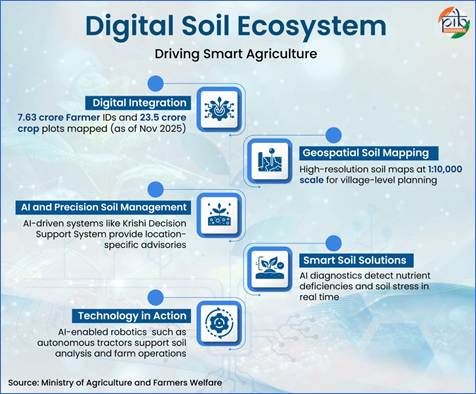
These advancements are enhancing precision, improving productivity, and strengthening the foundation for sustainable and climate-resilient agriculture in India.
Unlocking the Potential Beneath Our Feet
Soil remains one of India’s most valuable natural resources, sustaining agriculture, livelihoods, and food security. Scientific assessment, sustainable farming practices, and improved nutrient management are strengthening its long-term health. Through initiatives such as the Soil Health Card Scheme, NMSA, NMNF, and Green India Mission, the country is promoting scientific and sustainable soil management.
Efforts to improve soil health have encouraged balanced nutrient use, enhanced resource efficiency, carbon storage, and supported climate-resilient farming. At the same time, geospatial mapping, artificial intelligence, and digital agriculture platforms are enabling more precise and data-driven farm decisions. As awareness grows through efforts such as the Khet Bachao Abhiyan, India is steadily unlocking the true potential of soil as a critical national resource.
References
Cabinet
https://www.pib.gov.in/PressReleasePage.aspx?PRID=2250032
Ministry of Agriculture & Farmers Welfare
https://www.pib.gov.in/PressReleaseIframePage.aspx?PRID=2007523®=3&lang=2
https://soilhealth.dac.gov.in/files/Manual/Updated_140723FinalDraftManualClasses6_8.pdf
https://www.pib.gov.in/PressReleseDetailm.aspx?PRID=2074728®=3&lang=2
https://www.agriwelfare.gov.in/Documents/AR_Eng_2024_25.pdf
ICAR-Indian Agricultural Research Institute, Indian Farming 75 (12): 49-52; December 2025
https://sansad.in/getFile/loksabhaquestions/annex/1710/AU964.pdf?source=pqals
https://www.pib.gov.in/PressReleasePage.aspx?PRID=2244625
https://www.pib.gov.in/PressReleasePage.aspx?PRID=2037660®=3&lang=2
https://www.pib.gov.in/PressReleasePage.aspx?PRID=2239789®=3&lang=2
https://soilhealth.dac.gov.in/school
https://www.pib.gov.in/PressReleaseIframePage.aspx?PRID=2222808®=3&lang=2
https://soilhealth.dac.gov.in/files/Five%20Success%20Stories%20of%20Farmers.pdf
https://www.pib.gov.in/PressReleasePage.aspx?PRID=2264122®=3&lang=1
https://www.pib.gov.in/PressReleasePage.aspx?PRID=2262471®=3&lang=2
https://www.pib.gov.in/PressReleaseDetail.aspx?PRID=2267236®=3&lang=1
Ministry of Chemicals and Fertilizers
https://www.pib.gov.in/PressReleseDetailm.aspx?PRID=2148437
Ministry of Finance
https://www.indiabudget.gov.in/economicsurvey/doc/eschapter/echap06.pdf
https://www.pib.gov.in/PressReleasePage.aspx?PRID=2219915®=1&lang=1
https://dbtbharat.gov.in/success-story/view?id=NA==
Ministry of Environment and Forests
https://moef.gov.in/uploads/2017/08/GIM_Mission-Document-1.pdf
https://moef.gov.in/uploads/2018/04/NAP_E.pdf
https://www.pib.gov.in/PressReleasePage.aspx?PRID=2086742®=48&lang=2
PIB Backgrounders
https://www.pib.gov.in/PressReleasePage.aspx?PRID=2245639®=3&lang=2
https://www.pib.gov.in/PressNoteDetails.aspx?NoteId=155036&ModuleId=3®=3&lang=2
https://www.pib.gov.in/PressNoteDetails.aspx?NoteId=158761&ModuleId=3®=48&lang=1
United Nations