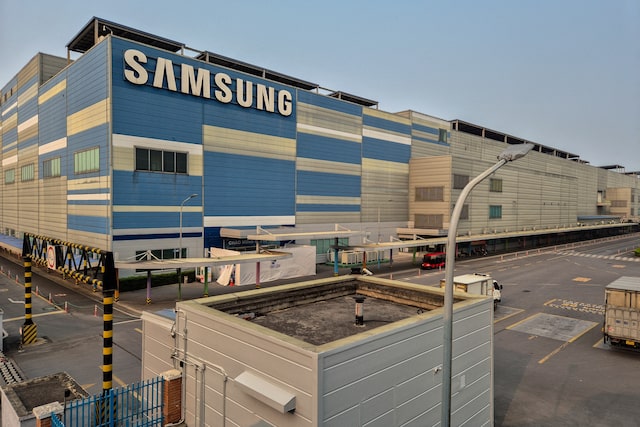
A view of a Samsung Electronics Vietnam factory in Bac Ninh province, Vietnam, April 3, 2025. Vietnam, with a tariff rate of 46 per cent imposed by U.S. President Donald Trump, is one of six countries in the nine Southeast Asian region slapped with much bigger-than-expected by the U.S. REUTERS.
Seoul, July 29 (Reuters) – Shares in Samsung Electronics (005930.KS), came under pressure on Tuesday, following a powerful rally the previous day after the South Korean technology company clinched a $16.5 billion deal to supply artificial intelligence chips to Tesla (TSLA.O).
Analysts said the deal could bolster the technology company’s unprofitable contract manufacturing business, but Samsung faces challenges in securing additional large customers both for logic chips and memory chips where it struggles against TSMC (2330.TW), and SK Hynix (000660.KS).
“This new deal breathes some much-needed life into the business and may signal the start of a turning point for Samsung, but its memory business will need to make considerable progress too,” Ben Barringer, global technology analyst at Quilter Cheviot, said.
Samsung Electronics, the world’s top memory chip maker, has suffered delays in supplying the latest high-bandwidth memory (HBM) chips to key U.S. customer Nvidia (NVDA.O), a setback that has dented its profits and weighed on its stock.
In its “foundry” or contract manufacturing business, where it manufactures logic chips designed by customers, Samsung remains a distant second to market leader TSMC.
“Whether this will open the door for additional large customers will depend heavily on its execution,” Barringer said.
Shares of Samsung recovered to around flat by midday on Tuesday, versus the broader market’s 0.6% gain. The shares were down more than 2 percent earlier in the session.
FAVORABLE TERMS
Tesla CEO Elon Musk said late on Sunday that Samsung’s new chip factory in Taylor, Texas, would make the auto company’s next-generation AI6 chips, likely to be used in self-driving cars, humanoid robots and data centers, without elaborating on the timing of the production.
The deal comes as Samsung has struggled to win major customers for its new Texas factory, partly due to low production yields of its cutting-edge chips.
“There also has to be a chance that the company was able to strike the long-term deal on favourable terms, given that Samsung needed to prove its contract manufacturing capabilities,” said Russ Mould, investment director at AJ Bell.
The long-term supply deal for a key technology from a U.S. factory would “lessen the risk of supply-chain dislocations or tariff friction,” he said.
“Samsung now needs to prove it can deliver in the right volume to the right quality for what is likely to be a demanding customer.”
While the deal is “more about securing the longer-term future, we won’t see these in cars for at least a year or two,” said Matt Britzman, senior equity analyst at Hargreaves Lansdown.
Reporting by Hyunjoo Jin in Seoul Zaheer Kachwala in Bengaluru, Jihoon Lee in Seoul; Editing by Ed Davies and Jacqueline Won