Five Years of Strengthening India’s Cooperative Movement
India’s Cooperative Journey: Rooted in Collective Growth
India’s cooperative movement is deeply rooted in the philosophy of Vasudhaiva Kutumbakam, the belief that the world is one family. Cooperatives have long served as institutions of shared ownership, mutual support, and inclusive development. From rural credit to dairy, fisheries, housing, and marketing, cooperatives have enabled millions to access markets, finance, and livelihoods. Established on July 6, 2021, the Ministry of Cooperation reflects the government’s commitment to unlocking the cooperative sector’s transformative potential by strengthening institutions and making them future-ready.
Advancing Digital and Institutional Reforms
The 5th Foundation Day of the Ministry of Cooperation was celebrated on July 6, 2026, at Bharat Mandapam, New Delhi. The occasion marked significant progress in strengthening India’s cooperative ecosystem through a series of major digital and infrastructure initiatives. This included the key highlight of the transformation of 50,000 Primary Agricultural Credit Societies (PACS) into e-PACS.
The programme also witnessed the laying of foundation stones for 47 grain storage godowns to enhance cooperative storage infrastructure. A Milk Supply Review Dashboard Portal for the National Dairy Development Board was launched to improve management of milk procurement and distribution. Additionally, two flagship initiatives of the National Urban Cooperative Finance and Development Corporation (NUCFDC) were unveiled – Sahakar CBS and Sahakar Sahyogi. Sahakar CBS is a centralized Core Banking Solution for Urban Cooperative Banks. Sahakar Sahyogi is a conversational AI-powered platform designed to enhance customer services and banking operations.
Strengthening Cooperatives through Structural Reforms
Over the last five years, the government has driven transformative reforms to strengthen India’s cooperative ecosystem. These reforms have focused on making cooperatives more inclusive, transparent, digitally empowered, and economically vibrant. These efforts have enabled cooperatives to emerge as stronger engines of grassroots prosperity and inclusive socio-economic growth. Over 152 major initiatives have been launched since the establishment of the Ministry of Cooperation. These initiatives have modernized traditional cooperative institutions while creating new opportunities for growth and diversification.
1. Revitalizing PACS: From Credit Institutions to Rural Growth Centres
Primary Agricultural Credit Societies (PACS) form the grassroots foundation of the short-term cooperative credit structure. They are actively functioning as multi-service institutions that serve as the first point of contact for rural economic services.
Key progress made for serving PACS, as of June 2026, is:
- Model bye-laws enable PACS in 32 states/UTs to undertake 25+ business activities
- PACS now functions beyond credit, covering retail, storage, healthcare, fuel, and digital services
- 394 PACS have applied for retail fuel outlets, and 3 outlets have been commissioned
- 39,177 PACS are functioning as PM Kisan Samriddhi Kendras
- 54,117 PACS are functioning as Common Service Centres
- 4,248 PACS are approved for Jan Aushadhi Kendras; 843 are ready to function
This diversification has improved access to essential services at the village level.
2. Digital Transformation of PACS
Technology has become central to strengthening cooperative governance and efficiency. Following progress has been made in the digitalization of PACS, as of June 2026:
- Total financial outlay has been increased to ₹2,925.39 crore in 2025 from the initial allocation of ₹2,516 crore in 2022
- The timeline for computerization of 63,000 PACS is up to March 31, 2027
- 79,630 PACS sanctioned; 63,428 PACS are currently using ERP software
- Hardware delivered to more than 65 thousand PACS
- Online audits completed in more than 42,700 PACS
- ERP software is made available in 14 languages
Digitization of PACS has significantly improved transparency, accounting, and service delivery.
3. Expanding Grassroots Cooperative Coverage
The government has focused on ensuring that every panchayat is connected to the cooperative institutions:
- 37,454 new multipurpose PACS, dairy & fisheries cooperative societies registered so far
- PACS present in more than 2.55 lakh Gram Panchayats
- Dairy cooperatives cover more than 87,159 Gram Panchayats
- Fisheries cooperatives cover more than 29,964 Gram Panchayats
This expansion is strengthening cooperative access in underserved regions.
4. Building Rural Infrastructure through Cooperatives
The government is also implementing the world’s largest decentralized grain storage plan through cooperatives:
- Godowns completed in 145 PACS
- Storage capacity created: more than 68,702 MT
This initiative helps reduce post-harvest losses and improve farmer incomes by enabling local storage and better market timing.
5. Strengthening Farmer-Producer Institutions (FPOs)
Cooperatives are being integrated with modern farmer collectives for better aggregation and market access:
- 1,863 FPOs formed in the cooperative sector
- 1,117 FPOs formed through PACS
- 1,070 Fisheries FPOs formed and ₹98 crore disbursed for their benefit
This is improving market linkage, processing, and farmer income realization.
6. Tax Relief & Ease of Doing Business
Policy reforms have also improved the financial health of cooperatives. Key tax relief measures introduced for cooperatives are:
- Surcharge reduced from 12% to 7% for cooperatives having income between ₹1-10 crore
- Minimum Alternative Tax (MAT) reduced from 18.5% to 15%
- TDS cash withdrawal limit raised from ₹1 crore to ₹3 crore
- Higher cash transaction limits for PACS & Primary Cooperative Agriculture and Rural Development Banks
These measures have increased liquidity and reduced compliance burden.
7. White Revolution 2.0
The cooperative dairy sector is being strengthened under White Revolution 2.0 with a focus on increasing milk procurement by 50% by 2028-29.
- 25,282 dairy cooperative societies have been registered so far
- Focus is on women-led dairy cooperatives and wider cooperative coverage
8. New National Cooperative Institutions
To strengthen sector-specific growth, three new national multi-state cooperative institutions have been established, and their progress has been recorded so far:
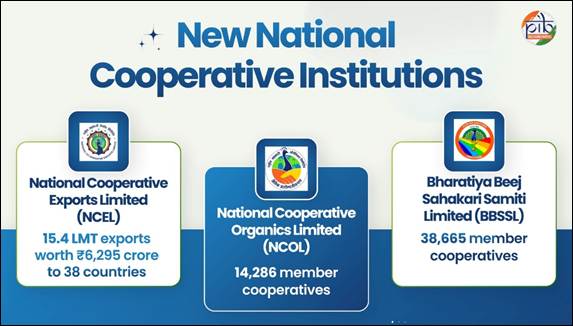
- National Cooperative Exports Limited (NCEL): NCEL serves as an umbrella organization for exporting surplus goods/services produced by various cooperative societies across the country. NCEL recorded 15.4 LMT exports worth ₹6,295 crore to 38 countries as of June 2026.
- National Cooperative Organics Limited (NCOL): NCOL acts as an umbrella organization for aggregation, procurement, certification, testing, branding, and marketing of organic products. It has 14,286 member cooperatives as of June 2026.
- Bharatiya Beej Sahakari Samiti Limited (BBSSL): BBSSL undertakes the production, procurement, and distribution of quality seeds under the brand name “Bharat Beej” through the cooperative network. It has 38,665 member cooperatives as of June 2026.
9. Capacity Building and Cooperative Education
The government is strengthening cooperatives through education and institutional development.
Tribhuvan Sahkari University (TSU) has been established as India’s first cooperative university.
The University supports education, research, and skill development in the cooperative sector.
Training programmes are conducted through the National Council for Cooperative Training (NCCT) and NABARD. These initiatives strengthen governance, leadership, and operational efficiency in cooperatives.
National Cooperative Development Corporation: Driving Investments
The National Cooperative Development Corporation (NCDC) has played a major role in financing the growth of cooperatives. During FY 2025-26, NCDC has sanctioned ₹1.55 lakh crore and disbursed ₹1.27 lakh crore. It has also disbursed ₹2,320 crore to FPOs/Cluster-Based Business Organizations (CBBOs) under the scheme for Formation and Promotion of 10,000 FPOs, as of May 2026. This sustained financing is accelerating cooperative expansion across sectors.
Bharat Taxi: India’s First Cooperative-based Mobility Platform
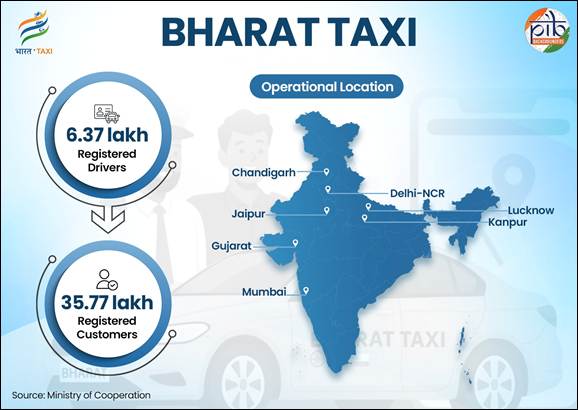
Bharat Taxi is an initiative of Sahakar Taxi Cooperative Limited. Sahakar Taxi Cooperative Limited is a driver-centric mobility platform based on the cooperative model. It aims to economically empower drivers while offering affordable, safe, and reliable transport services to the public.
At present, Bharat Taxi has 6.37 lakh registered drivers and 35.77 lakh registered customers. The service is operational in Delhi-NCR, Gujarat, Lucknow, Chandigarh, Mumbai, Jaipur, and Kanpur. Operations are planned to be launched in Ranchi, Patna, Guwahati, Bhopal, Kolkata, Indore, and Nagpur in the next few months.
Cooperatives Powering Viksit Bharat
In five years, the Ministry of Cooperation has transformed cooperatives into engines of inclusive growth. Stronger institutions, improved service delivery, and broader digital adoption have enhanced grassroots impact. Expanded infrastructure and better market access have strengthened rural economies. Women and farmers now have greater opportunities through cooperative-led development.
As India advances on its path of inclusive and sustainable development, cooperatives will continue to foster equitable growth and resilience. Guided by the vision of “Sahkar Se Samriddhi,” the cooperative movement continues to build a resilient, self-reliant, and prosperous India.
References
Ministry of Cooperation
https://cooperation.gov.in/en/about-primary-agriculture-cooperative-credit-societies-pacs
https://www.pib.gov.in/PressReleasePage.aspx?PRID=2146717®=48&lang=2
https://www.pib.gov.in/PressReleasePage.aspx?PRID=2241955®=3&lang=1
https://www.pib.gov.in/PressReleasePage.aspx?PRID=2214633®=3&lang=2
https://www.pib.gov.in/PressReleasePage.aspx?PRID=2201729®=3&lang=1
https://www.pib.gov.in/PressReleasePage.aspx?PRID=2281327®=48&lang=1
https://sansad.in/getFile/annex/270/AU4161_Yqq3fo.pdf?source=pqars
PIB Backgrounder
https://www.pib.gov.in/PressNoteDetails.aspx?NoteId=156980&ModuleId=3®=22&lang=13
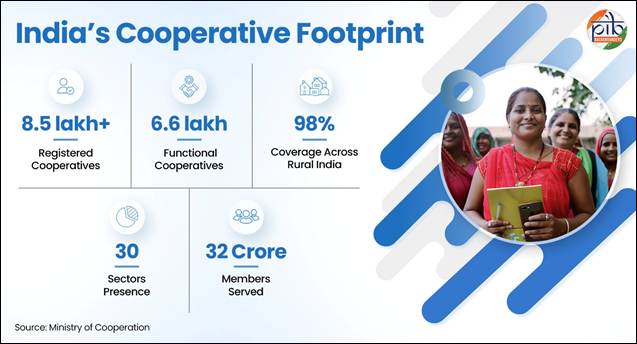
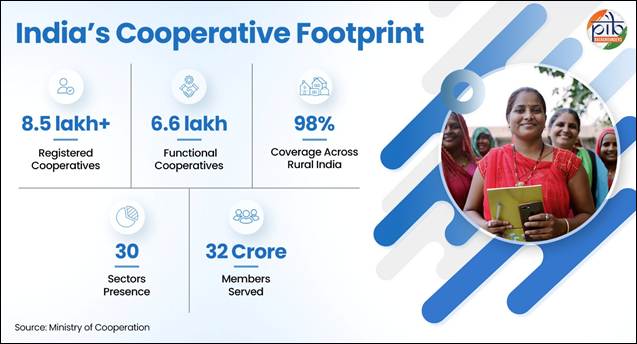
Cooperatives in India: Scale at a Glance
India today has one of the largest cooperative ecosystems in the world, spanning nearly every sector of the economy. These institutions form the backbone of grassroots economic participation, linking farmers, dairy producers, fishers, artisans, and workers to income opportunities.