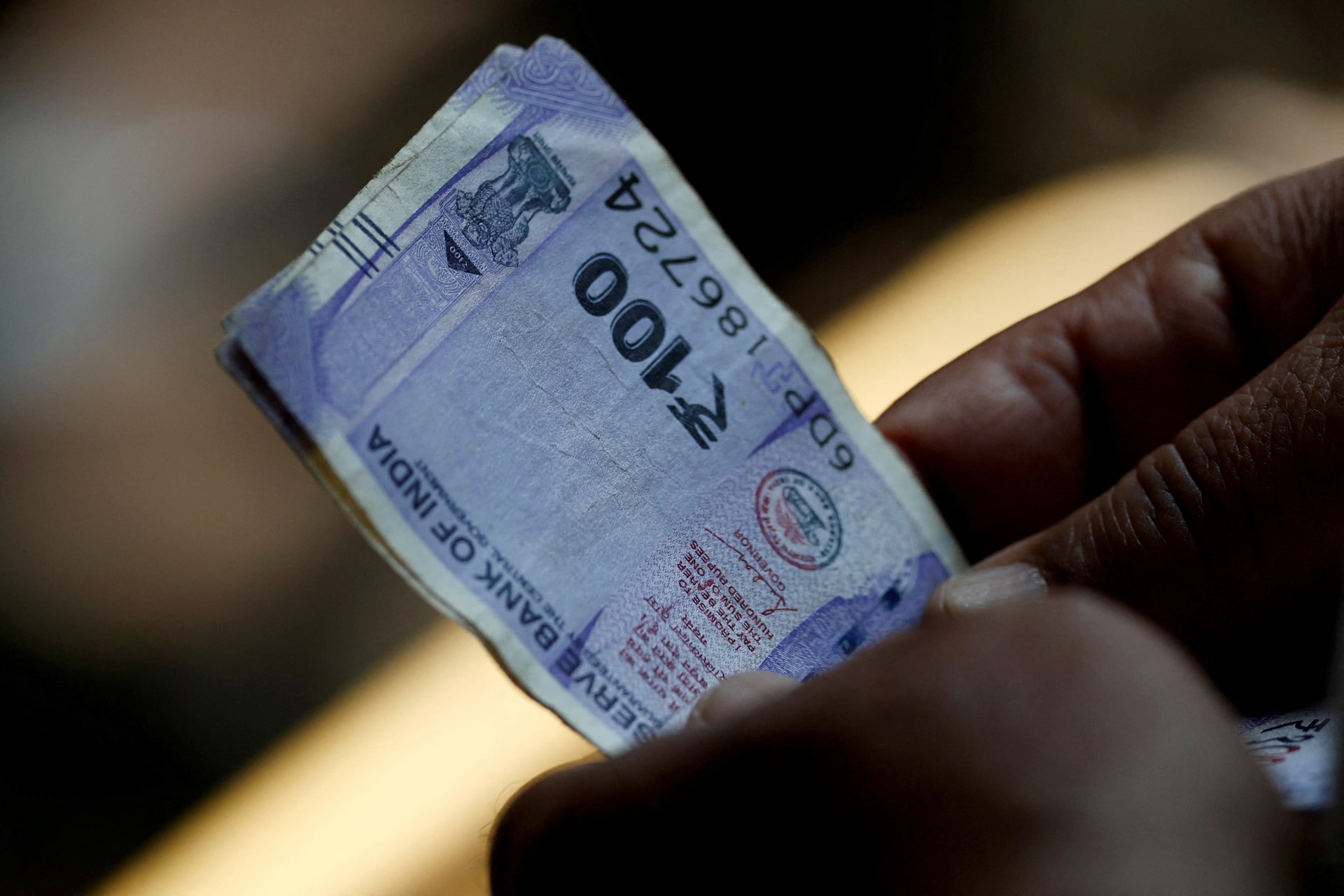
A customer holds hundred rupees Indian currency notes near a roadside currency exchange stall in New Delhi, India, May 24, 2024. REUTERS
MUMBAI, Feb 16 (Reuters) – The Indian rupee on Monday is expected to draw support from a broadly struggling dollar and anticipated Reserve Bank of India intervention, while weak domestic equities and patchy flows are likely to weigh.
The 1-month non-deliverable forward indicated the rupee will open largely unchanged from 90.6350 on Friday.
After rallying on the U.S.-India trade deal, which took the rupee to 90 per dollar from an all-time low of near 92, the currency has since come back under pressure.
Persistent dollar demand from importers at lower dollar/rupee levels for hedging, erratic equity flows and what bankers have said are one-time dollar payments have combined to keep the rupee under strain.
The RBI stepped in aggressively last week, surprising bankers, to alleviate headwinds from flows and curb potential speculative positioning.
Most bankers said the intervention was likely aimed at signalling a preferred zone for the currency, indicating that the RBI does not want the rupee to slip past the 91 level at this stage.
“Unless equity flows stabilise, dips (on dollar/rupee) are likely to be bought into,” a currency trader at a mid-sized private sector bank said.
“The bias is for a slow move higher rather than a breakdown, which is quite evident from price action.”
While equity flows turned more supportive of the rupee in the immediate aftermath of the U.S.-India trade deal, they have remained largely erratic.
Foreign investors sold more than $800 million worth of Indian shares on Friday, according to preliminary data, underscoring the fragility of sentiment. Domestic equities fell about 1% on the day.
DOLLAR, U.S. YIELDS
The dollar index dipped slightly on Friday, extending its weekly decline after softer-than-expected U.S. inflation data strengthened expectations that the Federal Reserve could cut interest rates later this year.
Moves were more pronounced in U.S. Treasuries, where the two-year yield fell to its lowest level since 2022, a development that does not bode well for the dollar, analysts say.
Reporting by Nimesh Vora; Editing by Harikrishnan Nair