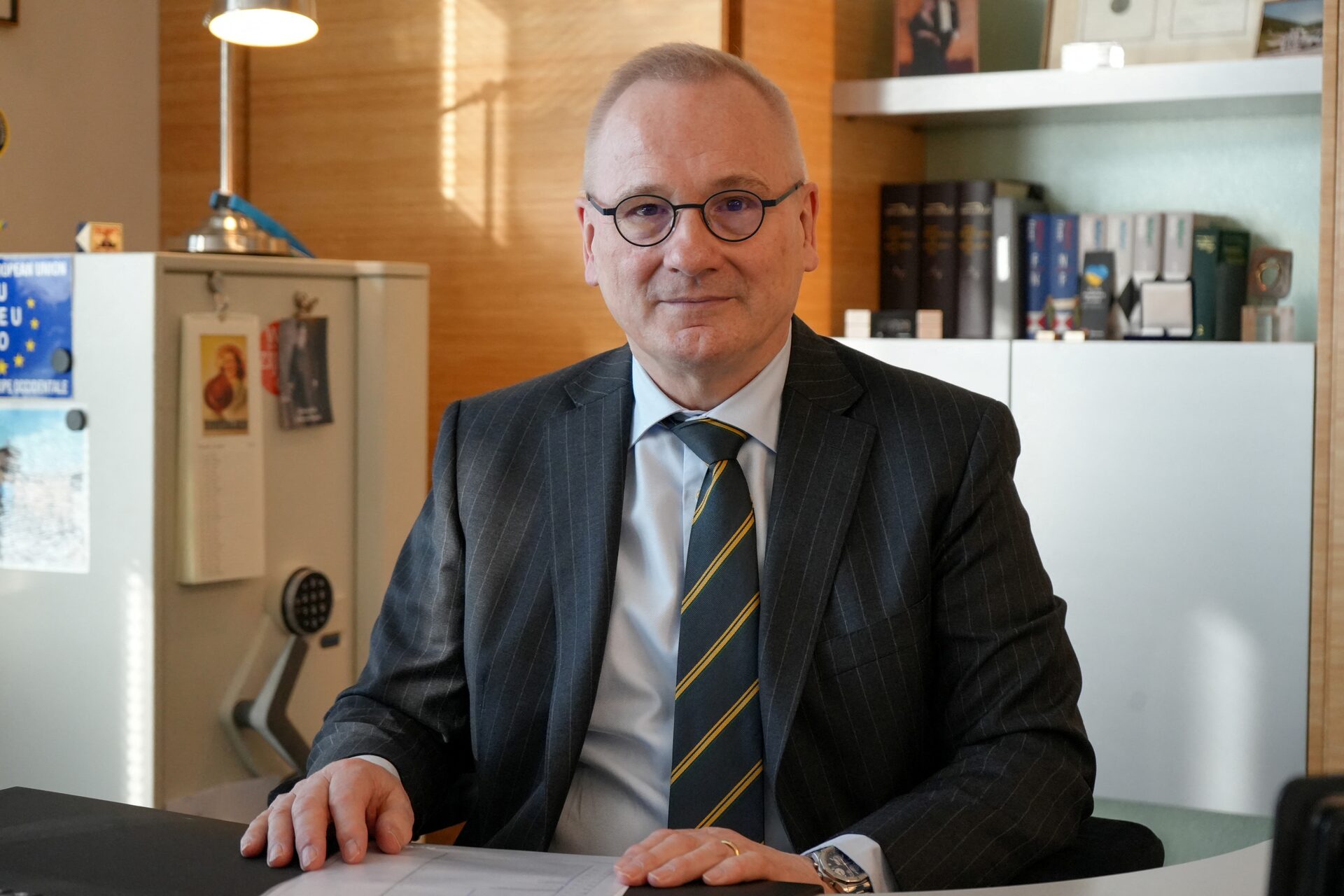
Robert in den Bosch, the Disarmament Ambassador and Permanent Representative to the Conference on Disarmament of the Kingdom of the Netherlands in Geneva, and Chair of the Convention on Certain Conventional Weapons Group of Governmental Experts on Emerging Technologies in Lethal Autonomous Weapons Systems, sits at a desk in his office in Geneva, Switzerland February 25, 2026. REUTERS
GENEVA, March 3 (Reuters) – Progress on a potential international framework to prohibit and restrict Lethal Autonomous Weapons Systems (LAWS) is urgently needed, as talks on the matter in Geneva enter a crucial phase, their chair said.
From this week to the mandate’s end in September, 128 states will discuss whether to agree by consensus a non-binding text that could pave the way for future negotiations on prohibitions and regulations on LAWS.
Since 2014, more than a hundred states party to the Convention on Certain Conventional Weapons have met in the Swiss city to discuss banning LAWS that do not comply with existing international law while regulating others.
“If we wait then it almost gets to a stage where you’re too late… We will be overtaken by technological developments,” Robert in den Bosch, the Dutch Disarmament Ambassador in Geneva and Chair of the CCW Group of Governmental Experts on LAWS, told Reuters.
There are mounting concerns over the role of AI-assisted semi-autonomous weapons that have been used in conflicts in Ukraine, Sudan, Gaza, and in Iran and the Gulf.
While states agree international humanitarian law (IHL) applies to LAWS, specific internationally binding standards for these systems remain virtually non-existent.
Russia and the United States, among others, oppose new legally binding instruments, arguing existing laws suffice.
In den Bosch stated that others say new rules are needed to bridge supposed accountability gaps in IHL, which place obligations on states and individuals, not on machines.
The Rolling Text under discussion in Geneva proposes “context appropriate human judgment and control” as a measure to ensure that systems that “identify, select and engage” targets without human intervention comply with IHL.
Despite growing calls for urgent regulation, U.N. Secretary-General Antonio Guterres’ deadline for agreeing a legally binding instrument on LAWS this year will realistically be missed, In den Bosch said.
While the deadline is outside the Geneva talks’ remit, the challenge of securing consensus on even non-binding elements underscores the difficulty of making progress, In den Bosch stated.
The talks are set within a challenging context of geopolitical tensions and recent European withdrawals from the landmine ban treaty over Russian threats.
The Review Conference of the CCW in November could decide to launch negotiations for a binding protocol after the Geneva talks end. However, in the absence of agreement, there is a risk some countries might pursue a breakaway treaty elsewhere, In den Bosch stated.
Reporting by Olivia Le Poidevin; Editing by Saad Sayeed