
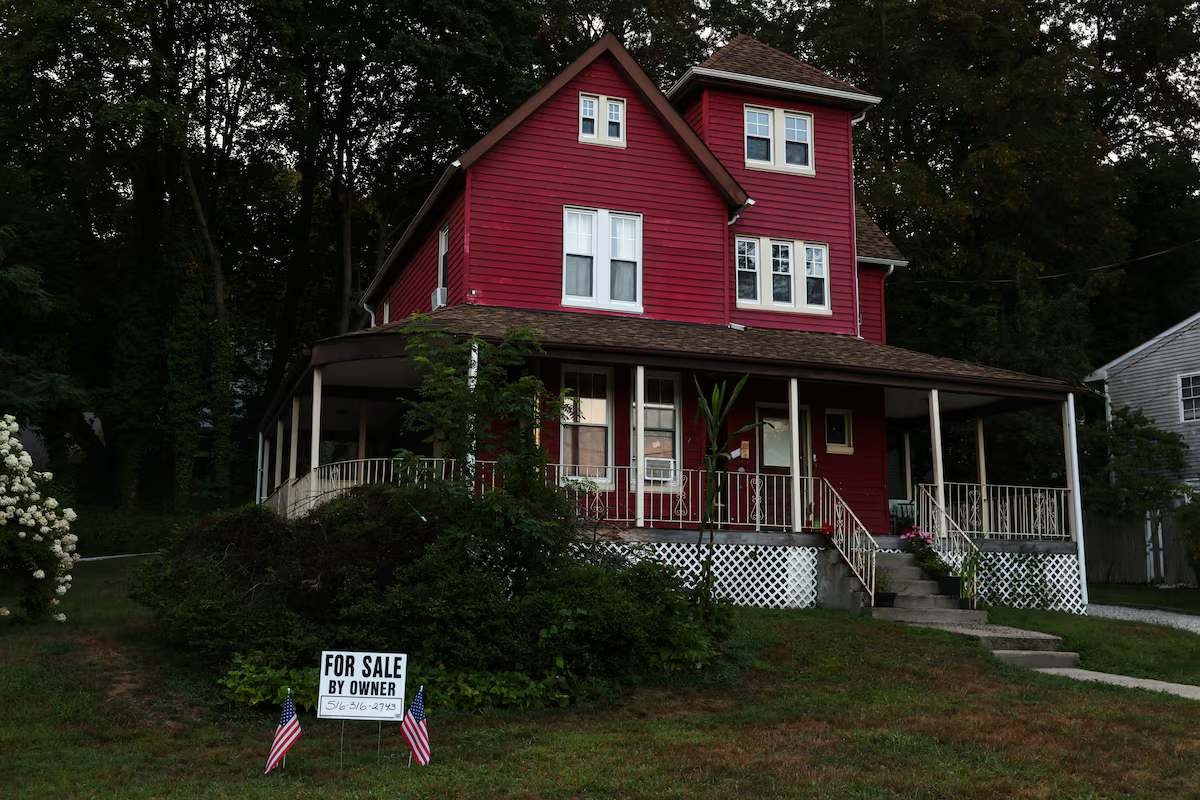
A “For Sale” sign stands in front of a house, on the North Shore of Long Island city of Glen Cove, New York, U.S., August 12, 2025. REUTERS
NEW YORK, (Reuters) – (This was originally published in the On The Money newsletter, where we share U.S. personal finance tips and insights every other week. Sign up here to receive it for free.)
Owning a home may be a cornerstone of the American dream, but it has been out of reach for many Americans.
According to Coldwell Banker’s new 2025 American Dream Report, 71% of aspiring homeowners are delaying major life decisions until they can afford to buy a home.
Cost-of-living concerns are top of mind as President Donald Trump’s poll numbers weakened in recent months. The economy, the impact of tariffs and ongoing frustration about inflation are some of the key reasons why Americans voted Democrats into office in New Jersey, Virginia and New York City.
The Trump administration is looking for new ways to boost housing affordability with a plan to introduce a 50-year mortgage.
Here is how it works: Making mortgage payments over five decades spreads the principal payments and can ease cash flow. On a $400,000 loan with 6.5% fixed annual percentage rate, your payment over 50 years is about $2,255 per month. By contrast, on a typical 30-year mortgage, you would pay about $2,528 per month. That works out to a savings of roughly $270 per month.
But over time you’ll be paying much more while increasing risks. The interest on a 50-year mortgage works out to about $953,000 versus $510,000 for the 30-year loan.
“Over the long run, the math decidedly does not work in your favor,” said Matt Schulz, chief consumer finance analyst at LendingTree.
“Sure, the monthly payment is likely to be lower, but that smaller payment will likely be accompanied by a higher interest rate, far more interest paid over the life of the loan, and far slower equity growth than you’d find with shorter-term mortgages.”
Home equity is an important factor in financial security, said Jeff DerGurahian, loanDepot’s chief investment officer and head economist.
“With a 50-year mortgage, you won’t build equity until well after 10 years into the life of the loan,” DerGurahian said.
That means you will not have much equity buildup if you need to sell or another major life event – such as a divorce or new job – impacts your finances.
In addition, the median age of first-time homebuyers now in the U.S. is 40.
“To be fair, Americans are living longer … but that also means you will be 90 by the time you pay off a 50-year mortgage,” said Carrie Lysenko, chief executive officer of Zoocasa, a real estate brokerage.
IS THE AI BUBBLE ABOUT TO POP?
Markets have for months marched past worries over elevated interest rates, stubborn inflation, trade turmoil and a patchy global economy leading to questions about whether the artificial intelligence boom is a bubble waiting to burst.
High-flying AI stocks tumbled in recent weeks. And the World Economic Forum, chief warns that AI is one of three possible ‘bubbles’ in the global economy, along with crypto and public debt.
But expert opinions about a pending AI bust are split.
What if the AI investment craze goes wrong? How will it impact you?
By Lauren Young; editing by Patricia Reaney