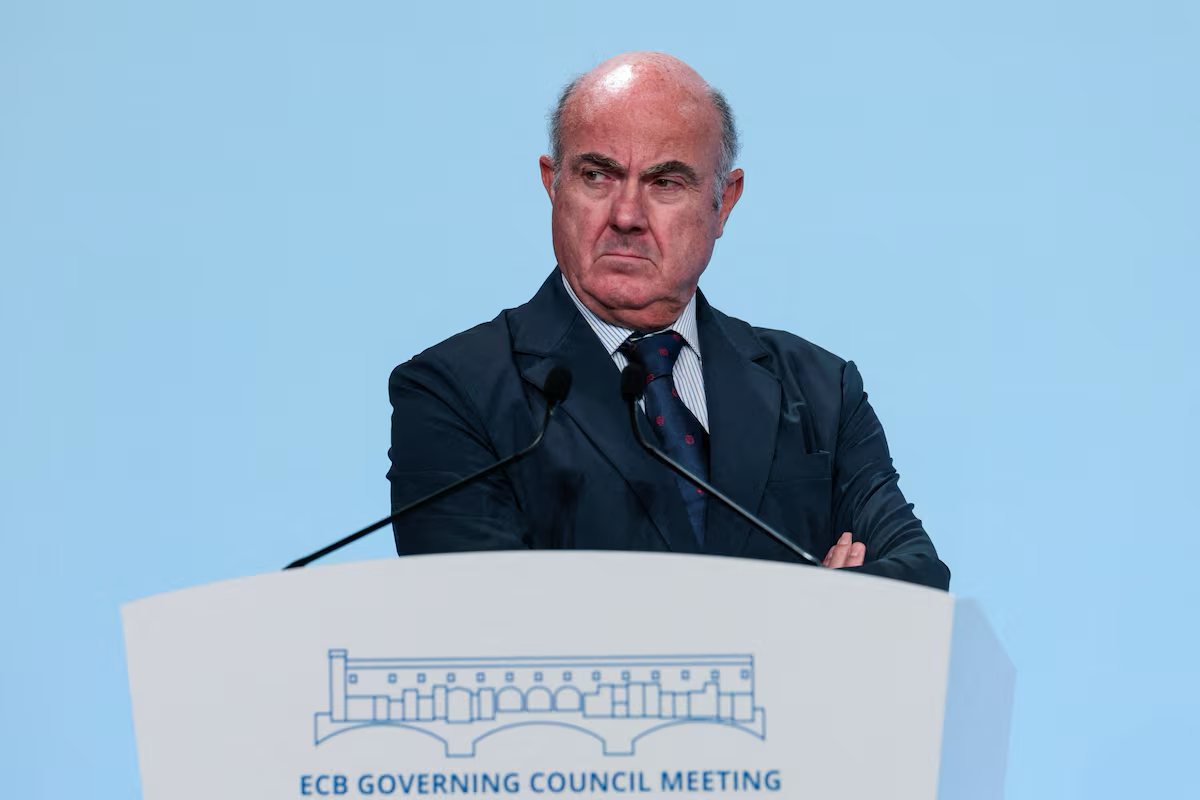
European Central Bank (ECB) Vice-President Luis de Guindos looks on at a press conference following the Governing Council’s monthly monetary policy meeting in Florence, Italy, October 30, 2025. REUTERS
FRANKFURT, March 26 (Reuters) – Euro zone banks have limited direct exposure to the war in the Middle East, but the conflict could still generate systemic stress given interconnected vulnerabilities, European Central Bank Vice President Luis de Guindos said on Thursday.
Financial markets have come under stress in recent weeks from the impact of the U.S. and Israeli war on Iran, but the selloff outside the Middle East has been limited, even as some assets remain overvalued.
“Spillovers to the euro area financial sector have so far remained contained,” de Guindos said in a speech. “Direct bank exposures to the region are limited, and the banking system is well positioned with strong profitability and robust capital and liquidity buffers.”
De Guindos argued that even market infrastructure operators, like central counterparties whose services include energy markets, have managed margin requirements effectively, despite the volatility.
Still, there was a broader risk, given interconnections in the financial system, said de Guindos, whose roles at the ECB include monitoring financial stability.
“Amid already elevated global uncertainty, this conflict could trigger the unravelling of interconnected vulnerabilities and cause systemic stress,” he said.
The conflict threatens to derail market sentiment at a time when asset valuations are high, potentially leading to a sharp repricing of risk for leveraged borrowers and sovereigns while amplifying stress in the non-bank financial sector, he said.
On the ECB’s core mandate of ensuring low inflation, de Guindos repeated the bank’s warning that inflation could rise and growth slow on the conflict but argued more time was needed to understand the full impact.
“We are unwavering in our commitment to ensuring that inflation stabilises at our 2% target in the medium term,” he said.
Reporting by Balazs Koranyi; Editing by Toby Chopra