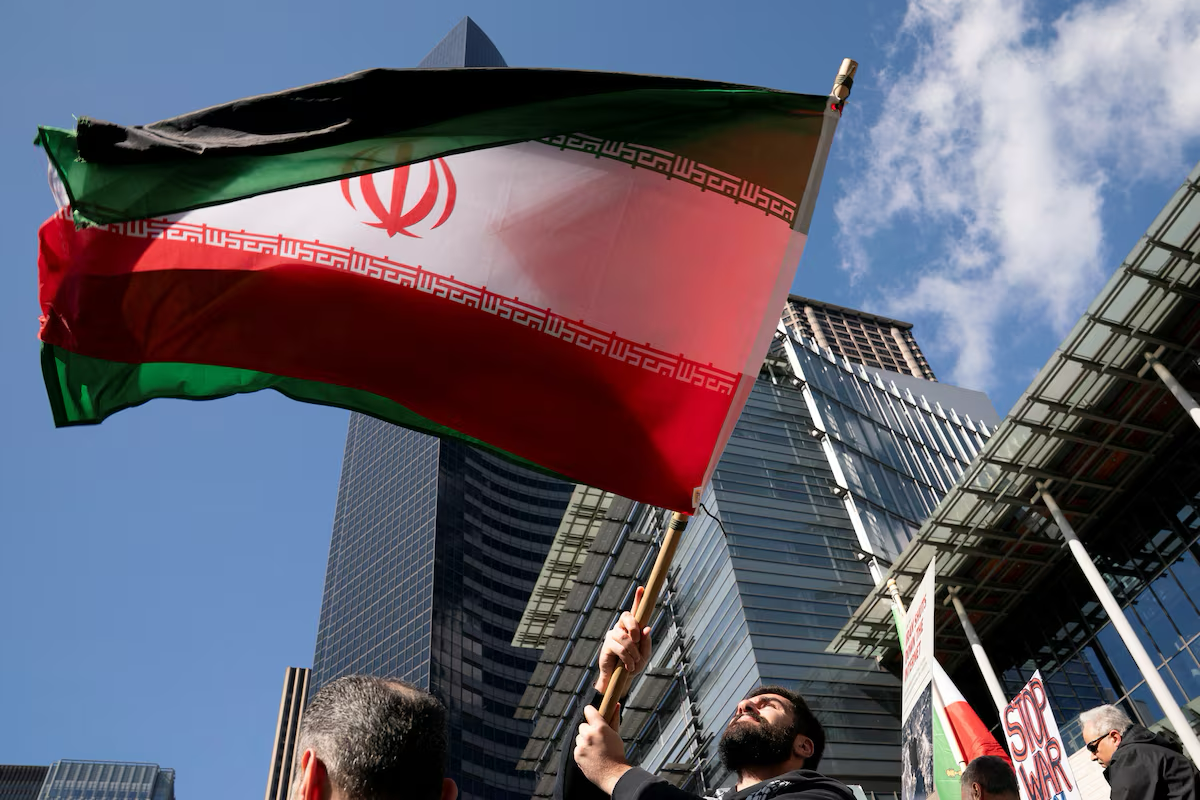
A demonstrator waves an Iranian flag during a “No War on Iran” rally outside of City Hall in Seattle, Washington, U.S., April 7, 2026. REUTERS
April 8 (Reuters) – U.S. President Donald Trump said on Tuesday that he had agreed to a two-week ceasefire with Iran, less than two hours before his deadline for Tehran to reopen the Strait of Hormuz or face widespread attacks on its civilian infrastructure.
Oil dived, bonds rallied and stocks surged as the ceasefire was seen as paving the way for a lasting peace and resumption of Gulf oil and gas exports.
Below are some reactions from investors and analysts:
SAUL KAVONIC, HEAD OF ENERGY RESEARCH, MST MARQUEE, SYDNEY:
“This provides an off ramp for Trump’s overly bombastic ultimatum, but not yet an off ramp for oil markets or the war. It is unlikely the shut in oil and LNG production will resume until there is more confidence in a lasting ceasefire.
“A two week ceasefire would enable a release of some oil and LNG tankers from the Strait of Hormuz to market, providing some market pressure relief in May. This does not result in more production, just a release of storage on water.”
“Even if a peace deal is reached, the market will (be) between 3 million bpd to 5 million bpd tighter for the next few years compared to pre-war expectations, due to damage to oil and oil product export infrastructure that will take months or even years to fix.”
SHINGO IDE, CHIEF EQUITY STRATEGIST AT NLI RESEARCH INSTITUTE, TOKYO:
“This time, it was not just a unilateral announcement from the U.S. side or from Trump. The fact that Pakistan is acting as an intermediary gives it a certain degree of credibility.
“I think there is growing hope that, if things continue this way beyond those two weeks, it could effectively transition into a real ceasefire.
“That said, there is still a considerable gap between what the United States and Iran are thinking … And what Israel is aiming for is on an entirely different level. I think there is still a long way to go before those three parties can reach an agreement in a form that all of them would accept.”
KYLE RODDA, SENIOR MARKET ANALYST, CAPITAL.COM, MELBOURNE:
“This is the Grande TACO the markets were hoping for. It’s a huge development which could mark a major turning point for the markets. Obviously in this world things are liable to swing violently on another headline. But the re-opening of the Strait is huge, with oil prices likely having seen their high-water mark. There’ll be ripple effects because of this crisis. But we’ve probably seen peak escalation and volatility.”
PRASHANT NEWNAHA, SENIOR RATES STRATEGIST, TD SECURITIES, SINGAPORE:
“A renewed escalation cannot be ruled out, but markets are treating this ceasefire as the real deal and all parties involved will sell the ceasefire as a major win. Risk assets and bonds should rally as the worst-case scenario has been avoided.
“Looking further out, oil prices are not returning to pre-war levels. This will leave inflation persistence as a key theme for markets to ponder. This is likely to put a brake at some point on the rally in front-end rates we are currently seeing.”
RAY ATTRILL, HEAD OF FX STRATEGY, NATIONAL AUSTRALIA BANK, SYDNEY:
“A lot has to happen in the next 14 days. Markets still need to proceed with a degree of scepticism that Iran is fully accepting, leaving markets vulnerable to a retracement.
“I don’t think anybody’s going to be trading on an ultimate resolution of the Middle East issue (and) there will be concerns about how much the oil price will come down. We know it’ll take several months or more to restore what’s been damaged. $90 is a very different story to an oil price of $75-85.”
CHARU CHANANA, CHIEF INVESTMENT STRATEGIST, SAXO, SINGAPORE:
“This is a positive de-escalation signal for markets, especially with Hormuz reopening, as it reduces the immediate oil shock and supports risk sentiment.
“From here, the key questions are whether talks keep progressing during this two-week window, how quickly energy flows and shipping activity normalise in practice, and whether insurers and tanker operators regain enough confidence for Hormuz to function smoothly again. That will determine whether this remains just a relief rally or starts to look more like a durable de-escalation.”
JAMIE COX, MANAGING PARTNER, HARRIS FINANCIAL GROUP, RICHMOND, VIRGINIA:
“Markets have been predicting that Trump was looking for an off-ramp in Iran. Today, he got one and took it.
“Markets have been inching higher over the last week due to an increase in tough talk, which usually precedes the inevitable twist to reach a deal.”
BESA DEDA, CHIEF ECONOMIST, WILLIAM BUCK, SYDNEY:
“Some cautious optimism in markets is likely, as this is the first meaningful ceasefire since hostilities began. However, investors will remain aware that it may not hold. The hope is that it does, limiting the risk of a deeper economic impact.
“Even if the ceasefire ultimately leads to a resolution, damage to refineries and infrastructure will take time to repair and normalise. But it’s far better than a prolonged impact.”
ANDREW LILLEY, CHIEF RATES STRATEGIST, BARRENJOEY, SYDNEY:
“We still have a long way to get back to where we were before this began. The worry now is the markets are unsure of the extent to which the oil price is going to get back to $75.
“This little precipice where actually oil is flowing, no one has a shortage, but it stays at an equilibrium price of $90, that is actually where you remove the tail risk that central banks are cutting.
“It’s kind of the scenario that results in permanently high yields because we’re going to have damaged infrastructure and a sticky high oil price for months to come, which means that we are going to get higher inflation.”
GEORGE BOUBOURAS, HEAD OF RESEARCH, K2 ASSET MANAGEMENT, MELBOURNE:
“Restocking energy supplies is the key over the next week as the conflict can reignite very quickly. This decreases the probability of a recession particularly if more oil, gas, fertiliser can flow in the next week or so. Markets are always pragmatic and not complacent as they are looking through the conflict and valuations remain compelling on a one-year view.”
MARTIN WHETTON, HEAD OF FINANCIAL MARKETS STRATEGY, WESTPAC, SYDNEY:
“This is what happens all the time. Does it mean people are going to take new risks? No, it doesn’t.
“It would have to actually be a lasting peace (to change things). People aren’t actually taking risk. This is algos doing stuff.”
BRIAN JACOBSEN, CHIEF ECONOMIST, ANNEX WEALTH MANAGEMENT, MENOMONEE FALLS, WISCONSIN:
“President Trump said he agreed to a two-week ceasefire. That’s enough to keep hopes alive that not only will an entire civilization NOT be destroyed, but we could see oil start flowing through the Strait of Hormuz.
“Is it just kicking the can down the road, moving the goal posts, TACO Tuesday, or whatever metaphor we’d like, to only to have tempers flare and bombs drop again? Who knows? But it’s good enough for now to elicit a positive response from the markets.”
Reporting by Tom Westbrook, Ankur Banerjee, Gregor Stuart Hunter and Tony Munroe in Singapore and by Satoshi Sugiyama in Tokyo; Editing by Sumeet Chatterjee