India’s Maritime Agenda for a Sustainable Ocean Economy
Key Takeaways
- Maritime India Vision 2030 is a catalyst for trade, investment, and employment, charting India’s course toward economic growth and global competitiveness
- Amrit Kaal Vision 2047 allocates nearly ₹80 lakh crore for green shipping & maritime growth.
- The Sagarmala Programme comprises 840 projects worth ₹5.8 lakh crore under implementation by 2035.
Introduction
The idea of Green Maritime in India grew from the need to make port operations safer, cleaner, and more sustainable. As global HSE (Health, Safety, and Environment) standards gained importance, Indian ports recognized that efficiency must go hand in hand with environmental protection and workers’ welfare. India has a long coastline with mangroves, lagoons, coral reefs, and beaches. It is rich in biodiversity and marine life, supporting many coastal communities but these coastal areas face growing pressure from trade and development. To manage this responsibly, Indian ports, as obligated entities under Renewable Purchase Obligations (RPOs), must focus on renewable power and adhere to the International Maritime Organization’s alignment with 9 UN Sustainable Development Goals for safe, efficient, and sustainable ports. This shift has made it essential for ports to adopt renewable energy, improve air and water quality, expand green cover, and enhance waste management. Building safe, sustainable, and green ports is now central to India’s effort to protect its environment while supporting economic growth.[1]
The Ministry of Ports, Shipping and Waterways (MoPSW) chalked out the Maritime India Vision 2030 which are the blueprint towards empowering India’s maritime sector and enabling it to become greener, cleaner and sustainable.[2]The future of maritime transport lies in clean fuels like green hydrogen, ammonia, biofuels, and LNG. In this direction, India’s National Green Hydrogen Mission is paving the way for zero-emission fuels, ensuring that our ports are not just fueling trade, but also fueling a sustainable future.[3]
The National Green Hydrogen Mission: It was launched by the Government of India to cut carbon emissions and make India a global leader in green hydrogen. By 2030, the goal is to produce 5 million tonnes of green hydrogen every year, bringing in ₹8 lakh crore investments, creating 6 lakh jobs, and saving ₹1 lakh crore in fossil fuel imports. The mission focuses on production, pilot projects, electrolyser manufacturing, skill training, infrastructure, and research, with plans to replace fossil fuels in steel, transport, and fertilizer sectors. To push this forward three major ports namely Kandla, Paradip and Tuticorin ports have been identified by MoPSW to be developed as Green Hydrogen hubs.[4]
Maritime India Vision 2030 & Amrit Kaal 2047: India’s Green Maritime Roadmap
- India’s maritime sector is entering a decisive decade, with new laws, mega projects, and global investment ambitions shaping the Maritime India Vision 2030. With a strong focus on green technologies and digital innovation, India is preparing to not only meet its trade demands but also emerge as a maritime leader. The MIV 2030 projects a total investment of INR 3–3.5 lakh crore across ports, shipping, and inland waterways. Backed by a recent landmark package of ₹69,725 crore to boost shipbuilding and revitalise the maritime ecosystem, India is charting a strategic course to leverage its vast coastline to anchor itself firmly on the global maritime map.
- Building onto this foundation is the Maritime Amrit Kaal Vision 2047, a long-term roadmap for India’s maritime resurgence, with investments of nearly ₹80 lakh crore earmarked for ports, coastal shipping, inland waterways, shipbuilding, and green shipping initiatives. The government is driving sustainable maritime operations by setting up green corridors, introducing green hydrogen bunkering at major ports, and promoting the use of methanol-fueled vessels. Outlining more than 300 actionable initiatives it projects India’s rise as one of the world’s top maritime and shipbuilding powers by the centenary of independence.[5]
India’s Green Port Initiatives[6]
The Central Government is planning the following steps to make Indian ports greener and more sustainable:
- Solar Energy: Ports need to assess land, rooftop and calm waters availability to install solar panels. There are two ways to develop captive solar power assets:
1. Usage of rooftops of offices, warehouses and other unusable land.
2. Shallow port water surfaces can be used to develop floating PV assets. Floating PV is rapidly gaining commercial acceptance.
- Wind Energy: Indian Ports to increase adoption of wind energy evaluating both onshore and offshore wind farms.
- Identify feasible areas for onshore wind farms across port land, shallow waters, and breakwaters.
- Set up windmills PPP with private wind producers and other mechanisms.
- Leverage offshore windfarms potential at southern tip of the Indian Peninsula, offshore regions around the Port of Okha, and vast salt fields of Kuchh region.
- Launching tidal energy pilot project in Gujarat (Gulf of Cambay or Kutch) to harness 8,000–12,000 MW potential power generation.
- Explore solar thermal in future to offset grid power where direct sunlight is high.
- Test wave energy using Oscillating Water Column Converter in existing coastal structures, building on Vizhinjam pilot by National Institute of Ocean Technology.
Flagship Initiatives and Programmes powering India’s Green Maritime Economy
Through initiatives like the ‘Harit Sagar Green Port Guidelines’, 2023, ‘National Green Hydrogen Mission, 2023’, and the ‘Green Tug Transition Programme’, 2024, the nation is transforming its ports and shipping industry into beacons of sustainability. The recently announced ₹25,000 crore Maritime Development Fund aims to catalyze investments in green infrastructure, alternative fuels, and fleet modernization, ensuring that India remains a leader in decarbonization.[7]
- Harit Sagar Green Port Guidelines and Green: These Guidelines act as a guiding tool for decision making in ensuring sustainability in development and operation of the Port and establishing frameworks towards attaining carbon neutrality with zero disturbance to the ecosystem dynamics of the surrounding aquatic and atmospheric environment. The guidelines promote use of sustainable materials, practices and technologies.[8]
- Green Tug Transition Programme (GTTP): The Green Tug Transition Program (GTTP) as a key initiative under the ‘Panch Karma Sankalp’. This landmark initiative is set to drive the transition from conventional fuel-based harbour tugs to greener, more sustainable alternatives, marking a major step in India’s commitment to environmental sustainability and the advancement of its maritime sector. This program not only aligns with country’s environmental goals but also strengthens India’s commitment to ‘Make in India,’ promoting domestic innovation and manufacturing in the maritime industry.[9]
The ‘Panch Karma Sankalp,’ announced in May 2024, includes five major announcements focusing on green shipping and digitization: MoPSW will provide 30% financial support for promoting green shipping under the Green Tug Transition Programme, Jawaharlal Nehru Port, VO Chidambaranar Port, Paradip Port, and Deendayal Port will procure two green tugs each; Deendayal Port and VO Chidambaranar Port, Tuticorin will be developed as Green Hydrogen Hubs; a Single Window Portal will be established to facilitate and monitor river and sea cruises; and Jawaharlal Nehru Port and VO Chidambaranar Port, Tuticorin will be transformed into smart ports .[10]
- Harit Nauka (Green Vessel) Initiative: The Harit Nauka guidelines for inland vessels have been launched which aim to promote adoption of greener technologies in inland waterway vessels.[11]
- Coastal Green Shipping Corridor: A Coastal Green Shipping Corridor will be established, with the Kandla-Tuticorin corridor being the 1st to be developed in partnership with SCI, Deendayal Port Authority (DPA) and V. O. Chidambaranar Port Authority (VoCPA).[12]
- Sagarmala Programme: A flagship initiative to transform India into a global maritime hub is a core pillar of the MIV 2030 and Maritime Amrit Kaal Vision 2047. The programme focuses on cutting logistics costs, enhancing trade efficiency, and creating employment through smarter and greener transport networks. Under its sphere, 840 projects worth ₹5.8 lakh crore are being implemented by 2035, with 272 projects worth ₹1.41 lakh crore completed and 217 projects worth ₹1.65 lakh crore in progress.[13]
Cleaner Ports: Cutting Emissions Through Green Tech & Practices[14]
Indian ports are switching to clean fuels, shore power, electric equipment, LNG, and green belts to cut emissions and meet sustainability goals.
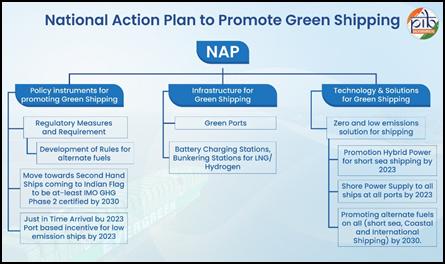
- Clean Fuels to reduce vehicle emissions at ports: Indian Ports have targeted to achieve 50%vehicle switch towards cleaner fuels – CNG, LNG and Electricity by 2030.

- Reducing Air Emissions by Ships inside Port Ecosystem: Ships stay at berth for hours running cranes, AC, and other equipment, causing big emissions. Shore-to-ship power gives clean energy from land, cutting:
- Port Equipment Electrification: Battery or electric drive trains offer better eco nomics than diesel engines. Hence, many global ports are opting for electrification of all equipment to reduce environmental impact and simultaneously lower operations costs. Indian Ports shall drive a 2-phased pan-India electrification program aimed to achieve more than 50% electrified material handling equipment by 2030:
- Phase I: Cranes used for transferring material from Shore to Ship and vice versa
- Phase II: Equipment moving cargo at port area e.g. RTGCs, reach stackers, straddle carriers, fork- lifts, etc
- LNG Bunkering: The changing over of small port crafts/trucks and Ships to LNG are a step forward worth considering facilities of road delivery of LNG and bunkering facilities available in India. Phase I: Awareness for LNG vessels. Leading global ports in Europe, Asia and America have been actively implementing LNG bunkering. Widely known advantages of LNG fuel are as follows:
- Lower emission of C02, PM and NO- 80% lower than diesel
- Limits Sulphur content in marine bunkering to 0.5%- complying to IMO norms
- 40%-50% cheaper than diesel
- Dust Emissions Management: Air emissions at Indian ports mainly come from container handling of dry bulk material and diesel consumption, while dust emissions arise from storage and handling of bulk materials like coal and iron ore. Diesel uses ranges from 500 KL to 5000 KL per year per port, releasing hazardous emissions like CO2 and CO. Leading ports use efficiency enhancement techniques to reduce air and dust emissions, and Indian ports have started monitoring emissions with potential to implement automatic monitoring at all ports.
- Green Belt: Indian ports are developing green belts to capture fugitive emissions, reduce noise, and improve aesthetics. The major benefits of green belts include supporting biodiversity, maintaining microclimate, retaining soil moisture, controlling erosion, protecting coasts, recharging groundwater, and absorbing pollutants like CO₂. MoEF&CC mandates 33% green area (including landscaping) around ports to control air and noise pollution. Current coverage varies from 3% to 36%; most ports struggle due to land constraints. All ports must increase green belts near material handling areas within 5 years, use alternative available land if needed, and discuss new flexible land options with MoEF&CC.
Ports Bill 2025: Modern Law for Global Green Leadership

Indian Ports Bill, 2025: With the Indian Ports Bill, 2025, India moves from catch-up mode to global maritime leadership. New Law Mandates Global Green Norms, Disaster Readiness for Indian Ports. India’s maritime sector has expanded dramatically over the past 10 years. Cargo handling at major ports hit a record 855 million tonnes in FY 2024–25, compared to 581 million tonnes in FY 2014–15. Port capacity rose nearly 87 percent in the same period. Average turnaround time for ships has been halved to 48 hours, matching global benchmarks. Coastal shipping volumes got more than doubled, rising by 118 percent, while cargo movement on inland waterways jumped nearly sevenfold. Indian ports are gaining global recognition, with nine featuring in the World Bank’s Container Port Performance Index. Yet, industry leaders had long called for a modern law to replace the outdated 1908 framework.[15]
India’s Global Green Maritime Partnerships & Dialogues
India is building global partnerships and hosting key dialogues to drive green, digital, and sustainable maritime growth.
- Sagarmanthan: Sagarmanthan offers a premier platform for global leaders, policymakers, and visionaries to share insights and shape the future of the marine sector. With critical themes spanning the blue economy, global supply chains, maritime logistics, and sustainable growth, the dialogue aims to chart a bold, actionable course for a vibrant and future-ready maritime ecosystem. Its structure revolves around four interconnected themes, each addressing critical challenges and opportunities shaping the future of the oceans[16].

Four Central Themes are:
- Green & Digital Maritime Corridors Dialogue at JNPA, Mumbai: The Jawaharlal Nehru Port Authority (JNPA) and the Indian Ports Association (IPA), under the aegis of MoPSW, organized the “Leaders’ Dialogue on Green & Digital Maritime Corridors” in Mumbai in August, 2025. JNPA was significant for charting a course towards “greener, smarter, more connected corridors. The day-long dialogue featured thematic sessions on maritime reforms, infrastructure achievements, and international cooperation, followed by panel discussions on resilient and sustainable maritime economic corridors.[17]
India-Singapore: Under, Central Government, the bilateral relations with Singapore have expanded across sectors. The India–Singapore Green & Digital Shipping Corridor will accelerate the adoption of low-emission technologies, strengthen digital tools, and transform maritime operations. The collaboration in green shipping, renewable energy, and maritime innovation will accelerate the transition to a sustainable future.[18]
- Green Shipping Conclave, Mumbai: The conclave focused on India’s commitment to advancing sustainability in the maritime sector, in alignment with international decarbonization goals. Union Minister of Ports, Shipping, and Waterways, emphasized initiatives like the GTTP and Harit Nauka (Green Vessel). India is also developing Green Gateways with the Harit Sagar Green Port Guidelines and is leading global efforts in sustainable ship recycling through the Alang Ship Recycling Program.[19]
India’s Strategic Framework for Green Shipping and Marine Pollution Control[20]

India today is laying down a robust strategic framework for green shipping and marine pollution control:
- India’s robust Oil-Spill Response Planning by Ports:
- Indian Ports focus on developing robust oil-spill response plans (e.g., Spill Control and Emergency Management Plan) in collaboration with other stakeholders such as the Navy.
- Indian Ports initiate satellite-image-based monitoring systems to maximise detection and monitoring of oil-spill incidents.
- Indian Ports build oil-sensitivity maps to guarantee fast and effective oil-spill response operations.
- Indian Ports prioritise environmentally-sensitive areas/receptors (e.g., mangroves, corals, aquaculture projects, beaches) in their oil-spill response planning.
Conclusion
India stands poised at the threshold of a transformative maritime era – one that harnesses its vast coastline, growing industrial capacity and strategic position to not only advance trade and connectivity but also cement a legacy of sustainability and resilience. Through visionary programmes, legislative reforms and green-shipping initiatives, the country is rewiring its maritime ecosystem for the future: cleaner ports, low-emission fleets, smart infrastructure and inclusive opportunity. As India charts its course toward 2047, it is doing so not just as a rising maritime power, but as a responsible steward of the seas, a globally competitive economy and a partner committed to the well-being of the planet.