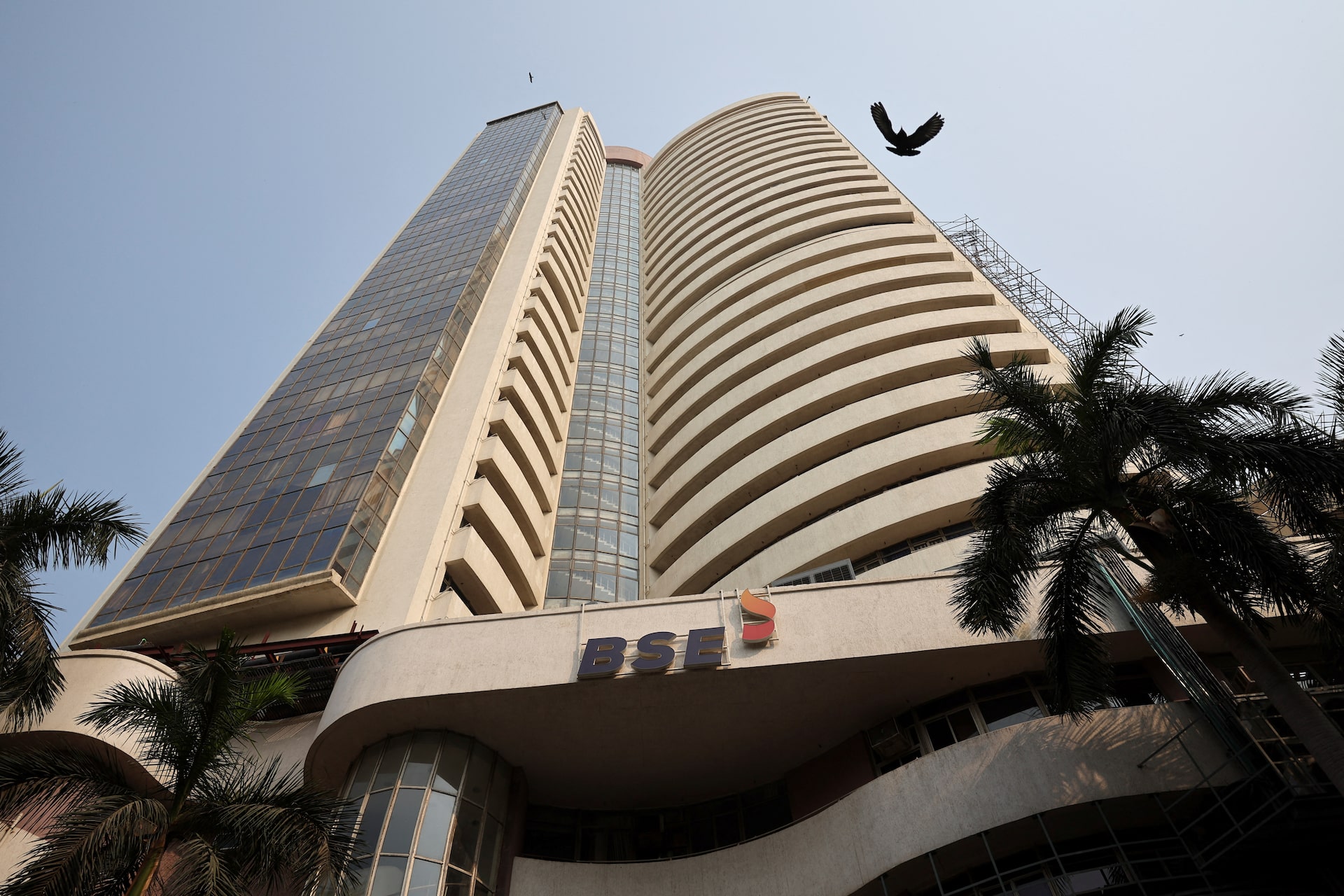
A bird flies near the Bombay Stock Exchange (BSE) building in Mumbai, India, April 3, 2025. REUTERS
March 9 (Reuters) – Indian shares are set to slide on Monday after oil prices surged nearly 20% in early trade to their highest since July 2022, as the widening U.S.-Israeli war with Iran stoked fears of tighter supplies and prolonged disruption through the Strait of Hormuz.
India, the world’s third-largest crude importer, faces renewed inflation risks, pressure on the fiscal deficit, higher input costs for companies and added strain on the rupee.
GIFT Nifty futures were at 23,811 at 7:37 a.m. IST, pointing to a 2.6% drop at the open for the Nifty 50 (.NSEI), opens new tab from Friday’s close of 24,450.45.
Other Asian stocks fell 4.7%, while Wall Street and European futures also slid as the inflationary shock from surging crude threatened to lift living costs and potentially interest rates worldwide. Safe-haven demand kept the U.S. dollar firm.
Iraq and Kuwait have begun cutting oil output, adding to earlier liquefied natural gas reductions from Qatar, as the war blocked Middle East shipments.
Brent crude jumped as much as 19.8% to $111.04 a barrel, and was up 17% at $108.3 by 7:03 a.m. IST.
On Monday, Iran named Mojtaba Khamenei as successor to his father Supreme Leader Ali Khamenei, signalling that hardliners remain firmly in control a week into the conflict with the United States and Israel.
Israel said it struck Iranian commanders in Beirut early on Sunday, widening its campaign after days of attacks that have killed nearly 400 people.
Even if the conflict eases soon, consumers and businesses globally could face weeks or months of elevated fuel prices because of damaged infrastructure, disrupted logistics and higher shipping risks.
The conflict has already dragged the Nifty 50 and Sensex to their worst weekly performance in more than a year, with both benchmarks losing about 2.9% last week.
“Escalating Middle East tensions are battering sentiment, with broad-based selling and risk aversion likely across sectors,” said Pravesh Gour, senior technical analyst at Swastika Investmart.
Persistent foreign investor outflows and a weakening rupee were compounding the pressure, Gour said.
Foreign institutional investors sold shares worth 60.30 billion rupees ($653.57 million) on Friday, while domestic investors bought 69.72 billion rupees, according to provisional NSE data.
($1 = 92.2630 Indian rupees)
Reporting by Bharath Rajeswaran, Vivek Kumar M in Mumbai and Kashish Tandon in Bengaluru; Editing by Eileen Soreng