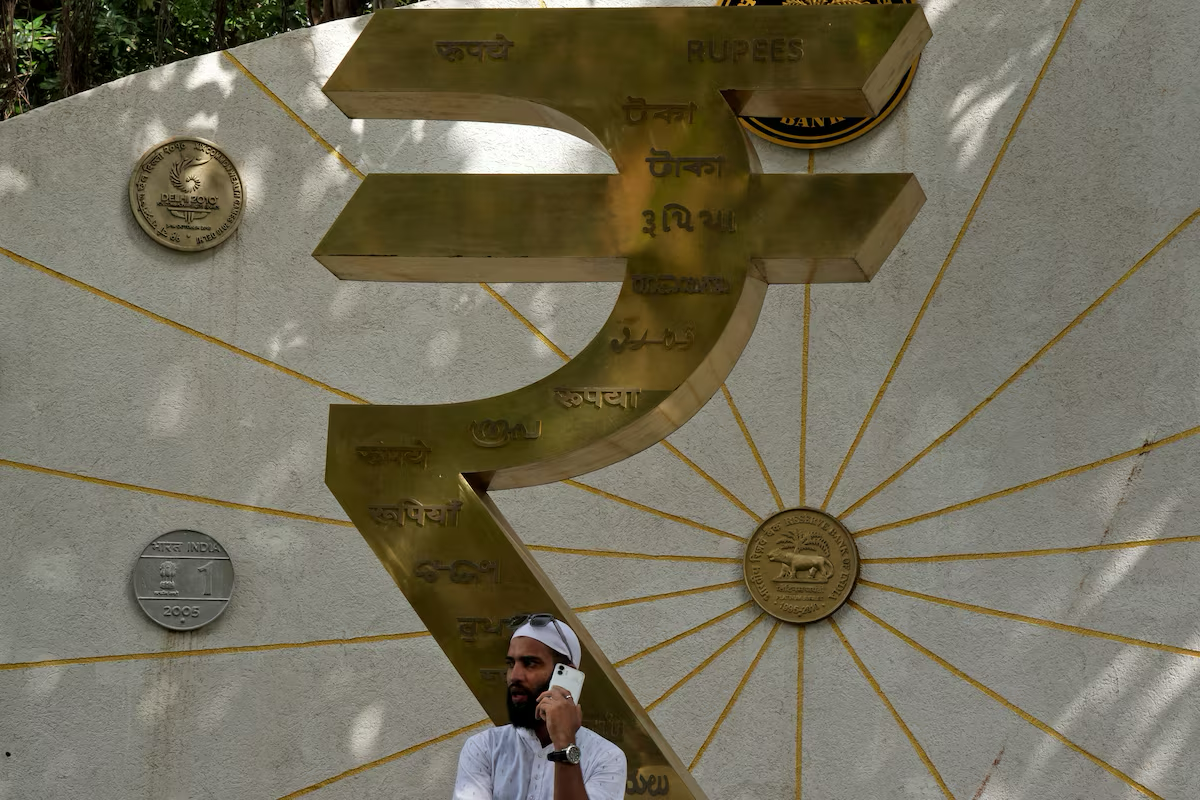
A man speaks on his mobile phone next to an installation of the Rupee logo and Indian currency coins outside the Reserve Bank of India (RBI) headquarters in Mumbai, India, August 1, 2025. REUTERS
MUMBAI, Dec 3 (Reuters) – The Indian rupee weakened past the key psychological level of 90 to the dollar on Wednesday, extending a rough patch as anaemic trade and sustained portfolio flows weighed in the absence of positive news on a trade deal with Washington.
By 9:40 a.m. (0410 GMT), the partially convertible rupee was trading at 89.9950/90.0050 per dollar, off a lifetime low of 90.14 earlier in the session.
SAT DUHRA, PORTFOLIO MANAGER, JANUS HENDERSON INVESTORS, SINGAPORE:
“The weak macro picture in India makes weak currency performance inevitable. There has been a slide in so many data points recently – rising trade deficits, weakening nominal GDP growth, weak FDI and foreigner selling down domestic equities, etc.
“However, while this has been happening for some time now. The recent tariff dispute with the United States has really accelerated the decline. Until this issue is resolved, with India now paying the highest U.S. tariffs globally, the pressure remains.”
ABHISHEK GOENKA, CEO, IFA GLOBAL, MUMBAI:
“A relatively weaker rupee would help soften the impact of the tariff differential with peers to some extent. The RBI, it seems, is adopting a more soft-touch approach to intervention, given that it is already considerably short in forwards, including NDF.
“It may therefore want to use its intervention power judiciously.”
CARL VERMASSEN, EM FIXED INCOME PORTFOLIO MANAGER, VONTOBEL ASSET MANAGEMENT, ZURICH:
“We think that recent INR-negative factors are more than sufficiently priced in. We welcome very much the actions of RBI to support the currency.
“Happy to see we are in good company deeming the INR undervalued. Regarding the sustainability of interventions, we should note that reserves are ample and the rise of gold and foreign reserve assets further reduces the net impact of the FX interventions.
The video player is currently playing an ad. You can skip the ad in 5 sec with a mouse or keyboard
“Moreover, the timing and scale of intervention suggests the RBI expects an India–US trade deal soon.”
BANK OF AMERICA ANALYSTS, IN A NOTE:
“The RBI’s management of FX volatility is again being relied upon to keep a lid on INR weakness.
“The RBI’s reserves remain adequate to contain risks of a larger depreciation for now.
“However, continued portfolio outflows could make these operations unsustainable or build-up of short USD positions on RBI’s forward book may skew return expectations on INR.
“We believe USD weakness next year should support mild INR appreciation and that could pick up pace around seasonally favourable Q1 for INR.
“We forecast INR to reach 86/USD by end-2026.”
DHIRAJ NIM, ECONOMIST AND FX STRATEGIST AT ANZ, MUMBAI:
“Not having a trade deal means they need to extend support to exporters and it seems like the central bank’s resistance to a weaker rupee has diminished.
“But still, it is known that the RBI does not like speculative build-ups or an overshooting of currency moves, so would expect the central bank’s interventions to be somewhat heavier now than the last few days.
“We expect the rupee to weaken to 91.30 by the end of next year, assuming status quo on U.S. trade tariffs, and views the risk it could happen sooner.”
SAKSHI GUPTA, PRINCIPAL ECONOMIST, HDFC BANK, MUMBAI:
“We accept that a favourable trade deal announcement before the end of 2025 could lead to some appreciation in the INR versus the USD. However, this is unlikely to trigger a sustained appreciation trend in the pair over the coming months.
“We also believe that the RBI might intervene and absorb any large dollar flows in this scenario (given the redemption of its rising short dollar forward book, last at $63.6 billion, as of October 2025.”
RADHIKA RAO, SENIOR ECONOMIST, DBS BANK, SINGAPORE:
“The recent intervention bias suggests that the currency will be allowed to find its equilibrium, to better reflect underlying macro shifts.
“The need to maintain the currency at competitive levels stems from the broader focus on manufacturing, unfavourable tariff differentials at this juncture and subdued portfolio flows outlook.”
Reporting by Jaspreet Kalra and Ankur Banerjee; Compiled by Swati Bhat; Editing by Clarence Fernandez