
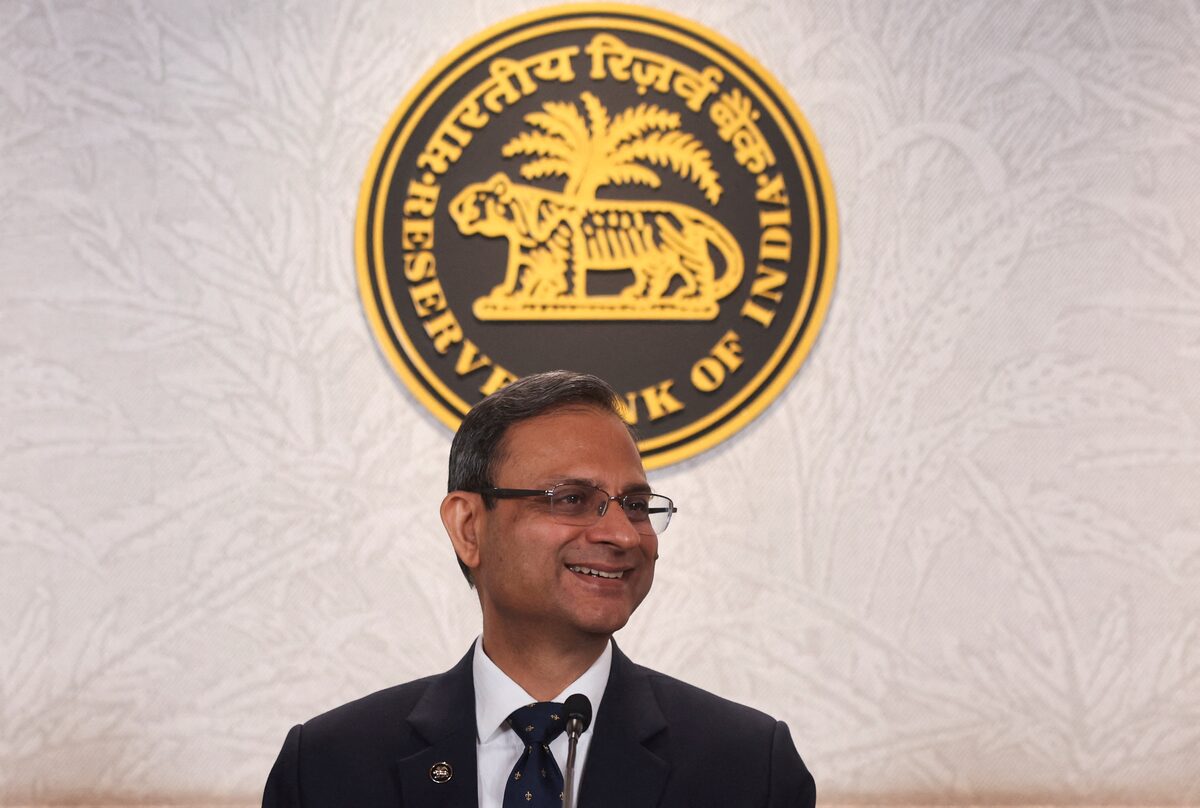
Reserve Bank of India (RBI) Governor Sanjay Malhotra arrives at a press conference in Mumbai, India, April 8, 2026. REUTERS
MUMBAI, April 8 (Reuters) – India’s central bank on Wednesday signalled liquidity levels that would be essential to keep overnight rates closer to the key policy rate.
The central bank maintained that the weighted average call rate (WACR) is its operative rate, and it aims to keep it as close to the policy repo rate as possible.
Maintaining liquidity surplus in a range of 0.6% to 1.1% of deposits is likely to keep the spread between the WACR and the policy rate between 5-10 basis points, the Reserve Bank of India said in its monetary policy report.
The move in liquidity is inversely related to the spread, but the relationship is found to be non-linear, the RBI said.
Earlier in the day, the RBI kept its repo rate and policy stance unchanged, and Governor Sanjay Malhotra said the RBI will continue to be proactive and pre-emptive in liquidity management and ensure sufficient liquidity to meet the productive requirements of the economy.
In contrast to the surplus conditions, a liquidity deficit in the range of 0.4% to 0.7% of deposits is likely to keep the WACR above the repo rate by 5-10 bps, the report said.

“Large excess liquidity does not have a substantial incremental impact on the spread beyond a threshold, but under deficit conditions, the spread becomes unbounded at higher levels of deficit,” the central bank said.
Banking system liquidity surplus rose above 4 trillion rupees ($43.21 billion), its highest in eight months, and has moved the WACR below 5.10% so far this month, down by more than 15 basis points from the repo rate of 5.25%.

The RBI further said the impact of excess liquidity on the spread diminishes significantly beyond a point as the curve flattens with excessive rise in liquidity.
“Keeping the WACR aligned to the repo rate entails different levels of liquidity in deficit and surplus conditions. Moreover, the extent of alignment is also contingent on the level of the surplus or deficit.”
($1 = 92.5625 Indian rupees)
Reporting by Dharamraj Dhutia; Editing by Harikrishnan Nair