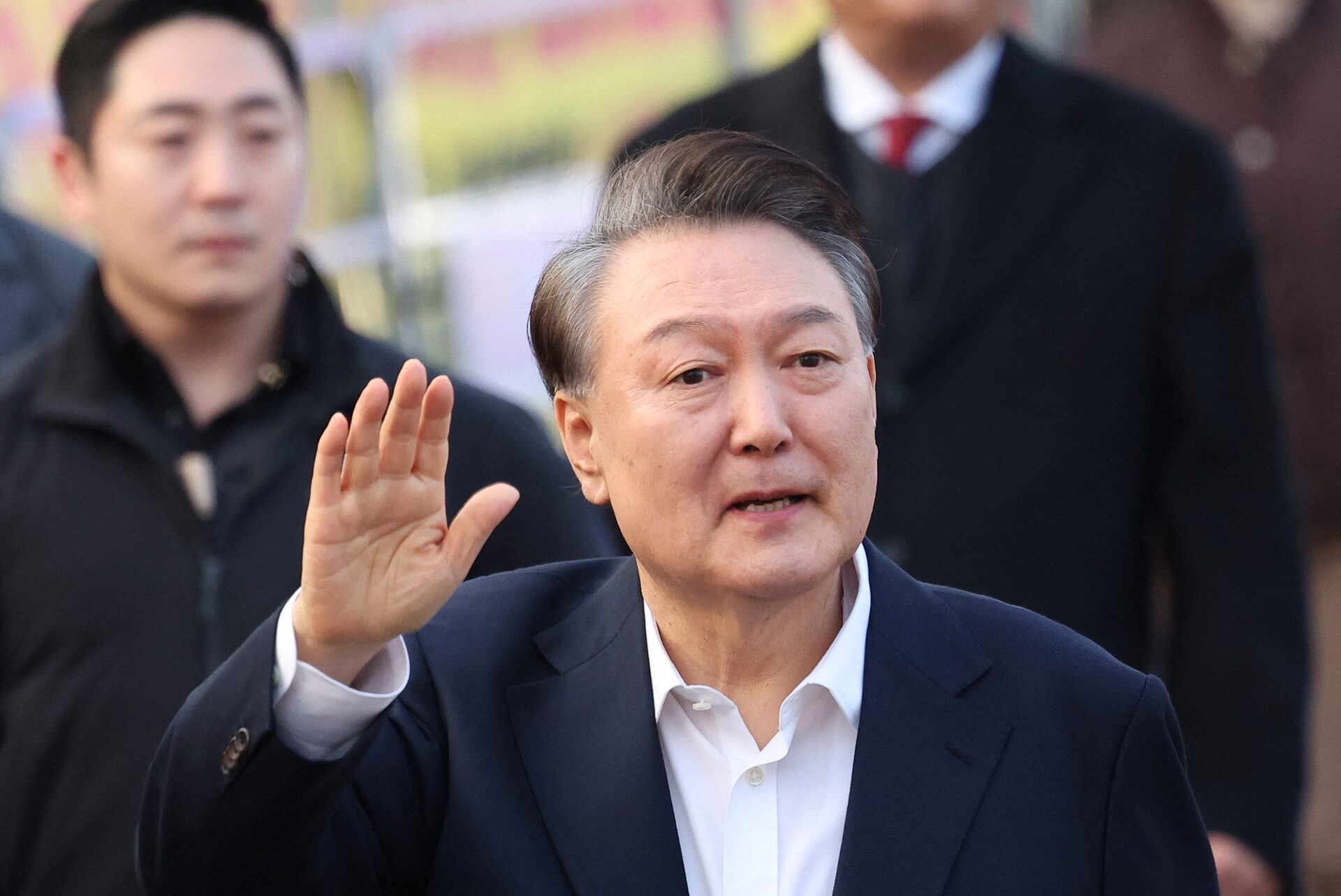
South Korean impeached President Yoon Suk Yeol gestures outside the Seoul detention center after his release, in Uiwang, South Korea, March 8, 2025. REUTERS
SEOUL, Dec 3 (Reuters) – South Korea marks on Wednesday the first anniversary of ousted President Yoon Suk Yeol’s brief attempt to impose martial law, a move that sent shockwaves through a country that had long been viewed as one of Asia’s most resilient democracies.
Here are key events in the year since martial law including Yoon’s impeachment, arrest, and indictment, and the election of President Lee Jae Myung.
December 3, 2024: Shortly before 10:30 p.m. (1330 GMT), Yoon declares on national television he is imposing martial law to root out “anti-state forces” and overcome political deadlock.
An hour later the military issues a decree banning activity by political parties and lawmakers, and troops and police descend on the opposition-controlled parliament. Staffers use barricades and fire extinguishers to ward off special operations soldiers.
Lawmakers hop fences to avoid the security cordons and crowds of protesters gather.
December 4: Parliament with 190 lawmakers present in the early hours unanimously votes to reject Yoon’s declaration and troops begin to leave.
About three and a half hours later, Yoon lifts martial law. The decree was in effect for about six hours.
Opposition parties submit motion to impeach Yoon.
U.S. Deputy Secretary of State Kurt Campbell says Yoon “badly misjudged” his decision to declare martial law, which was “illegitimate.”
December 7: Yoon addresses the nation to apologise, saying he will put his fate in the hands of his ruling People Power Party (PPP), but does not say he will resign.
A vote to impeach Yoon fails as the PPP boycotts, depriving parliament of a quorum.
December 8: Prosecutors name Yoon as the subject of a criminal investigation over the martial law attempt. Ex-Defence Minister Kim Yong-hyun is arrested.
December 10: Kwak Jong-geun, commander of the Army Special Warfare Command, tells a parliamentary committee that Yoon gave an order to “drag out” lawmakers from parliament after declaring martial law.
Ex-Defence Minister Kim attempts suicide in jail.
December 12: Yoon says he will “fight to the end”, alleging North Korea had hacked South Korea’s election commission and expressing doubt over his party’s landslide election defeat in April. The National Election Commission denies the claim.
December 14: Parliament impeaches Yoon with the support of 204 of the 300 lawmakers in the one-chamber parliament. At least 12 PPP members vote to impeach.
Yoon’s presidential powers are suspended, and Prime Minister Han Duck-soo becomes acting president.
December 16: The Constitutional Court begins reviewing the impeachment case.
December 27: Parliament impeaches acting President Han. Finance Minister Choi Sang-mok assumes the position of acting president.
The court holds first hearing in Yoon’s impeachment case.
December 31: A Seoul court approves an arrest warrant after Yoon failed to appear for questioning by investigators.
Yoon’s lawyers say the arrest warrant is illegal and invalid because investigators do not have the authority. January 3-15, 2025: Authorities try but fail to arrest Yoon during clashes with presidential security and military troops inside his compound. Yoon finally agrees to turn himself in after a local court extended the arrest warrant.
January 21: Yoon attends his impeachment trial at the Constitutional Court for the first time. When questioned by a justice, he denies ordering military commanders to drag lawmakers out of parliament.
January 26: Prosecutors indict Yoon on insurrection charges and ask that he be kept in custody.
March 9: Yoon is released from detention after a court cancels his arrest warrant. He spent 54 days in jail.
April 4: The Constitutional Court rules Yoon violated his constitutional duty and removes him permanently from office.
April 27: The liberal Democratic Party names its former leader and 2022 presidential candidate Lee Jae Myung as its candidate for a new election.
June 3: Democratic Party’s Lee Jae Myung is elected president in a snap election.
June 12: A special prosecution team launches an investigation into Yoon’s alleged attempt at insurrection.
July 10: Yoon is back in jail after a local court approved the special prosecutor’s request to detain him.
August 13: Yoon’s wife, former first lady Kim Keon Hee, is jailed after a local court approved an arrest warrant, making the pair the first presidential couple behind bars in Korea’s history.
August 29: Special prosecutors indict former first lady Kim on bribery and other charges.
September 22: Han Hak-ja, the leader of South Korea’s Unification Church, is jailed on allegations that she directed bribes to former first lady Kim.
October 10: Special prosecutor indicts Unification Church leader Han.
November 10: Special prosecutor indicts Yoon on more charges, including aiding an enemy state related to his imposition of martial law.
November 26: Special prosecutor requests a 15-year jail term for former prime minister Han Duck-soo on charges of abetting insurrection and committing perjury.
Reporting by Josh Smith, Joyce Lee and Heejin Kim Editing by Jack Kim, Ed Davies and Michael Perry