
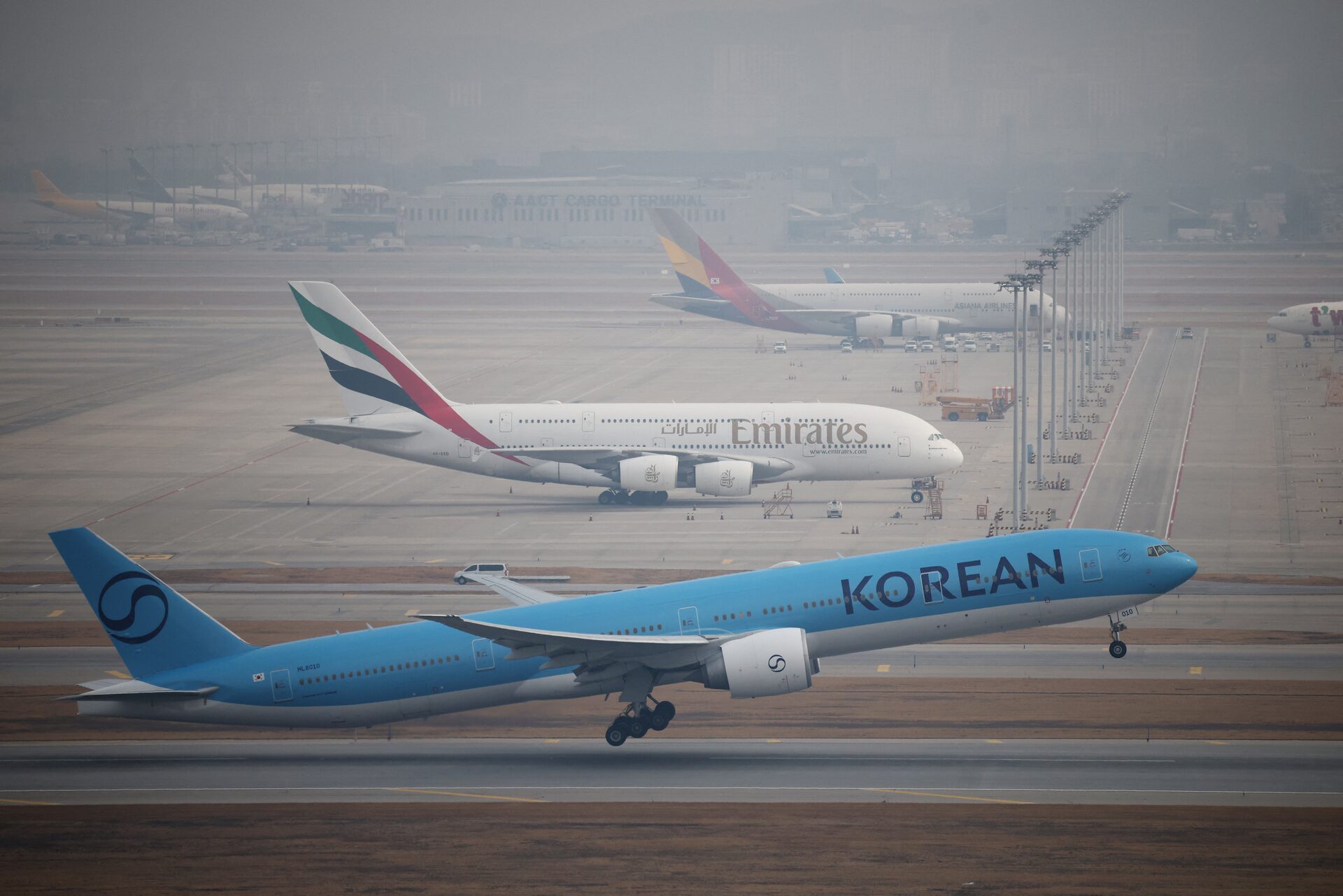
An Emirates Airbus A380 aircraft that has remained parked at the airport after the flight was cancelled, amid the U.S.-Israel conflict with Iran, at Incheon International Airport in Incheon, South Korea, March 5, 2026. REUTERS
HONG KONG, March 5 (Reuters) – Airline shares were mixed on Thursday, as some regained ground on more flights taking off from the Middle East while others dipped on spiking oil prices after U.S.-Israeli strikes on Iran sparked massive disruption in the aviation market worldwide.
Governments have scrambled to arrange flights out of the Middle East for tens of thousands of citizens stranded by the intensifying U.S. and Israeli conflict that closed most of the region’s airspace due to the risk of missiles hitting planes.
That saw takeoffs from the key Dubai International Airport more than double on Wednesday, the latest data from Flightradar24 show, as activity slowly restarts at the world’s busiest travel hub that was brought to a standstill amid the conflict.
It remains far below normal levels, with global aviation disruption likely to take some time to normalize with the conflict showing little sign of easing. Air cargo has also been disrupted, hitting movement of perishable and aircraft parts.

AIRLINES SHARES MIXED
After sharp falls since the initial strikes over the weekend, shares in Hong Kong’s Cathay Pacific Airways Qantas Airways Korean Air Lines rose, paring the week’s losses. Japan Airlines edged down 1%.
Major Chinese carriers such as Air China , China Eastern Airlines, , and China Southern Airlines, fell between 1% and 4% in both Hong Kong and Shanghai.
In Europe, Air France KLM was up slightly, but Lufthansa, British Airways-owned IAG and budget carrier Ryanair dipped. Wizz Air, which flagged a $58 million hit to profits from the conflict, slid a deeper 6%.
“Asian airlines are highly sensitive to Iran’s situation due to exposure through routes and energy in both revenue and costs. Any news on shortening the duration of the war can easily turn sentiment,” said Gary Ng, a senior economist at Natixis.

REPATRIATION FLIGHTS RAMP UP
Emirates and Etihad Airways are now operating a limited number of services from Dubai and Abu Dhabi through the United Arab Emirates’ safe air corridors.
“Emirates can confirm that it is currently operating a reduced flight schedule until further notice,” an airline spokesperson said, adding that on Thursday and Friday more than 100 flights should depart from Dubai with passengers and cargo.
Qatar Airways said it would run limited relief flights from Thursday for stranded passengers departing from Muscat in Oman to six European destinations including London, Berlin and Rome as well as from Riyadh to Frankfurt.
These would be the airline’s first flights since Saturday, when its Doha hub was shut after the strikes on Iran, according to flight-tracking service Flightradar24.
By Thursday morning, Emirates flights had left Dubai for destinations such as Sydney, Hong Kong, Paris, Amsterdam, Toronto and Mumbai, data from the tracking service showed, though the vast majority of services remained cancelled.
A U.S. government charter flight was bringing Americans home from the Middle East, with additional flights being arranged from other regional locations, the U.S. State Department said.
Since February 28, more than 17,500 Americans have returned to the United States from the Middle East.
Canada said it was working to repatriate stranded citizens on commercial flights and contracting charter flights.

AIRLINE REBOUND RESTS ON WHAT HAPPENS WITH IRAN CONFLICT
Jet fuel prices have soared globally since the strikes on Iran, hitting an all-time high in Singapore on concerns of supply disruption, S&P Global Platts said on Thursday.
Still, many Asian airline shares have rebounded or pared double-digit percentage drops in the past few days amid surging oil prices and concerns over how long the conflict might last.
“For now, I consider this rebound to be primarily short-term in nature,” said Kenny Ng, a securities strategist at China Everbright Securities International. “Its sustainability will still depend on the ongoing situation in the Iranian conflict.”
In a sign of possible relief, operatives from Iran’s Ministry of Intelligence signalled openness to the U.S. Central Intelligence Agency to talks on ending the war, the New York Times said, citing officials briefed on the matter.
The restrictions on airspace have forced airlines to reroute flights, load extra fuel or make additional refuelling stops to guard against sudden diversions or longer flights on safer routes. Prices on some key global routes have risen sharply.
Marooned tourists and some expatriates have also tried to find their own way out of the Middle East through Saudi Arabia or Oman, where the airspace remains open.
Reporting by Julie Zhu and Joyce Zhou in Hong Kong; Additional reporting by Li Gu in Shanghai; Writing by Anne Marie Roantree; Editing by Jamie Freed, Clarence Fernandez and Jan Harvey