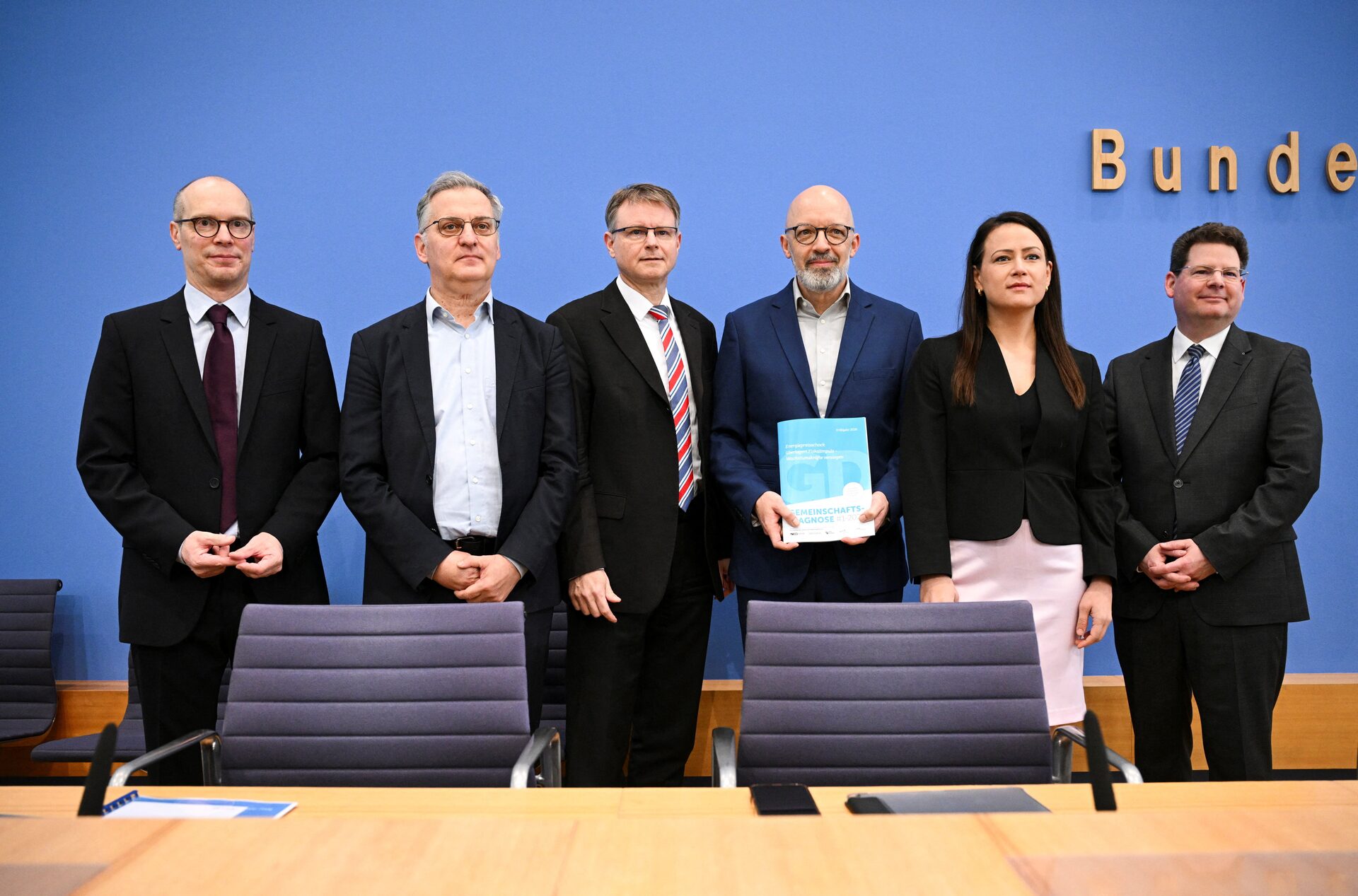
Stefan Ederer of Austrian Institute of Economic Research Vienna (WIFO), Torsten Schmidt of Leibniz Institute for Economic Research Essen (RWI), Stefan Kooths of Kiel Institute for the World Economy (IfW Kiel), Timo Wollmershaeuser of Institute for Economic Research (ifo Munich), Geraldine Dany-Knedlik of German Institute for Economic Research (DIW Berlin) and Oliver Holtemoeller of the Leibniz.
BERLIN, April 1 (Reuters) – Germany’s leading economic institutes cut their economic growth forecasts for this year and next on Wednesday and sharply raised their inflation forecasts in response to the Iran war.
The institutes slashed their 2026 economic growth forecast to 0.6% from the 1.3% projected in and lowered their 2027 growth outlook to 0.9% from a prior estimate of 1.4%, as Reuters reported on Tuesday.
The changes reflect the economic fallout from the Iran war, which has triggered a surge in energy prices, already pushing German inflation to .
Europe’s largest economy has struggled to regain momentum since the COVID-19 pandemic, as rising competition from China and higher energy prices have strained its export-driven economic model. The latest surge in energy prices poses a further threat to its long-awaited recovery.
The updated forecasts of the economic institutes feed into the government’s economic planning, including tax revenue projections.
The report is a joint effort by five prominent economic institutes: RWI in Essen, the Ifo institute in Munich, IfW in Kiel, IWH in Halle and DIW in Berlin.
Reporting by Maria Martinez Editing by Madeline Chambers