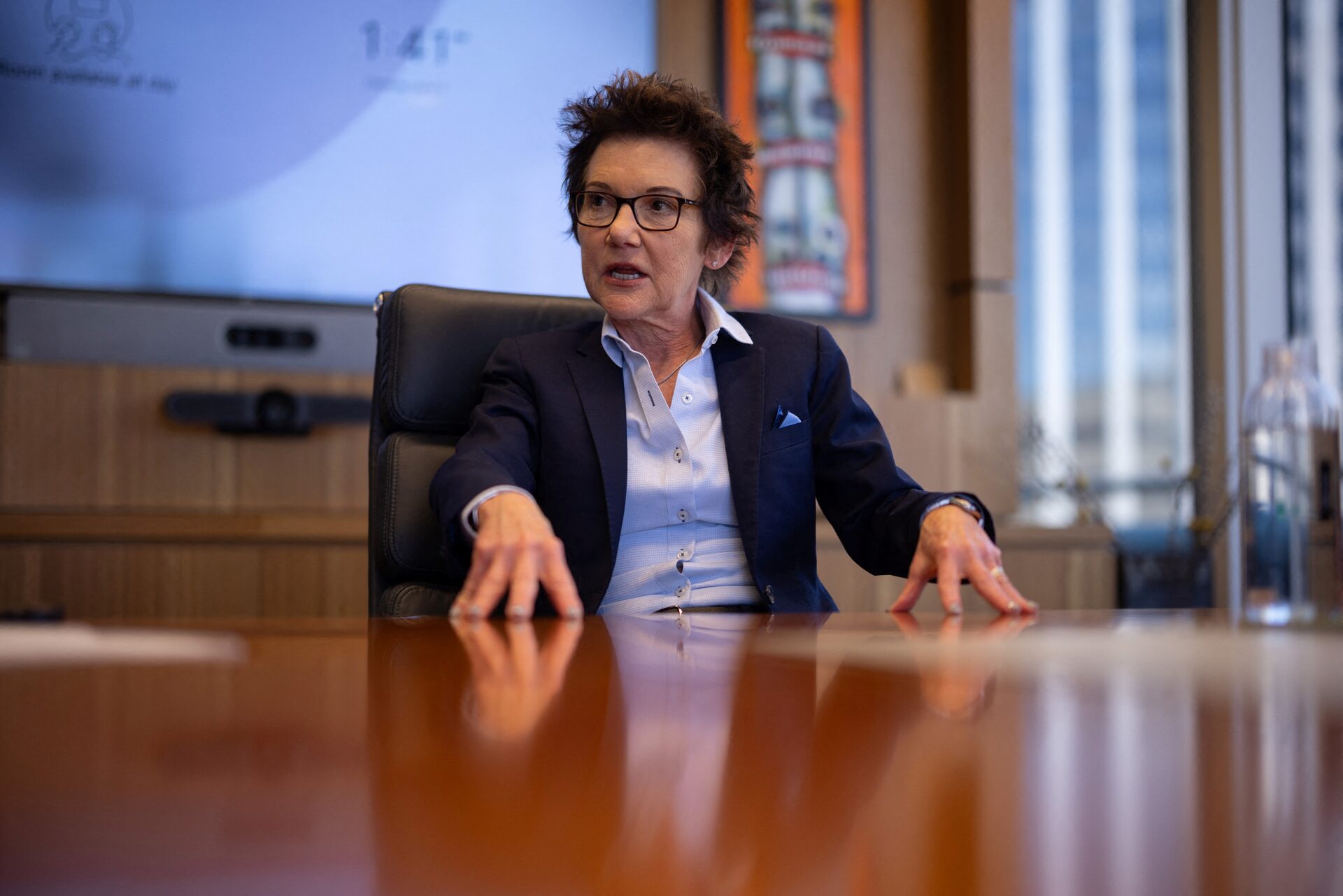
San Francisco Federal Reserve Bank President Mary Daly speaks during an interview with Reuters at the Federal Reserve Bank building in San Francisco, California, U.S., April 9, 2026. REUTERS/Carlos Barria Purchase Licensing Rights
April 10 (Reuters) – San Francisco Federal Reserve President Mary Daly said the U.S. economy is fundamentally solid, the labor market has steadied, and monetary policy is in a “good place” — restrictive enough to put downward pressure on inflation without undercutting the labor market.
But the oil shock from the Iran war, she told Reuters in an interview late Thursday, extends the timeline on getting inflation back to the Fed’s 2% goal, and may leave the Fed in a holding pattern on interest rates.
“We had work to do before we had the oil price shock; with the oil price shock, the work just takes longer,” Daly said, noting that though the drop in oil prices after the U.S. and Iran announced a ceasefire deal earlier this week brings some relief, “no one’s really sure how long that will last.”
The Fed has held its short-term interest-rate target in the 3.50%-3.75% range at each of its two meetings so far this year. Many Fed policymakers, Daly included, had felt that tariff-related inflation would probably ease later this year, allowing the central bank to resume cutting rates. She had thought one cut might be needed, maybe two.
Then came the Iran war, driving oil prices up sharply and lifting gasoline prices above $4 a gallon.
Oil shocks “push up inflation if they persist, and they will tug at growth, and what we would have to do as policymakers is balance those risks and make the best decision to get to both of our goals as quickly and easily as we can.”
At the moment, Daly said, risks to the Fed’s two goals of full employment and price stability are balanced.
She ticks through what could happen next.
“Scenario one: this resolves quickly, the ceasefire extends, the conflict is more or less over, oil prices come back down, and firms begin to see and consumers see that gas prices and other energy costs are coming back down — and we resume the trajectory we were on, which is good growth, steady labor market, and gradually falling inflation with the tariffs rolling off,” Daly said.
If those things happen, she said, “then a rate cut to continue on our path of normalization is not out of the question.”
But another scenario also has her attention: the disruption to oil delivery from the war, even if over, could keep inflation elevated for longer than the Fed had anticipated. “If that’s the case, then of course we would be just holding steady until we know that we are getting the job done,” she said.
Less likely than a cut or a hold on rates, she said, is the possibility of a rate hike: “I’m really putting a lower probability on a rate hike than the other two,” she said.
A protracted conflict and persistently higher oil will boost inflation and slow growth at the same time, she said, and the Fed will face a complicated calculus of figuring out how to respond.
“I do think that inflation is extremely important to bring back to 2%,” she said. “But if we do that at the expense of jobs, then we put families behind the eight ball in a way that they do not deserve.”
Daly spoke with Reuters on the eve of a government report widely expected to show that consumer prices surged last month at the fastest pace in nearly four years.
“I think this is already showing through to the economy and a higher CPI number will not be a surprise to anyone,” Daly said. People are paying higher gas prices, farmers are worried about surging fertilizer prices, travel and tourism are down as people worry about the cost of the drive or the flight, she said.
“The new news is that it looks like the conflict could stabilize and that the shipping lanes can open and that we can start to return to something that looks more reasonable for people,” she said. “But, you know, that’s the uncertain piece.”
Reporting by Ann Saphir; Editing by Chizu Nomiyama