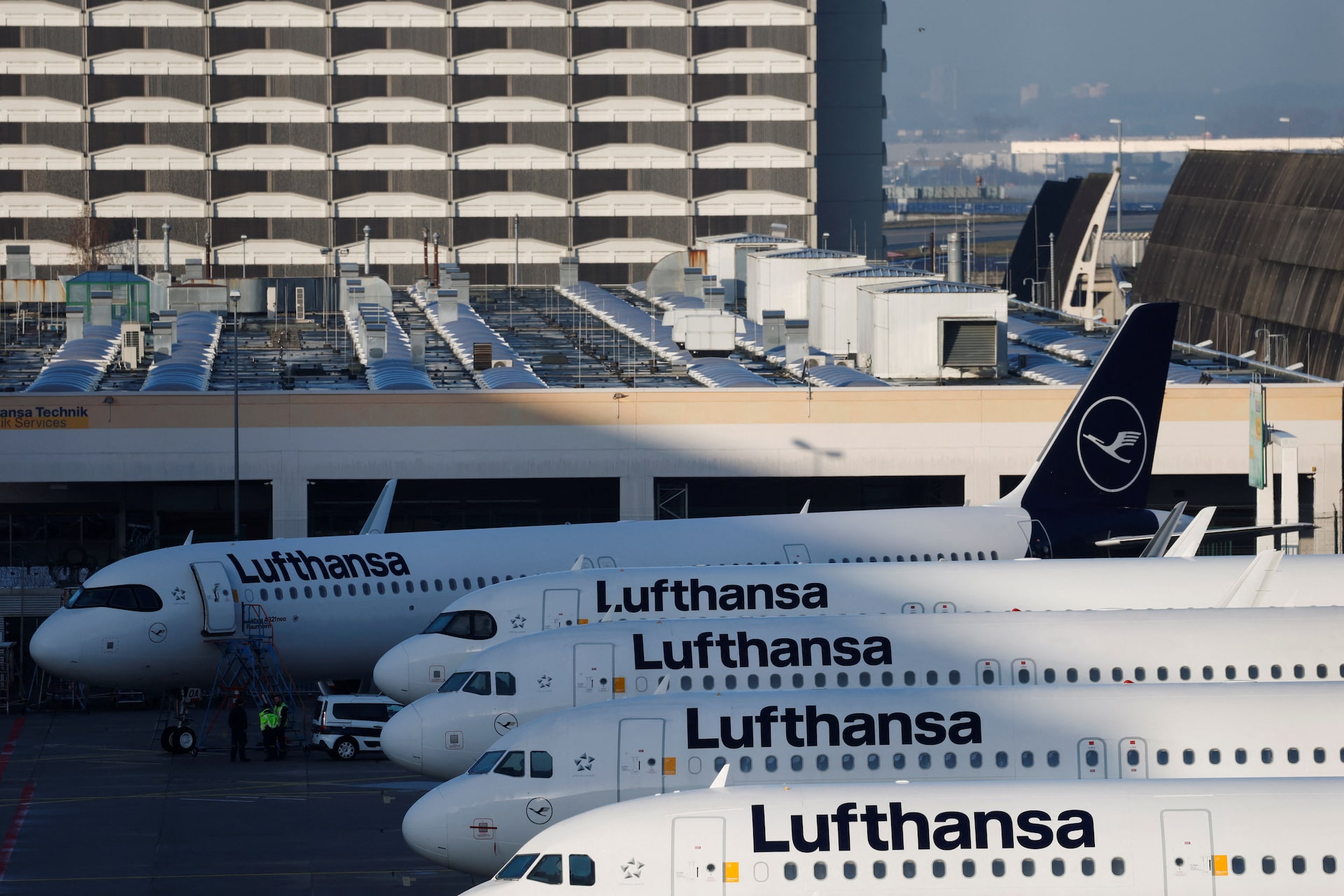
Aircraft of German air carrier Lufthansa are parked on the tarmac at the airport in Frankfurt, Germany, March 12, 2026. REUTERS
LONDON/BRUSSELS, March 17 (Reuters) – European airlines are taking aim at planned rules over synthetic sustainable aviation fuel, two sources told Reuters, underscoring pushback from the sector amid worries about high costs and lack of availability of the green jet fuel.
The sector is planning to formally call for at least a delay in new EU rules set to come into force in 2030 that mandate airlines use a certain amount of synthetic green jet fuel, or eSAF, in their planes, with an announcement set for Thursday.
The planned challenge, previously unreported, is still under discussion and could be changed amid resistance from regulators behind the scenes to the intended move. The European Commission did not immediately respond to a request for comment.
The airline sector, sideswiped by the Iran war that has grounded flights and pushed up fuel costs, argues Europe’s green jet fuel mandates are too strict, there isn’t enough sustainable aviation fuel on the market to meet EU rules and that its prices are too high.
Aviation is among the hardest sectors to decarbonise, with zero-emission aircraft not expected this decade. Green fuels, with net-zero emissions or lower emissions than normal jet fuel, can in the near-term help reduce air travel’s carbon footprint.
Europe’s airline executives are following in the footsteps of the car industry, which managed to water down a rule last year that would stop any CO2-emitting cars being sold after 2035.
AIRLINES SEEK TO POSTPONE OR EVEN OVERTURN RULES
The announcement is pencilled in to be made at an industry conference organized by trade group Airlines for Europe (A4E), with details still being finalized, the sources said.
The A4E group includes major European airlines Air France-KLM Lufthansa Ryanair easyJet and British Airways-owner IAG.
“They want to postpone the eSAF requirements until there is enough production online,” said Camille Mutrelle, a policy officer at advocacy group Transport and Environment (T&E) who has knowledge of the plans. T&E supports keeping the rules in place.
“If we postpone, eSAF startups will die and Europe will lose the early mover advantage.”
A second person with knowledge of the talks said airlines were discussing calling for the scrapping of the eSAF mandate altogether.
A spokesperson for A4E confirmed its members were set to meet on Thursday, though declined to comment on the position the group is set to take. “Airline CEOs decide on A4E positions,” the spokesperson said.
The EU required 2% of fuel made available at regional airports to be SAF (sustainable aviation fuel) in 2025, which rises to 6% in 2030. A level of 1.2% of the total will have to be synthetic SAF (eSAF) from 2030, rising to 5% in 2035, according to current planned EU rules.
Airlines argue that there’s almost no available supply of synthetic jet fuel and that plans to build facilities are unlikely to materialise in time to meet the mandate.
Most SAF on the market is made from recycled or used cooking oil or animal waste. It costs three to five times more than traditional jet fuel and makes up just 0.3% of global jet fuel supply.
Synthetic sustainable jet fuel is made from renewable energy such as captured carbon dioxide or green hydrogen. It emits less carbon than bio-based SAF, but is much more expensive to make.
Reporting by Joanna Plucinska in London and Kate Abnett in Brussels; Editing by Adam Jourdan and Keith Weir