
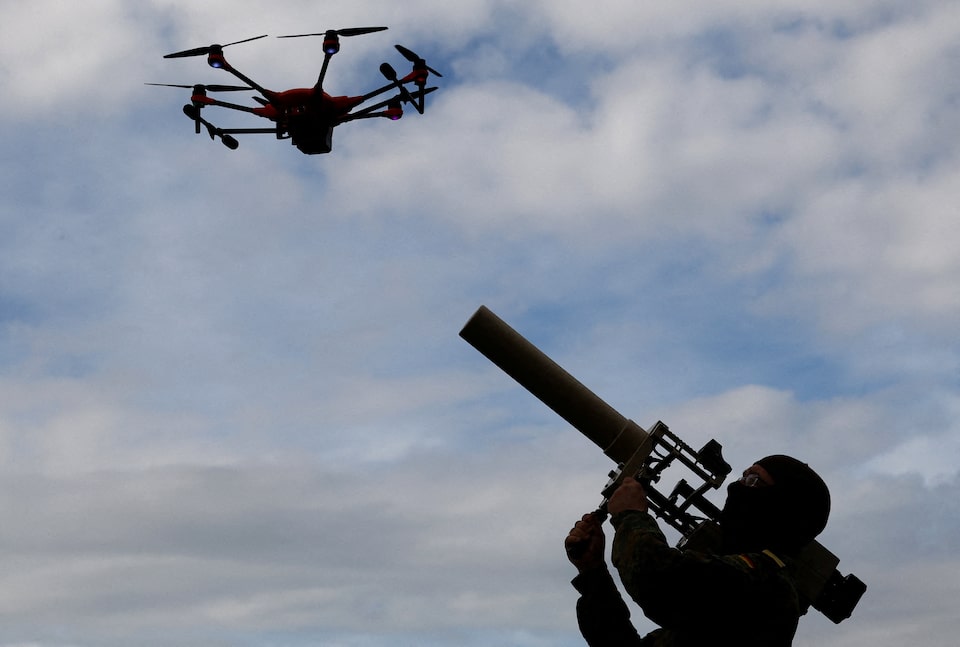
LONDON, June 16 (Reuters Breakingviews) – How involved should private companies be in how states wage war? Quite a bit, if you’re Ukraine’s 35-year-old defence minister. Since launching his “private air defence initiative” at the end of 2025, Mykhailo Fedorov has been busily outsourcing the shooting down of Russian drones – 30 firms have destroying over 20 Shahed-type attack drones and Zala reconnaissance unmanned aerial vehicles (UAVs). This model has a name: Defence-as-a-Service (DaaS). It takes military procurement into murky territory – but may also be exactly what European rearmament needs.
Investors have long grown accustomed to “Software-as-a-Service”. Enabling IT customers to pay an annual charge for their computing usage smooths out tech company revenues, but it also allows clients to benefit from necessary upgrades to iron out bugs. These same arrangements, however, differ markedly from the way sovereign governments have tended to pay for their defence equipment. The notorious “cost-plus” contracts by which tanks, guns and airplanes have been procured in recent decades involve public officials making long-term and often incorrect bets on the sort of armed force capabilities they will need several decades hence. They then pay a premium to make any changes that inevitably emerge. As of 2023, the U.S. F-35 fighter, for example, was $183 billion, over its original cost estimate.
This runs counter to the flexibility army officials say they need. In a speech, last year, Britain’s land forces chief General Roly Walker predicted that only a fifth of defence capabilities in the future would be in the form of the advanced, crewed hardware like tanks and helicopters that constitute the popular conception of what an army is. While 50% of the defence budget would be spent on that sort of kit, the other half would go on areas like unmanned surveillance aircraft, and expendable software and hardware to counter threats like enemy drones.
What makes this new generation of military capability different is that it behaves more like updatable software: Russia’s war with Ukraine has seen both sides develop new drone and counter-drone systems at a relentless pace, with new versions emerging almost every month. In this sort of rapidly changing world, paying a regular fee to a private company for a technologically advanced DaaS capability rather than owning it outright can make sense. And flexibility of this kind is not a nice-to-have. According to former RAF Air Commodore Blythe Crawford, who now works at U.S. defence tech group Tiberius Aerospace, a nation’s deterrence lies not in any single weapon, but in the ability to out-innovate adversaries – constantly developing and deploying new drones and software before existing models are rendered obsolete.
DaaS is starting to become more widespread. Britain’s Royal Navy is delivering the first phase of its “Atlantic Bastion” undersea surveillance and anti-submarine programme in 2026 under a model where a private contractor owns and operates the equipment on the Navy’s behalf. Two U.S. Army programmes – ARTEMIS (Aerial Reconnaissance and Targeting Exploitation Multi-Mission Intelligence System) and ARES (Airborne Reconnaissance and Electronic Warfare System) – also use the DaaS model, with a private contractor providing intelligence, surveillance and reconnaissance (ISR) capabilities as a service. Anduril, the $60 billion U.S. defence tech startup, signed a “capability-as-a-service” contract in 2024 with the Royal Australian Air Force to help defend its bases against drones.
All that said, DaaS-like contracts represent less than 5% of the $71 billion in U.S. space military spending earmarked for 2027. That could be because while DaaS easily lends itself to supporting functions such as logistics, governments may be wary of becoming reliant on rented technology for defence capabilities of a more critical nature. The danger is that a function could be taken away, stop working, or become too expensive. This is hardly a theoretical risk – in 2022 Elon Musk notably refused a Ukrainian request to activate his Starlink satellite network in Crimea’s port city of Sevastopol.
Moreover, you don’t have to be a fan of dystopian 1980s science fiction films like “RoboCop” – in which profit-seeking corporations gain life-or-death powers over ordinary citizens – to recognise how DaaS also carries risks and raises moral questions. One key dilemma is the extent to which a non-government entity is allowed to exercise lethal force, particularly if they deploy unmanned, AI-enabled autonomous capabilities to do so.
Right now, the norm in warfare is for lethal force decision-making to be exclusively the domain of elected officials. A series of U.S. legislative steps such as the Federal Activities Inventory Reform Act (FAIR), introduced in 1998, attempt to define what sort of defence activities are inherently governmental. Ukraine’s private air defence network is subject to tightly controlled guidelines and is in any case shooting down unmanned machines. Still, if the same capabilities were to be used for offensive strikes against human targets it would drag DaaS and whichever private company stood behind it into unfamiliar legal and ethical waters.
All that said, the imperative to innovate in warfare likely means defence-as-a-service will grow. In an ideal world, DaaS contractors would compete against each other – perhaps coordinated by using burgeoning new military “app stores” like Tiberius Aerospace’s GRAIL where customers can browse available capabilities to develop their supply chains. The upshot might be low-cost services that involve private sector employees working within armies to operate their high-tech kit – as Palantir’s cadre of “forward-deployed engineers” do when they help the U.S. Army operate its “Maven” software that helps generals identify targets and coordinate operations.With the right guardrails, DaaS can be a step forward. And given Ukraine is where most of Europe’s best military intellectual property and expertise resides, Kyiv firms could soon be at the forefront of a stream of this kind of work. Still, defence-as-a-service looks likely to go through at least some growing pains.
Follow George Hay on Bluesky and LinkedIn.
Editing by Aimee Donnellan; Production by Oliver Taslic