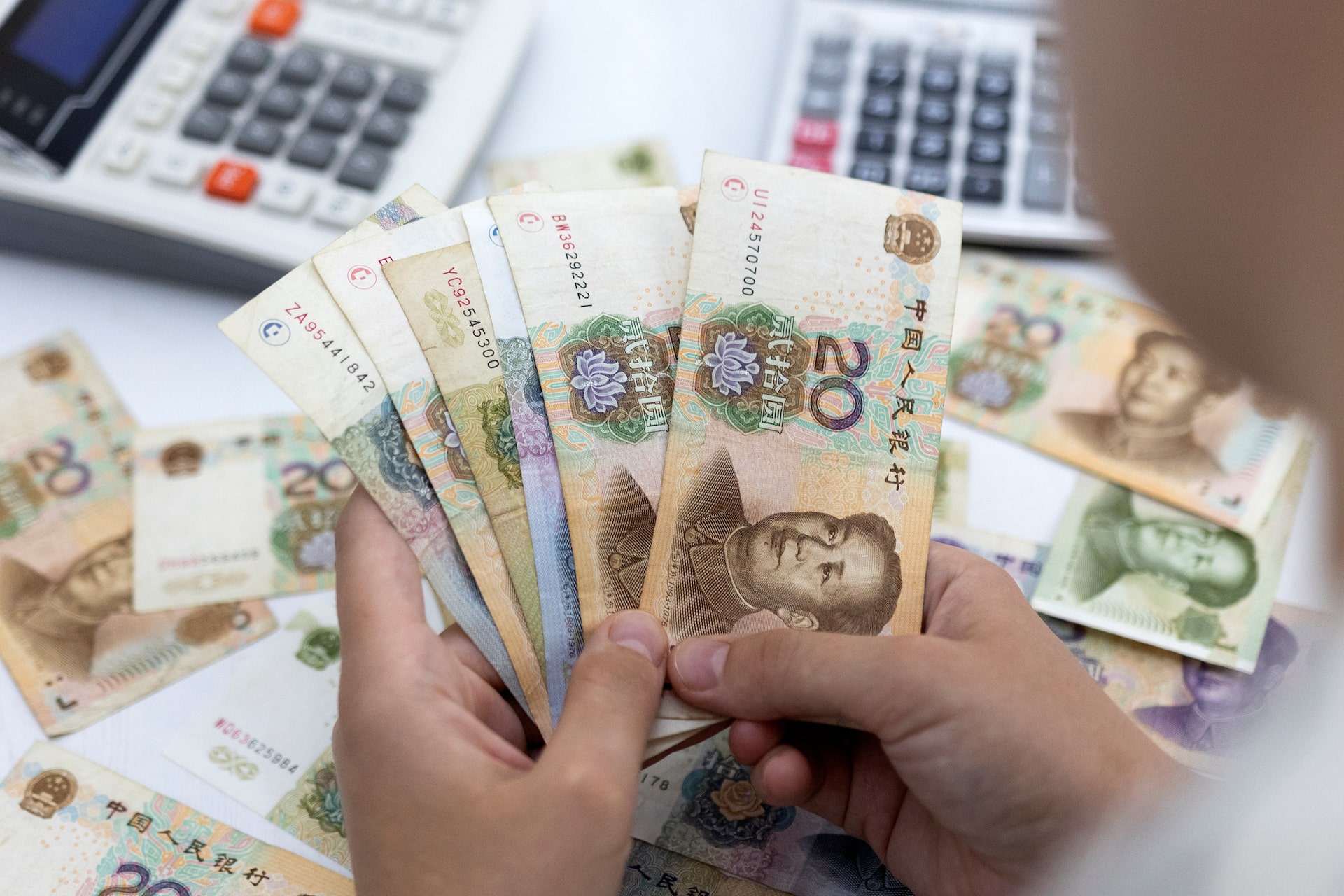
Woman holds Chinese Yuan banknotes in this illustration taken May 30, 2022. REUTERS
SINGAPORE, Feb 27 (Reuters) – The Australian dollar was poised for another sharp monthly gain on Friday as expectations grow for a more hawkish central bank, while the yuan lost momentum after China hit the brakes on a long-running rally in the currency.
The People’s Bank of China (PBOC) moved on Friday to slow the pace of rapid yuan appreciation, saying it will scrap the foreign exchange risk reserves for some forward contracts – seen as a way to encourage dollar buying.
That, alongside a weaker-than-expected yuan midpoint fix, sent the onshore yuan down 0.2% to 6.8553 per dollar, snapping a 10-day winning streak. It has still gained around 2% so far this year, after appreciating more than 4% in 2025.
“It is clear that the PBOC wants the yuan appreciation pace to slow,” said analysts at Maybank.
“Many suggest that China has gained leverage in the wake of the (U.S. Supreme Court) quashing Trump tariffs and recent gains could be evidence of such.”
Elsewhere, the Australian dollar was up 0.3% at $0.7127 and on track for a monthly gain of more than 2%.
Up more than 6% for the year thus far, it is the best-performing G10 currency to date, as a domestic economy in rude health fuels expectations for a more hawkish Reserve Bank of Australia.
Moves in currencies have been driven primarily by shifting rate expectations this month, even as investors grappled with geopolitical tensions and the pivotal U.S. Supreme Court ruling that struck down President Donald Trump’s earlier tariffs, among other things.
“The rates are reflecting the changing macro situation,” said Sim Moh Siong, a currency strategist at OCBC.
“Last year was about which central banks will cut rates and by how much. This year, the focus has shifted towards which central banks will lead in terms of hiking rates.”
Also on the hiking path is the Bank of Japan, though that has done little to help the yen as domestic politics complicate the rate outlook, despite BOJ Governor Kazuo Ueda signalling openness to a near-term hike.
While the yen was up 0.2% at 155.78 in Asia, it has fallen 0.45% for the week and 0.64% for the month thus far.
This week, Japan’s government nominated two academics seen as strong advocates of economic stimulus to join the BOJ’s board, sending a message about Prime Minister Sanae Takaichi’s distaste for higher interest rates.
“The political optics around appointments make markets question the pace and conviction of policy normalisation,” said Saxo’s chief investment strategist Charu Chanana.
ASSESSING THE RATE OUTLOOKS
Sterling was steady at $1.3494, and set to snap three straight months of gains with a 1.4% fall in February.
It has been undermined by a dovish tilt from the Bank of England, with traders now pricing in an 83% chance of a rate cut in March.
Meanwhile, the dollar was up 0.55% for the month, helped by a slightly more hawkish Federal Reserve after several policymakers signalled at January’s meeting their openness to rate hikes if inflation remains elevated.
Nonetheless, investors continue to price in two more Fed cuts this year.
The Supreme Court’s decision on Trump’s tariffs also reinforced checks and balances on presidential power, in turn lifting the dollar, analysts said.
“It suggests that the long-term prospects for the U.S. dollar might not be as grim as previously imagined,” said Macquarie Group’s FX and rates strategist Gareth Berry.
Moves in the euro were more muted, with the common currency little changed at $1.1808 on Friday and headed for a monthly loss of 0.35%.
Reporting by Rae Wee; Editing by Edwina Gibbs and Kim Coghill