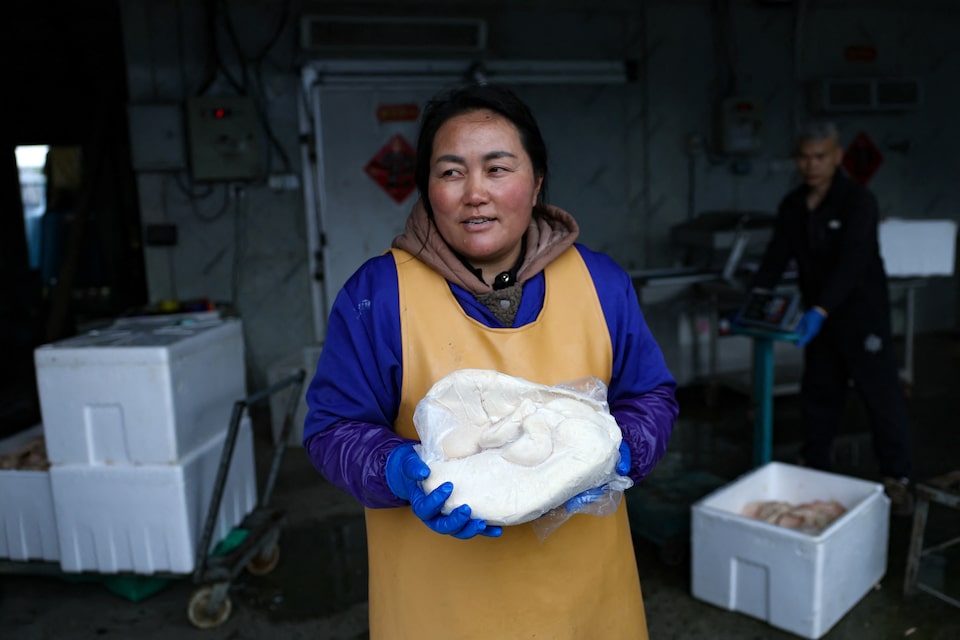
Wu Deli, the wife of the owner of foie gras producer Changhao Biotechnology Co, shows off a frozen goose liver weighing 2.9 kilograms.
 Geese are raised at a farm for foie gras production, in Huoqiu county, Anhui province, China.
 A worker uses a specialised machine filled with a corn mixture to force-feed geese at a goose farm owned by foie gras producer Minghe Ecological Breeding Technology Co, in Huoqiu county, Anhui province, China.
 Frozen geese hang in a cold storage room at foie gras producer Minghe Ecological Breeding Technology Co in Huoqiu county, Anhui province, China.
 A worker carries a dead goose to a workshop for defeathering at foie gras producer Minghe Ecological Breeding Technology Co in Huoqiu county, Anhui province, China.
 A staff member serves customers at a hotpot restaurant featuring goose meat in Luan city, Anhui province, China.
 Fabien Chevalier, Chairman of French foie gras producers group CIFOG and Managing director of Maison Lafitte, poses in the Maison Lafitte shop.
 Jars of foie gras, produced by French producer Maison Lafitte, are displayed on a shelf at the company’s shop in Paris, France.
 Li Fengshan, owner of foie gras producer Changhao Biotechnology Co, shows cherry-shaped foie gras desserts produced by his company.
MENGJI, China/PARIS, June 20 (Reuters) – Li Fengshan grew up so poor he could only afford one meal a day. Today, the 50-year-old drives a white Maserati SUV, funded by ballooning foie gras profits from his geese farm in eastern China.
Over the last 10 years in China, foie gras — the fattened livers of force-fed ducks or geese — has gone from a high-end delicacy to a popular affordable product, spurring farmers like Li to become even more ambitious.
His company, Changhao Biotechnology — a mid-sized foie gras producer — made 300 metric tons last year and is planning a big jump to 500 tons this year. The average French producer, by contrast, makes around 10 tons a year.
While impediments to exports — not least China’s own customs rules — abound, Li has started to tiptoe into overseas markets, shipping 6,000 cans to Dubai last year.
China’s massive surge in output, much cheaper costs and pricing as well as increasing demand worldwide for the product mean it’s only a matter of time before exports grow, domestic farmers say.
“Our foie gras agricultural products will eventually end up on numerous overseas tables. It’s inevitable,” said Li.
CHINA MAY SOON BE WORLD’S LARGEST PRODUCER
In China, foie gras fried rice is a thing, as is dipping raw slices into hotpot. Newer products such as frozen cherry- and rose-shaped foie gras desserts that have been dipped in red wine and blueberry sauce are also popular.
And a slice in a restaurant in China costs 30 yuan to 70 yuan ($4 to $10), far cheaper than prices of €15 to €40 ($17 to $46) in a restaurant in France.
The Chinese love affair with foie gras has been so intense that some industry analysts and participants expect China to soon be the world’s biggest producer, perhaps next year or even this year.
China’s foie gras production may have hit as much as 14,000 tons last year, according to previously unreported estimates from five China-based industry analysts.
That would represent a jump of roughly 30% from 2024 and compares with estimates of just 2,000 tons a decade ago. France — the world’s leading producer — saw output slip 3% to 15,044 tons last year.
“It’s worrying that they’re developing so quickly,” said Fabien Chevalier, chair of the French foie gras industry group CIFOG. “We didn’t see them coming like that.”
Together France and China account for over 80% of global output, with Hungary and Bulgaria also making sizeable amounts.
EXPORT DEALS EMERGING
Less than 5% of Chinese output was exported last year, according to customs data and analysts’ estimates. Stringent rules imposed by Chinese customs that require farmers to prove some 300 chemicals are not present in the poultry after vaccination make exports a daunting task.
But Chinese producers are keen to try their hand, knowing that if they jump through the many regulatory hoops required, far more attractive profit margins await them abroad.
Jilin Zhengfang Agriculture & Animal Husbandry, China’s biggest producer of duck foie gras with 1,500 tons made annually, is preparing to export to Southeast Asia and Europe this year, General Manager Min Wei said.
Shandong Chunguan Food, a major foie gras producer, told state media in May it had just signed a contract to export to South Korea and was working with companies in Japan, Russia and Southeast Asia to ship to those markets. The company declined to comment when contacted by Reuters.
“China will definitely be a strong competitor to France in some overseas markets, especially in up-and-coming foie gras markets like Southeast Asia and the Middle East,” said Zhou Menghan, a poultry analyst at Beijing Orient Agribusiness Consultants.
CIFOG’s Chevalier said a few Chinese producers have started to make an appearance at international trade fairs, and their products could find homes in Southeast Asia.
“We will need to be vigilant about what they intend to bring to market,” he said.
But he added that European markets are tightly regulated and he expects consumers to stick with products such as those bearing the “foie gras du Sud-Ouest” label which guarantees the birds were raised in France’s southwest according to local feeding standards.
BIGGER LIVERS BUT HARD WORK
China’s surging output is partially due to generous subsidies. In Li’s case, they cover over 50% of his infrastructure and vaccine costs. But it also owes much to a work ethic that results in much bigger livers, he says.
Each member of his staff is responsible for handling more than 400 geese from hatching to slaughter, and in the final 10 days of the birds’ 100-day lives, they work around the clock with very little sleep to force-feed each one six daily meals.
“Europeans aren’t able to raise a large number of geese anymore, because it’s hard work,” he said as his wife proudly displayed a 2.9-kilogram (6.4-pound) liver.
Goose livers at his farm weigh at least 1 kg (2.2 pounds). In France, where most foie gras is made from duck, typical livers weigh 500 to 550 grams (1.1 to 1.2 pounds), while goose livers are generally under 750 grams (1.7 pounds). Li adds that he’s in talks with robotics firms to develop robots that could handle the intensive feeding programme better than humans.
Foie gras has long been controversial, with animal welfare activists arguing that the forced-feeding, usually done in cages, is inhumane. But many in the industry assert that ducks and geese lack a gag reflex, meaning that inserting a feeding tube is not as stressful as it would be for a human.
Chinese producers brush off the suggestion that animal welfare concerns could impede growth. There’s little opposition in China, and foie gras demand around the world is only increasing, they say.
Proof of that is the significant smuggling of Chinese foie gras abroad via Shenzhen and Hong Kong to other countries to skirt Chinese customs rules, said four sources who declined to be identified discussing the illegal practice.
The smuggling of foie gras, disguised as other products or mixed in with other products, can amount to as much as 10 tons per month, they added.
China’s farm ministry and customs authorities did not respond to Reuters requests for comment on the smuggling.
($1 = 6.7617 Chinese yuan)
($1 = 0.8625 euros)
Reporting by Daphne Zhang, Nicoco Chan and Tingshu Wang in Mengji, and Sybille de La Hamaide in Paris; Additional reporting by Xiuyuan Ning in Beijing; Editing by Casey Hall and Edwina Gibbs.