
Enabling safe and responsible gaming under the Online Gaming Rules, 2026
Operationalising the Promotion and Regulation of Online Gaming Act, 2025
The Promotion and Regulation of Online Gaming Rules, 2026 will come into force on 1 May 2026. This marks a decisive step in shaping India’s digital gaming landscape. The Rules establish a structured system to govern online games. The focus is on user safety and industry growth. Their commencement signals a shift from broad policy intent to enforceable regulation.
The Rules flow from the Promotion and Regulation of Online Gaming (PROG) Act, 2025, enacted by Parliament in August 2025. The Act addresses the rising harm of online money gaming. It also enables growth of e-sports and online social games. It reflects the Government’s vision to make India a global gaming hub. The aim is to foster innovation and creativity while protecting users from financial and social risks.
Understanding the Online Gaming Sector
The online gaming sector has expanded rapidly and now forms a significant part of India’s digital economy. The Indian market generated INR 232 billion in 2024. 77 per cent of this revenue came from transaction-based games. The sector is projected to grow at a CAGR of 11 per cent, reaching INR 316 billion by 2027. Recognising this scale, the Promotion and Regulation of Online Gaming Rules, 2026 introduce a clear framework. It distinguishes between safe and harmful forms of online gaming. In this regard, determination and classification is central to effective regulation and enforcement. The sector can be broadly divided into three distinct segments with varying implications for users and society.
- Esports: This refers to competitive digital sports, which are part of multi-sports events and where teams or individuals participate in organised tournaments. Success in esports requires strategy, coordination, and advanced decision-making skills.
- Online Social Games: These are casual games that form part of everyday recreation. They are primarily skill-based and designed for entertainment, learning, or social interaction. Such games are generally considered safe.
- Online Money Games: This segment includes games involving financial stakes. These may be based on chance, skill, or both. These platforms have raised serious concerns due to reports of addiction, financial losses, money laundering and even suicides.
The rapid growth of the online gaming sector highlights both its economic potential and the need for safeguards. E-sports and online social games support innovation and recreation. Online money games, however, raise serious financial and social concerns. It is estimated that around 45 crore people have been affected by such platforms, with losses exceeding Rs. 20,000 crores. This magnitude of impact highlights the urgency of clear classification and effective regulation. In response, the Government has acted to protect citizens while promoting safe and responsible gaming.
Overview of the PROG Act, 2025
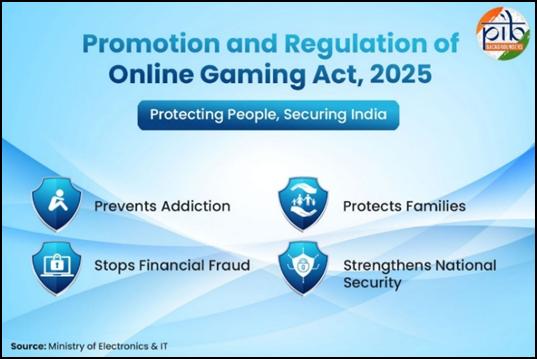
The Promotion and Regulation of Online Gaming Act, 2025 was enacted to bring clarity and balance to India’s online gaming ecosystem. It seeks to promote innovation in e-sports and online social games while firmly prohibiting online money games. The law sets out a clear distinction between permissible and prohibited activities in the sector.
The Act imposes a complete ban on all forms of online money games. This applies to games of chance, games of skill, and any mix of the two. It also prohibits their advertising, promotion and facilitation. Banks and payment systems are barred from processing transactions linked to such games. Unlawful platforms may be blocked in accordance with the Information Technology Act, 2000.
Strict deterrent penalties have been prescribed to ensure compliance. Offering or facilitating online money games may attract imprisonment of up to three years or a fine up to one crore rupees or both. Repeat offences carry a minimum of three years imprisonment, extendable to five. Fines range between one crore and two crore rupees. Advertising such games may invite up to two years imprisonment. Alternatively, a fine of up to fifty lakh rupees may apply, or both. Repeat violations attract higher penalties. Cyber cell officers at State and UT levels are empowered to investigate offences. This includes officers at police station, district, and Commissionerate levels.
Alongside prohibition, the Act promotes a safe and structured gaming environment. It provides recognition to e-sports and online social games. It establishes the Online Gaming Authority of India. It also introduces a transparent determination and registration system. Additionally, it provides a grievance redressal mechanism and safeguards to protect users from harm.
To learn more about the Act please click here.
What the Rules Aim to Achieve
The Rules give practical shape to the provisions of the PROG Act, 2025. They translate the intent of the law into clear procedures and obligations.
Their purpose is to:
- Provide a clear, transparent, and time-bound mechanism. This determines whether a game is an online money game and thus prohibited. Or whether it qualifies as a permissible online social game or e-sport.
- Establish the Online Gaming Authority of India as a unified, digital first regulator for the sector.
- Create a statutory registration regime for e-sports and such categories of online social games as may be notified.
- Issue mandatory user safety features, grievance redressal and transparency obligations for online game service providers.
- Lay down the procedure for inquiry and imposition of civil penalties under Section 12 of the Act.
- Provide an appellate mechanism to ensure accountability, fairness and observance of the principles of natural justice.
Collectively, these measures establish a clear, fair and effective framework for regulating the online gaming sector.
Key Pillars of the Regulatory Framework
The Rules are built around six key pillars. Together, they create a structured system for online gaming regulation in India. The framework is clear and comprehensive. It rests on core governance principles. These include oversight, classification, user protection, and enforcement.
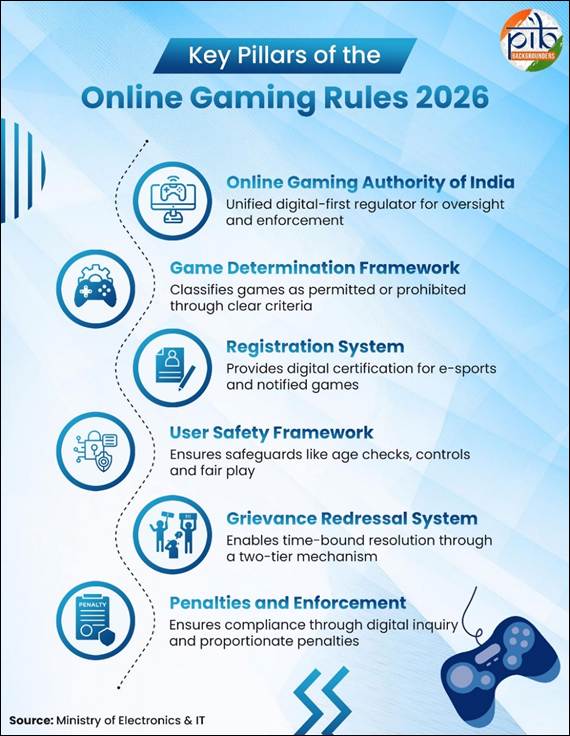
These pillars are outlined below.
Online Gaming Authority of India
- Constituted as an attached office of the Ministry of Electronics and Information Technology with its head office in the National Capital Territory of Delhi. It is designed to function as a digital office.
- Structured as a compact and multi-sectoral body. It is chaired by the Additional Secretary, MeitY. It includes Joint Secretary level representation from Home Affairs, Finance, Information and Broadcasting, Youth Affairs and Sports, and Law and Justice.
- Maintains and publishes the list of online money games and inquiries into complaints.
- Issues directions, orders and codes of practice, hears appeals on user grievances, and coordinates with financial institutions. It also works with law enforcement agencies. This ensures effective and timely action.
Determination of an Online Game
- Rules provides a clear test to classify whether a game is an online money game or a permissible category.
- Triggered through Suo motu action by the Authority, application by a service provider, or notification by the Central Government.
- It is based on objective factors such as payment of stakes, expectation of monetary winnings, revenue model, and monetisation of in game assets outside the game.
- To be completed, as far as practicable, within 90 days, with the outcome recorded in a determination order specific to the game and provider.
Registration of Online Games
- Required only when notified by the Central Government. It applies to all games offered as e-sports. The decision is based on risk to users, scale, financial transactions and country of origin.
- Successful registration leads to a digital Certificate of Registration with a unique number, valid for up to 10 years.
- Online money games are not eligible for recognition or registration as e-sports under the National Sports Governance Act, 2025.
- Service providers must display registration details. They must designate a point of contact. They must comply with data retention requirements and follow directions on facilitating payments.
User Safety Features
- Introduces user safety features as technical, procedural and behavioural safeguards suited to the risk profile of each game.
- Includes age verification, age gating, time restrictions and parental controls.
- Covers user reporting tools, counselling support, and fair play and integrity monitoring.
- Requires disclosure of safety features and internal grievance mechanisms at the time of application for determination or registration.
Two-Tier Grievance Redressal and Appellate Mechanism
- Every online game service provider must establish and maintain a functional grievance redressal system.
- Users may approach the Authority within 30 days if dissatisfied with provider’s resolution or if grievances remain unresolved.
- The Authority endeavours to dispose of appeals within a further 30 days.
- A second appeal lies before the Appellate Authority i.e., the Secretary, MeitY. The Authority should dispose of appeals within 30 days, as far as possible.
Penalties and Enforcement
- Proceedings are to be conducted in digital mode unless physical presence is considered necessary.
- Cases are to be concluded within 90 days from receipt of a complaint.
- Penalties are proportionate and consider gain from non-compliance, loss to users, recurrence and gravity.
- Mitigation efforts by the service provider are also to be taken into account while determining penalties.
- All penalties imposed under the Act shall be credited to the Consolidated Fund of India.
Together, these pillars create a clear and enforceable framework that ensures effective regulation while safeguarding users and supporting responsible growth of the sector.
Wider Impact on Citizens and Economy
The Promotion and Regulation of Online Gaming Act, 2025 is now supported by Rules coming into force on 1 May 2026. Together, they are expected to deliver wide-ranging benefits for society and the economy. The Act sets the legal foundation, while the Rules ensure that its provisions are implemented in a clear and time bound manner. Together, they create a balanced framework that promotes growth while safeguarding users.
Key positive impacts are:
- Boost to the Creative Economy: The Act supports India’s emergence as a hub for digital creativity and innovation. By encouraging e-sports and safe online games, it expands opportunities for exports and investment. It also creates new jobs across design, technology and content creation. This strengthens India’s position in the global digital economy.
- Empowering Youth: Young people gain access to safe and constructive digital spaces. E-sports and skill-based games help build confidence, discipline and teamwork. These platforms also open up new career pathways for talented players. Over time, this can nurture a new generation of professionals in the gaming sector.
- A Safer Digital Environment: Families are protected from predatory online money gaming platforms. Such platforms often rely on misleading claims of easy financial gains and can lead to user safety concerns including psychological risks like addiction and distress. The Act prohibits these practices, while the Rules ensure effective enforcement. This creates a healthier and more secure digital ecosystem.
- Strengthening Global Leadership: India is positioned as a leader in responsible gaming and digital regulation. The framework shows how innovation can be balanced with strong social safeguards. It offers a model for other countries dealing with similar challenges. This enhances India’s credibility in global digital governance.
In combination, the Act and the Rules balance innovation with strong safeguards, ensuring sustainable growth of the sector.
The Road Ahead for Online Gaming in India
The coming into force of the Rules on 1 May 2026 marks a new phase in the governance of online gaming in India. It brings clarity to a sector that has grown rapidly but lacked a unified framework. By aligning legal provisions with clear procedures, the framework ensures that regulation is both effective and predictable.
The Act and Rules strike a careful balance between innovation and protection. They enable growth of e-sports and online social games. They also firmly address risks posed by online money gaming. This strengthens user trust and provides certainty to industry stakeholders.
Over time, this framework is expected to support responsible expansion of the gaming ecosystem. It also reinforces India’s position as a credible voice in global digital policy. Strong safeguards and clear rules are now in place. The sector is better equipped to grow in a safe and sustainable manner.