

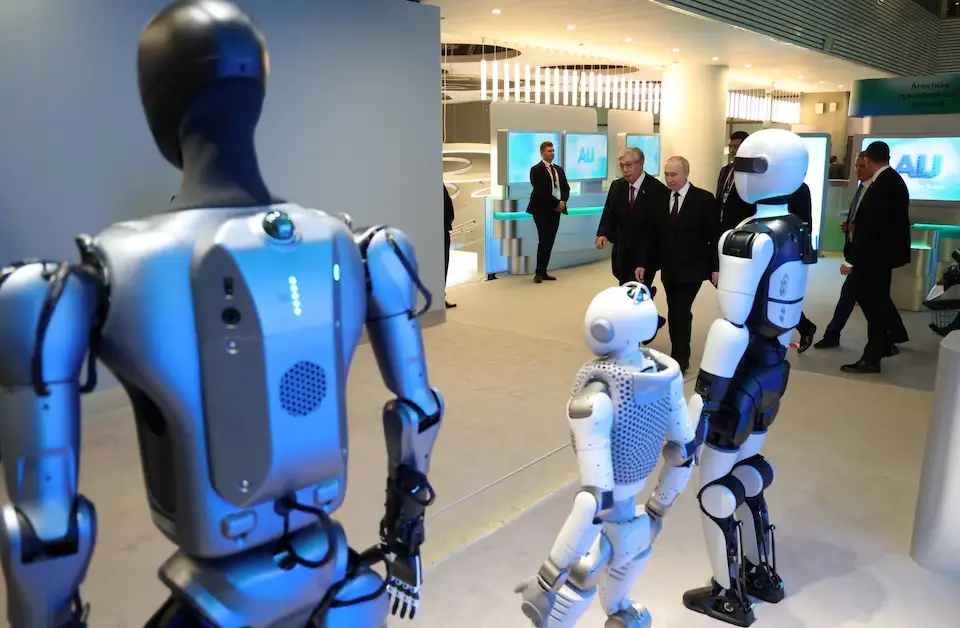
MOSCOW, Nov 26 (Reuters) – Kazakhstan’s President Kassym-Jomart Tokayev advanced his country’s AI ambitions at Russia’s main AI conference on Thursday, telling President Vladimir Putin that Russian companies Sberbank and Yandex were welcome in Kazakhstan’s market.
Tokayev’s visit to Moscow comes a month after he held a meeting with Nvidia (NVDA.O), opens new tab Chief Executive Jensen Huang in the Kazakh capital Astana, during which Freedom Holding, a big Kazakhstan bank, said it was placing a large order for Nvidia’s B300 chips.
Russia’s supercomputers are built on older versions of Nvidia chips. It is struggling to develop its AI industry and catch up with leaders United States and China, as US sanctions over its war in Ukraine have halted its imports of the US-made chips needed to train AI models.
Many Russian companies operate in Central Asian nations without restrictions, taking advantage of these countries’ continued relations with the West, as well as their proximity and business ties to China. Closer Russia-Kazakhstan cooperation on AI and a growing Russian corporate footprint in the ex-Soviet state could boost this trend.

“We are pleased to see Russian companies’ progress in our market, and they can rely on our comprehensive assistance,” Tokayev told Putin ahead of Sberbank’s AI Journey conference in Moscow.
BOTTLENECKS IN TECHNOLOGY RACE
Tokayev said that Russia-based technology group Yandex was the biggest employer in Kazakhstan, and a large delegation of his country’s AI entrepreneurs and officials responsible for AI joined the president on his visit to Moscow.
Sberbank unveiled new versions of its GigaChat AI model and its video-generating Kandinsky model on Thursday, and presented Tokayev and Putin with a new generation of its Grin AI-powered humanoid robots.
Russia does not produce its own advanced chips, and its supercomputers used to train AI models were built before the war in Ukraine began and the West imposed sanctions. The .
“A shortage of electricity, power grids, and complex component base are becoming bottlenecks in the technological race. Overcoming these barriers requires new, massive investments,” Putin told the conference.
CHINA-MADE CHIPS
A new Russian decree allows Russian companies to use data centres located abroad with the permission of security services. Putin signed it after Ukrainian drones targeted Russian data centres and supercomputers earlier this year.
Sberbank and Yandex did not publicly say whether they would respond by moving some of their services to data centres in other countries, as information about data centres at Russian companies is confidential.
Sberbank Chief Executive German Gref visited China in May to discuss access to the most advanced China-made chips, but a person with knowledge of those discussions told Reuters the talks were inconclusive.
The Russian daily Kommersant reported on Thursday, citing sources, that Gref, who was born in Soviet Kazakhstan, was also in regular discussions about AI development with Tokayev and was a frequent visitor to the Kazakh capital.
Sberbank did not comment on the report.
During Huang’s October visit to Kazakhstan, Freedom Holding, led by Russian-born entrepreneur Timur Turlov – who renounced his Russian citizenship in 2022 and also severed business links to Russia – announced plans to build a $2 billion Sovereign AI Hub in Kazakhstan.
“We are already placing an order for our first computing cluster powered by Nvidia’s latest B300 chips, with up to 300 servers and a total investment of hundreds of millions of dollars,” Turlov said at the time.
Huang, who this month resigned and was then reinstated to his role as CEO, also confirmed during the October visit that Nvidia had invested in Kazakhstan’s AI video generation startup Higgsfield as part of the statup’s $400-million funding round.