

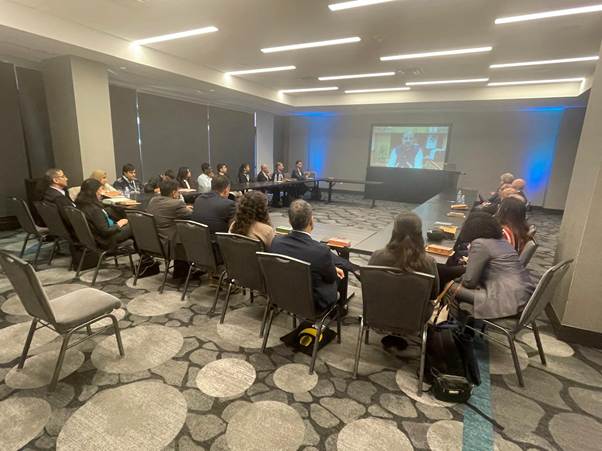
Addressing Indian agricultural diaspora at the World Food Prize Foundation programme in the United States virtually, Dr Jat highlights industry–academia collaboration, policy dialogue and international knowledge exchange
Dr. M. L. Jat, Secretary, Department of Agricultural Research and Education (DARE) and Director General, Indian Council of Agricultural Research (ICAR), has called for reimagining agricultural higher education to prepare future professionals to address global challenges, including climate change, natural resource degradation, biodiversity loss and the growing demand for nutritious and healthy food.
Addressing a Roundtable organized on the sidelines of the ‘2026 Norman E Borlaug International Dialogue’ during the World Food Prize Foundation at Des Moines in the United States virtually, Dr. Jat delivered his remarks as President of the National Academy of Agricultural Sciences (NAAS), India. He acknowledged the Academy’s representation at the programme by its Secretary, Dr. B.S. Dwivedi; Foreign Secretary, Dr. Karim Meredia; and Convener of the International Chapter for the Western Hemisphere, Dr. P.V. Varaprasad.
In his address, Dr Jat emphasised the need to transform agricultural education and research to meet the evolving requirements of agri-food systems. He highlighted India’s long-standing partnerships with global institutions, noting that international collaboration enables mutual learning and provides opportunities to share scientific and educational advancements.
He stressed the importance of moving beyond production-centric agriculture towards an integrated agri-food systems and value-chain approach. He underscored the need for stronger collaboration between academia and industry to develop industry-ready human resources and facilitate industry participation across the agri-food value chain, including support for farmers.

Highlighting the role of NAAS in agricultural policy and research, Dr Jat noted the importance of policy dialogues, policy papers and policy briefs in addressing critical issues in agricultural research and development. He emphasised the need to bring together researchers, policymakers, academic institutions, industry and other stakeholders to develop collaborative solutions to emerging challenges.
Dr Jat also highlighted efforts to connect the Indian agricultural diaspora with domestic research and educational institutions. Strengthening these networks, he noted, can facilitate international knowledge exchange and contribute to reimagining agricultural higher education through global expertise and experience.
Referring to efforts to expand international institutional partnerships, Dr Jat highlighted the signing of a Memorandum of Understanding (MoU) with the Council for Agricultural Science and Technology (CAST). The partnership is expected to create new avenues for cooperation in agricultural research, capacity development and knowledge exchange.
Dr. Jat expressed confidence that stronger international partnerships would contribute to advancing agricultural research, education and extension, with particular relevance for countries of the Global South. He called for collective efforts to transform agri-food systems and build a more resilient and sustainable future for agriculture worldwide.