

VIGOR programme to advance four AI-discovered drug candidates towards clinical development, strengthening India’s pharmaceutical innovation ecosystem
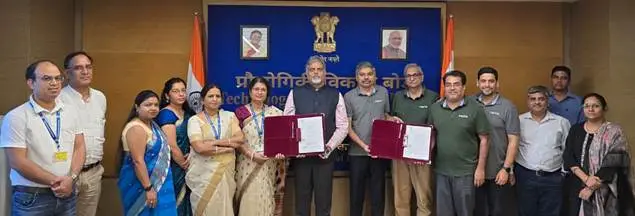
In a significant step towards accelerating the development of next-generation therapeutics through artificial intelligence, the Technology Development Board (TDB), Department of Science & Technology (DST), Government of India, has signed an agreement with Peptris Technologies Private Limited, Bengaluru, Karnataka for financial support of ₹86 crore under the Research Development and Innovation (RDI) Fund.
The project, titled VIGOR: Advancing AI-Discovered Molecules from Bench to Clinic, has a total project cost of ₹172 crore. It aims to advance four drug candidates from Technology Readiness Level (TRL)-4 to TRL-6 through preclinical development, validation and preparation for clinical trials. The financial support will be provided through Optionally Convertible Debt (OCD).
Artificial intelligence is opening new possibilities in drug discovery by enabling researchers to identify promising molecules, investigate disease mechanisms and accelerate the search for potential therapies. However, translating computational discoveries into viable drug candidates requires extensive experimental validation, preclinical studies and clinical development.
Peptris’ VIGOR programme seeks to address this critical transition by leveraging its proprietary AI-driven drug discovery platform to advance a portfolio of molecules towards clinical development. The programme focuses on therapeutic areas with significant unmet medical needs, with an emphasis on identifying and developing novel therapies through a combination of computational capabilities, scientific validation and established drug-development processes.

The programme covers four drug candidates: PEPR111, targeting neuromuscular disorders and oncology; PEPRX101, focused on alopecia; PEPR202, targeting neuropathy; and PEPR112, focused on DMD. Each candidate is currently positioned at TRL-4, with the project targeting advancement to TRL-6. The development programme envisages a structured progression over three years, encompassing advanced preclinical and investigational new drug (IND)-enabling studies, formulation development, clinical trial preparation and initiation activities, subject to the relevant scientific and regulatory requirements.
The VIGOR programme is designed to build on Peptris’ AI-based drug discovery capabilities and its existing platform experience to accelerate the development of novel therapeutic candidates. The approach combines AI-enabled discovery with established drug-development expertise, including the use of global contract research organisation (CRO) networks to support development and validation. By supporting the advancement of multiple candidates within a coordinated programme, the project seeks to strengthen the translation of AI-led research into potential therapeutic products. Its focus on selected disease areas also reflects the opportunity to direct innovation towards conditions where effective treatment options remain limited.
Sh. Rajesh Kumar Pathak, Secretary, TDB, said, “The application of artificial intelligence in pharmaceutical research has the potential to transform how new drug candidates are identified and developed. However, translating promising discoveries into validated therapeutic candidates requires sustained investment, rigorous scientific evaluation and a structured development pathway. Through the RDI Fund, TDB is supporting such technology-intensive programmes to help bridge the gap between innovation and clinical development, while strengthening India’s capabilities in biotechnology, pharmaceuticals and AI-led healthcare innovation.”
Representative of Peptris Technologies Private Limited said, “The support from TDB under the RDI Fund will help us advance our VIGOR programme and progress our AI-discovered molecules through critical preclinical development milestones. Our approach combines AI-driven discovery with experimental validation and established drug-development processes to address unmet medical needs. This partnership will support our efforts to translate promising computational discoveries into therapeutic candidates with the potential to progress towards clinical development.”