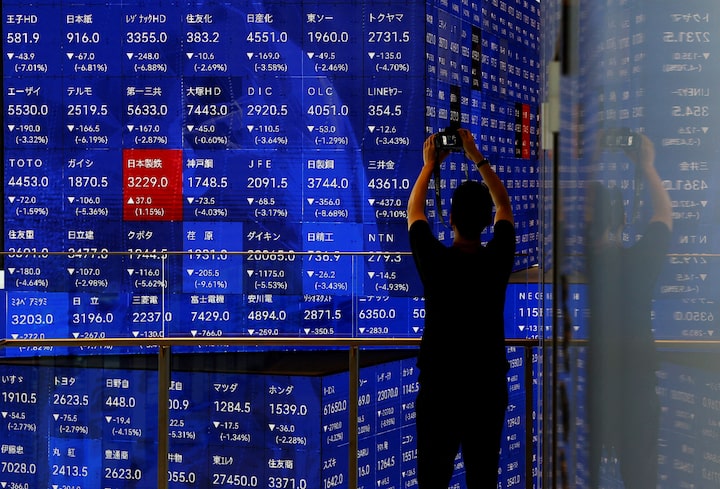
A man takes a photo next to an electronic stock quotation board inside a building in Tokyo, Japan August 2, 2024. REUTERS

Traders work on the floor at the New York Stock Exchange (NYSE) in New York City, U.S., December 10, 2024. REUTERS

A visitor stands next to an electronic screen displaying Japan’s Nikkei stock prices quotation board, inside a building in Tokyo, Japan February 22, 2024. REUTERS
BOSTON/LONDON/SINGAPORE, Jan 28 (Reuters) – U.S. stock futures steadied, the dollar ticked higher and tech stocks in Asia slid on Tuesday following a wave of selling as apparent advances by a Chinese AI startup cast doubt on U.S. dominance and spending in one of the market’s hottest sectors.
Overnight, chipmaker Nvidia (NVDA.O), dived 17%, wiping off nearly $593 billion in the biggest market capitalisation loss in history.
“We are on the front edge of an urgent re-evaluation of a narrative that has gripped the market for almost two years. That makes it hard to shrug off after 36 hours,” said Brent Donnelly, president of trading and analytics firm Spectra Markets.
Nvidia stock was up slightly in after-hours trading. Nasdaq 100 futures rose 0.1% and S&P 500 futures were broadly flat.
Nvidia supplier Advantest (6857.T), was down 10% in Japan on Tuesday, taking losses for the week so far to nearly 19%. There were further sharp falls for AI-backer SoftBank Group (9984.T), down 5.5%, and data-centre cable maker Furukawa Electric (5801.T), down 8%. Both had already fallen heavily on Monday, with SoftBank now 13% lower after two days and Furukawa down 20%.
Advertisement · Scroll to continue
Data centre landlords tumbled in Australia. Tech heavy markets in Taiwan and South Korea were closed for a holiday.
Nvidia accounted for most of the 3% drop in the Nasdaq on Monday though selling extended from Tokyo to New York and hit everything with a slice of the AI supply chain, from cable makers to data centres, power utilities and software firms.
The CBOE Volatility Index (.VIX), known as Wall Street’s fear gauge, leapt and safe-haven assets such as government bonds, the yen and the Swiss franc all rallied.
Ten-year U.S. Treasury yields fell 9.5 basis points, and were last steady at 4.55% in Asia. Fed fund futures have put in an extra 9 bps of easing by year end. Even oil prices dropped 2% on worries about energy demand.
DeepSeek, a little-known startup from Hangzhou, China, has a free AI assistant it said was developed very cheaply using lower-cost chips and less data than U.S. rivals.
“The narrative that’s concerning people here is that DS … has delivered performance-topping models on a shoestring budget,” said J.P. Morgan sector specialist Josh Meyers in a note to clients.
“This has been seen by some as egg-on-the-face of the big, multi-billion dollar operations like OpenAI, Google and Anthropic. And it’s calling into question whether we’ll need multi billions of dollars in compute capex when DeepSeek’s leading distilled models can run natively on an iPhone.”
BROAD RISK-OFF MOOD
The S&P 500 (.SPX) on Wall Street dropped 1.5%. Chipmaker Broadcom (AVGO.O), fell 17.4% and the Philadelphia semiconductor index (.SOX), dropped 9.2% – its biggest loss since March 2020.
Gold prices declined more than 1% as investors liquidated bullion to cover losses elsewhere.
Google parent Alphabet (GOOGL.O), fell 4.2% and Microsoft (MSFT.O), fell 2.1%, with both steadying in after-hours trade.
In Europe, the STOXX Europe 600 technology index (.SX8P), fell more than 3% and ASML (ASML.AS), which makes chip manufacturing equipment, fell 7%.
Bitcoin , lately a barometer of markets’ risk appetite, dropped below $100,000 for the first time in a week before steadying around $101,700.
The dollar fell nearly 1% against the yen overnight and 0.4% against the Swiss franc <CHF=EBS> – two currencies that often gain during periods of market unease.
Early on Tuesday it ticked higher against both, trading at 155.36 yen and making modest gains elsewhere, holding the euro to $1.0454. Markets in China were closed to usher in the Lunar New Year and Hong Kong trade closes at noon.
Both the U.S. Federal Reserve and the European Central Bank meet to set interest rates later in the week.
Reporting by Lawrence Delevingne in Boston, Samuel Indyk in London and Tom Westbrook in Singapore; Additional reporting by Davide Barbuscia; Editing by Rod Nickel and Christopher Cushing