

Ayurveda for a Healthier Tomorrow
स्वस्थ भविष्य के लिए आयुर्वेद
On the 11th Ayurveda Day, India celebrates a decade of bringing its 5,000-year-old healing system into every day, modern healthcare through evidence-led scientific research. Today, government clinics and hospitals across the country offer Ayurvedic treatments right alongside regular medical care. Free online doctor visits, insurance coverage, and top-tier scientific research are making these ancient wellness practices safer and far easier for everyone to access. Through strong global partnerships, India is showing the world how traditional wisdom and modern science can work together for a healthier future.
Ayurveda: The Foundations of Holistic Living
Ayurveda is a science of life that is over 5,000 years old. It has roots tracing back to the Rigveda. The word Ayurveda is derived from Ayu (life) and Veda (science), with its foundational goal –“Swasthasya Swasthya rakshnam, aturasya vikara prashaman”-being to maintain wellness in the healthy and cure illness in the sick.
Ayurveda defines true health as a harmonious balance of metabolic entities. This requires optimal alignment among the bio-energies (doshas), metabolic fire (agni), bodily tissues (dhatus), and waste elimination (malas), alongside a serene soul (atma), mind (manas), and senses (indriyas). By utilising the medicinal and therapeutic properties of plants, animal products, and minerals, which are also described in the Charaka Samhita and Sushruta Samhita, Ayurveda remains an ancient science with modern relevance. Central to this science is the principle that good health is a state of total alignment between the individual body, mind, and spirit – and the surrounding world.

To honour and promote this heritage, the Government marks September 23rd annually as Ayurveda Day, aligning with the autumnal equinox to reflect natural balance. Under the theme “Ayurveda for a Healthier Tomorrow,” the Government is executing a national strategy to revive traditional healthcare.
The Government is also establishing an ecosystem to support the growth of the Ayurveda sector. This is through upgrading education, advancing evidence-based R&D, establishing drug standards, global outreach, and integrating Ayurveda with modern medicine. This whole-of-government approach runs in tandem with the growing global popularity of Ayurveda and allied traditional medical systems, including Yoga & Naturopathy, Unani, Siddha, and Homoeopathy.
Building the Health Infrastructure
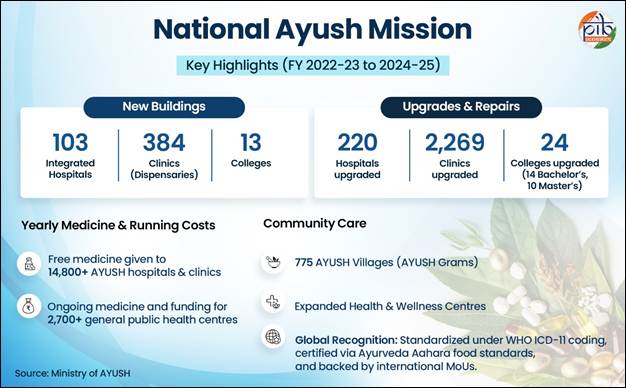
The Government, through its National Ayush Mission (NAM), and the National Health Mission, is expanding, modernising and integrating Ayush systems, including Ayurveda, into mainstream public medicine. The two national missions run by the Ministry of Ayush and the Ministry of Health and Family Welfare, respectively, are establishing Ayush clinics, hospitals, departments and community public health centres across the country.
The NAM is driving the expansion and integration of Ayush healthcare in the country. Between the financial years 2014–15 and 2025–26, the Central Government released over Rs.6,406.99 crore through the NAM to States and Union Territories to weave Ayush healthcare into conventional medical systems.The NHM is also supporting some of these initiatives. These initiatives include:
- Modernising and Establishing Local Ayush clinics/health centres: Existing health clinics (dispensaries) are being modernised and upgraded into better-equipped wellness centres called Ayushman Arogya Mandirs (Ayush). This is a collaborative effort by the NHM, which supports Ayush AAMs by funding and training Ayush health personnel, and the NAM, which provides for the infrastructure, equipment/furniture, and medicines.
- There are 12,260 Ayush AAMs functional (as on September 19, 2026). The NAM is targeting the setup of 12,500.
- These Ayush AAMs are also being co-located with other community health centres through the NHM. The NHM helps offer Ayush services alongside standard medical care in 13,249 public health facilities nationwide.
- Facilities Covered (as on December 30, 2025):
- 6,302 Primary Health Centres
- 3,191 Community Health Centres
- 475 District Hospitals
- 3,281 Other local health facilities
- Staffing Support: The government funds salaries for 25,322 Ayush doctors and 5,666 Ayush paramedics working across various states and union territories.
- Facilities Covered (as on December 30, 2025):
- A trained Ayurveda practitioner (a Bachelor of Ayurveda, Medicine and Surgery graduate) can be a Community Health Officer (CHO) to manage a village-level primary healthcare centre, providing a holistic approach to healthcare.
- Combining Services Under One Roof: Adding traditional medicine counters and doctors inside standard public healthcare facilities, including local health centres and district hospitals.
- Upgrading Existing Hospitals & Clinics: Repairing and updating standalone traditional medicine hospitals and clinics.
- Building Better Facilities: Fixing run-down clinic buildings, moving clinics out of rented spaces into permanent ones, and constructing brand-new clinics in areas that currently have no traditional medicine services.
- Building New Integrated Hospitals: Setting up new 10, 30, or 50-bed hospitals that combine different traditional medicine practices under one roof.
- Providing Essential Medicines: Ensuring a steady, free supply of necessary traditional medicines to government clinics, hospitals, and teaching facilities.
- Community Health Programs: Running public health drives tailored around traditional wellness and preventive care.
- Awareness Campaigns: Creating educational programs, advertisements, and community outreach to teach people about health, wellness, and available treatments.
- Opening New Medical Colleges: Building new traditional medicine colleges in states and regions that do not have enough public options for students.
- Improving Medical Schools: Upgrading campus facilities, classrooms, and equipment for existing colleges, while adding advanced degrees, pharmacy programs, and paramedic training.
The Government is also expanding Ayush care by establishing Departments of Integrative Medicine at these central government hospitals:
- Vardhman Mahavir Medical College (VMMC) & Safdarjung Hospital, and
- Lady Hardinge Medical College.
These departments provide preventive, promotive, and therapeutic medical services, including a fully functional Panchakarma unit. Additionally, extended OPD services by Ayush Research Councils are available at:
- Vardhman Mahavir Medical College (VMMC) & Safdarjung Hospital,
- Lady Hardinge Medical College, and
- Dr. Ram Manohar Lohia Hospital.
Ayush services are also available at the new All India Institute of Medical Sciences.
Telemedicine
The government offers a free telemedicine service–eSanjeevani–which has served over 50 crore patients. In addition to conventional medicine, eSanjeevani also offers Ayush OPD services, allowing patients to virtually consult doctors specialised in Ayurveda (and other Ayush services) directly through the platform.
Health Insurance
The government has updated insurance policies to cover Ayush treatments under health insurance plans. In 2024, the Insurance Regulatory and Development Authority of India (IRDAI) mandated that all insurers are required to offer products or add-ons covering all systems of medicine–including Ayurveda–under Board-approved underwriting policies.
On February 10, 2026, the All-India Institute of Ayurveda (AIIA), New Delhi, signed a Common Empanelment Memorandum of Understanding (MoU) with the General Insurance Council (GIC). This empanelled AIIA with all 32 general insurance companies in India, marking the first time an Ayush institution entered into a universal empanelment agreement for cashless treatment. The AIIA also launched a dedicated Ayush Health Insurance Helpline (1800-11-0008) to assist beneficiaries with their insurance-related queries and improve awareness about Ayush insurance coverage.
Inclusion of Ayurveda in the WHO ICD-11 Module
Ayurveda’s terms are now internationally recognised due to the World Health Organisation including it in the International Classification of Diseases 11th Revision Module. This inclusion will now enable clinicians worldwide to record ASU (Ayurveda, Siddha and Unani) diagnoses using standard codes, ensuring uniform interpretation across different regions and health facilities. It also makes it easier for insurance providers to process, approve, and reimburse Ayush treatments, help with research and development and policy-making, including making disease-control strategies for the future.
Development of Ayurveda Educational Infrastructure
An expanding Ayush health infrastructure also needs Ayush health personnel to run it. The NAM makes provisions for the expansion of education in Ayurveda through the establishment of undergraduate and postgraduate institutions, including pharmacy and para-medical programmes.
17 Ayush colleges have been approved for establishment across the country under the NAM, out of which 12 are centred on impacting Ayurvedic education. Ayurveda educational institutions–both public and private–are growing in number and helping build the sector. Across the country (as on March 13, 2026), there are:
- 593 Ayurveda colleges,
- 45,245 undergraduate Ayurveda seats, and
- 5,673 post-graduate Ayurveda seats.
Beyond clinical training and academic expansion, establishing Ayurveda’s credibility within contemporary medicine requires rigorous, evidence-based research and scientific validation.
Research and Development in Ayurveda
To advance research and development in Ayurveda, the government runs several schemes aimed at modernising traditional medical practices and strengthening drug development.
AYURGYAN Scheme
Central to these efforts is the AYURGYAN scheme, launched in 2021-22 by the Ministry of Ayush, which provides financial backing for R&D initiatives. Out of a total research funding pool of Rs. 17.79 crore across 34 projects, Ayurveda accounts for half of the portfolio, receiving Rs. 9.38 crore for 17 dedicated projects.
By early 2026, 11 specific research projects had been approved, with six focused on developing safety and efficacy dossiers for five key single Ayurvedic botanicals. These efforts reflect a growing academic output, contributing to 33 Ayurvedic-specific research publications between 2014-15 and 2025-26, and 77 total publications since 2001-02.
AYUR SWASTHYA Yojana
Complementing AYURGYAN scheme is the AYUR SWASTHYA Yojana (2021-2026), which provided financial assistance to government or non-profit Ayush organisations for research and developmentinto Ayush clinical and drug research, education, public health initiatives, and for the upgradation of facilities to Centres of Excellence.
Out of 25 projects supported through late 2025, 22 focused on or incorporated Ayurveda interventions. The scheme established 28 specialised Centres of Excellence, with 22 dedicated to advancing Ayurveda-centric research and healthcare delivery.
Central Council for Research in Ayurvedic Sciences (CCRAS)
At the institutional level, the Central Council for Research in Ayurvedic Sciences (CCRAS)-one of five autonomous research bodies under the Ministry-leads the scientific formulation, coordination, and promotion of Ayurvedic studies nationwide. Operating through a network of 30 national and regional institutes, CCRAS builds research capacity through fellowships, training programs, and targeted student initiatives such as the SPARK Programme.
SPARK Programme
The Studentship Programme for Ayurveda Research Ken (SPARK) fosters research interest and aptitude among undergraduate Ayurveda students. The programme supports short-term independent projects to encourage students to conduct research in Ayurveda. Between 2022-23 and 2024-25, 289 Ayurveda colleges benefited through the SPARK programme.
AI-Translation of Ayurveda Research
To make scientific knowledge accessible to everyone, the CCRAS partnered with Anuvadini AI-an artificial intelligence translation platform developed by the Ministry of Education’s AICTE-in March 2026. Through this collaboration, CCRAS is translating its extensive research findings, educational resources, and quarterly medical journals into 13 regional Indian languages.
By breaking down language barriers, this initiative democratises access to Ayurvedic medical research, ensuring that students, practitioners, and the general public across India can easily read and learn from these scientific developments.
Development of Medicinal Plants
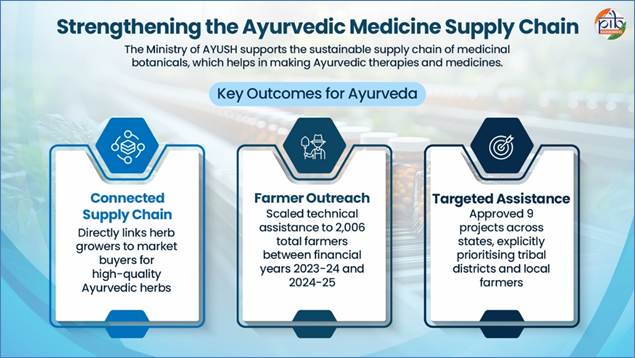
The Government actively supports farmers and research bodies in conserving, cultivating, and processing therapeutic herbs. It does so by bridging supply chain gaps, incentivising farmers while empowering local communities and maintaining pharmaceutical standards.
Strengthening Regulatory Standards: Drug Safety and Consumer Foods
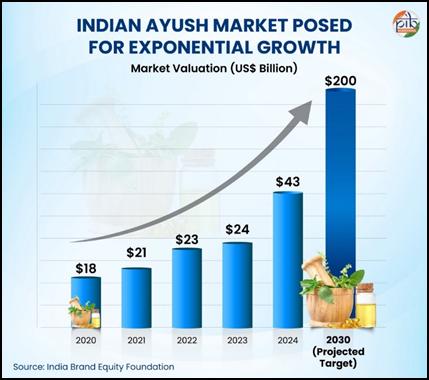
As the Ayurveda market booms, the Government is also establishing a legal framework to ensure that the products are safe for consumers.
Quality Control of Medicines
Ayurvedic medicines are strictly regulated under the Drugs & Cosmetics Act, 1940, and the Drugs Rules, 1945. Under these legal frameworks:
- Manufacturers must adhere to Good Manufacturing Practices (GMP), prove drug safety and efficacy, and meet pharmacopoeia standards.
- Government Drug Inspectors conduct routine sampling and testing to maintain quality control, supported by a specialised Ayush vertical established within the Central Drugs Standard Control Organisation (CDSCO).
To streamline compliance, the government launched the e-Aushadhi portal for paperless processing and real-time tracking of drug manufacturing license applications.
Ayurveda Aahara
Extending these safety principles from pharmaceuticals to nutrition, the Food Safety and Standards Authority of India (FSSAI), in collaboration with the Ministry of Ayush, introduced a standardised regulation for Ayurveda Aahara. This initiative establishes a product list of authentic Ayurvedic dietary items based on authoritative classical texts. This list is also crucial for licensing and registration of traditional food manufacturers. It creates a transparent, regulated sector for traditional food manufacturers while boosting consumer confidence in India and globally.
Expanding International Partnerships and Diplomatic Ties
For the global acceptance and market integration of Ayush, the Government has established strategic bilateral partnerships, research collaborations, and educational exchanges worldwide. This is through the signing of various country-to-country agreements, research collaborations, educational exchange programmes, and global certification of medicines.
International Collaborations
Through strategic international partnerships, collaborative research frameworks, academic chair appointments, and specialised scholarship programs, the country continues to establish a strong international footprint in holistic healthcare and integrative medicine. India has signed various MoUs, such as:
- 27 Country-to-Country MoUs for cooperation in traditional medicine and Homoeopathy.
- 16 MoUs with international institutes for setting up Ayush Academic Chairs.
- 57 Institute-to-Institute MoUs for collaborative research and academics.
- 3 Country-to-Country MoUs signed in 2025-26 in Angola, Kazakhstan and Tanzania and 6 institute-level MoUs signed with institutions in Ghana, South Africa, Réunion Island, Germany, Malaysia and Mongolia, and an academic chair MoU with Oman.
This global footprint is further supported by:
- 46 Ayush Information Cells established across 43 foreign nations.
- 104 scholarships offered to foreign nationals under the International Ayush Fellowship/Scholarship Program.
Leading Global Summits, Frameworks, and Strategic Agreements
India is now a global hub for policy and standards in traditional medicine. In December 2025, New Delhi hosted the Second WHO Global Summit on Traditional Medicine at Bharat Mandapam. The event gathered delegates from over 100 countries and 22 health ministers under the theme “Restoring Balance: The Science and Practice of Health and Well-being“. Attendees adopted the Delhi Declaration, encouraging member states to bring traditional medicine into primary healthcare through proven scientific methods.
Setting International Standards and Promoting Cultural Diplomacy
Setting strict quality and training standards drives India’s global strategy. The WHO Global Traditional Medicine Centre in Jamnagar, Gujarat, acts as a primary research and policy hub. The Ministry of Ayush partnered with the WHO to create standard training guides for Ayurveda and Unani. It also co-hosted an herbal drug regulation workshop with 17 nations and presented research at the International Conference on the Science of Botanicals in the US. Cultural outreach continues to expand.
The 11th International Day of Yoga in June 2025 featured roughly 2,000 events across 191 countries. Meanwhile, daily Yoga sessions at World Expo 2025 in Osaka, Japan, turned the Indian Pavilion into one of the event’s most visited highlights.
Multilateral Cooperation and Medical Value Travel
India continues to embed traditional healthcare into major international alliances. Following recent BRICS statements, including the Rio de Janeiro Declaration, the 16th BRICS Health Ministers’ Meeting in Chandigarh established a dedicated Expert Working Group on Traditional, Complementary, and Integrative Medicine.
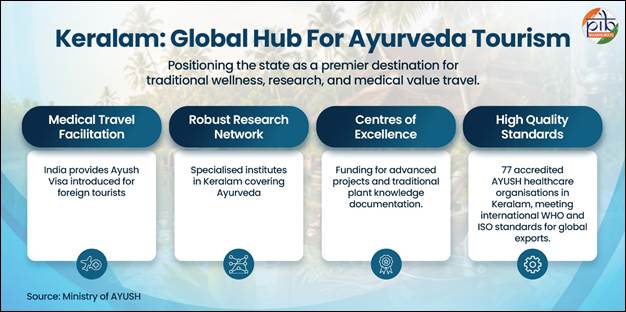
At the same time, the government is making it easier for foreign patients to seek natural care in India. Specialised Ayush Visa options now streamline travel, offering the M-3 visa for patients and the M-4 visa for their accompanying caregivers. This initiative supports India’s aim to be a global medical tourism hub.
Union Budget 2026-27 Allocations for the Ayush Sector
The Union Budget’s (2026-27) allocation of Rs. 4,408 crores for the Ministry of Ayush highlights the government’s commitment to strengthening Ayush healthcare systems across the country, promoting evidence-based research and innovation, and strengthening other Ayush-related infrastructure and global outreach. The Budget announced several key initiatives:
- Establishment of three new All India Institutes of Ayurveda (AIIA) to strengthen education, clinical services and research.
- Upgradation of Ayush pharmacies and Drug Testing Laboratories to ensure quality, standardisation and availability of skilled manpower.
- Upgradation of the WHO Global Traditional Medicine Centre, Jamnagar, to promote evidence-based research and global outreach in traditional medicine.
Integrating Tradition with Modern Health Systems
Ayurveda’s journey from an inherited knowledge tradition to an increasingly institutionalised component of contemporary healthcare reflects its evolving relevance in modern society. The expansion of healthcare infrastructure, education, research, regulatory mechanisms, digital access, and international collaborations has created a broader ecosystem for its development and responsible integration. The growing emphasis on scientific validation, quality standards, and evidence-based research is particularly significant in strengthening its contemporary relevance.
At the same time, Ayurveda’s integration into public health systems and its expanding global partnerships show how traditional knowledge can engage with modern institutions and scientific inquiry. Ayurveda’s continuing evolution thus represents a dynamic interface between India’s civilisational knowledge, contemporary healthcare systems and the pursuit of holistic well-being.