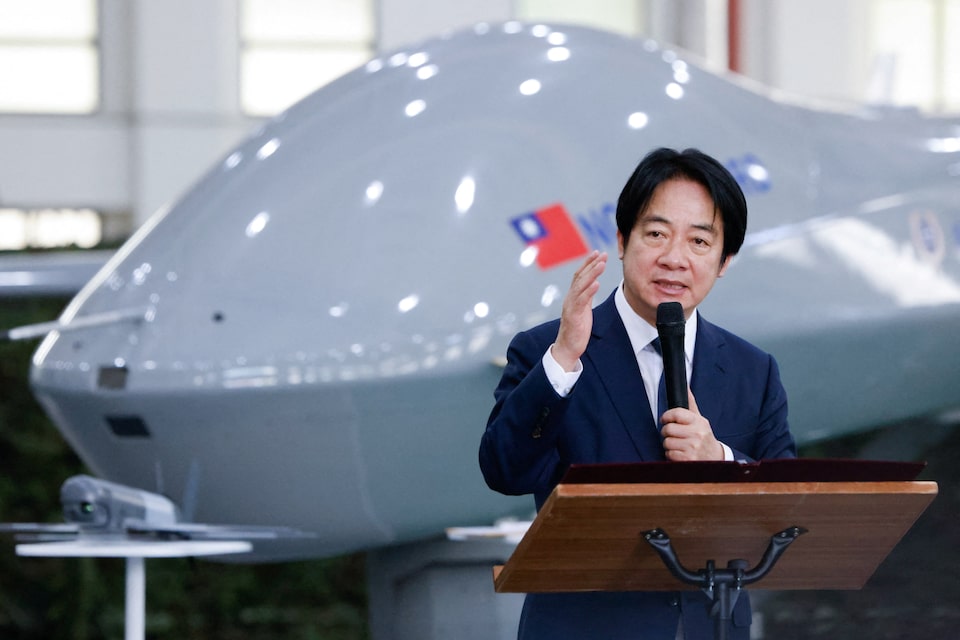
Taiwan President Lai Ching-te speaks in front of a Teng Yun unmanned aerial vehicle during a visit to the National Chung-Shan Institute of Science and Technology (NCSIST) to inspect developments in drone technology in Taichung, Taiwan, July 17, 2026.
 The Albatross II unmanned aerial vehicle is displayed during a visit by Taiwan President Lai Ching-te to the National Chung-Shan Institute of Science and Technology (NCSIST) to inspect developments in drone technology in Taichung, Taiwan, July 17, 2026.
 Taiwan President Lai Ching-te listens to a briefing on the Mighty Hornet IV unmanned aerial vehicle, jointly developed by the National Chung-Shan Institute of Science and Technology (NCSIST) and Kratos Defense & Security Solutions, during a visit to NCSIST to inspect developments in drone technology in Taichung, Taiwan, July 17, 2026.
 Engineers demonstrate a mobile unmanned aerial vehicle (UAV) flight simulator at the National Chung-Shan Institute of Science and Technology (NCSIST) during a visit by Taiwan President Lai Ching-te to inspect developments in drone technology in Taichung, Taiwan, July 17, 2026.
 Locally developed anti-radiation unmanned aerial vehicles (UAVs) in launch canisters at the National Chung-Shan Institute of Science and Technology (NCSIST) during a visit by Taiwan President Lai Ching-te in Taichung, Taiwan, July 17, 2026.
TAICHUNG, Taiwan, July 17 (Reuters) – Taiwan must heed international calls to share the responsibility for “collective defence”, President Lai Ching-te said on Friday, appealing for parliamentary support for new spending on drones.
While Taiwan’s government has prioritised drones and other asymmetric systems, in May the opposition-dominated parliament passed only two-thirds of the T$1.25 trillion ($38.69 billion) in extra defence spending Lai had asked for, earmarking funds only for U.S. arms.
The government has now proposed a new, T$210 billion package for surveillance, coastal attack and small surface drones to the end of 2031. Taiwan’s opposition parties are pushing their own drone spending plans.
Speaking to reporters during a visit to government arms contractor the National Chung-Shan Institute of Science and Technology in the central city of Taichung, Lai said Chinese pressure on Taiwan has become increasingly intense.
“To demonstrate our determination to safeguard the nation, maintain stability across the Taiwan Strait, and uphold peace in the Indo-Pacific, we must respond to the international call to share the responsibility of collective defence,” he said.
China views democratically-governed Taiwan as its own territory and has never renounced the use of force to bring the island under its control. Lai and his government reject Beijing’s sovereignty claims.
Lai said that looking at the Ukraine-Russia conflict and the fighting between the United States and Iran, drones have become the “most important assets on the battlefield”.
Lai said he hoped parliament would support drone spending plans.
“I also call on both the ruling and opposition parties to jointly support national security and industrial development, in order to respond to the international community’s expectations regarding Taiwan’s determination to safeguard its security,” he said.
The United States, Taiwan’s most important arms supplier and international backer, has strongly backed the government’s plans to boost defence spending, especially on drones.
Earlier this month, the top U.S. diplomat in Taiwan said Taiwan needs a “hornet’s nest” of drones to help deter conflict and provide security.
The Trump administration has called on U.S. allies to spend more on their militaries, something Lai has strongly embraced.
($1 = 32.3110 Taiwan dollars)
Reporting by Ann Wang; Writing by Ben Blanchard; Editing by Jamie Freed.