
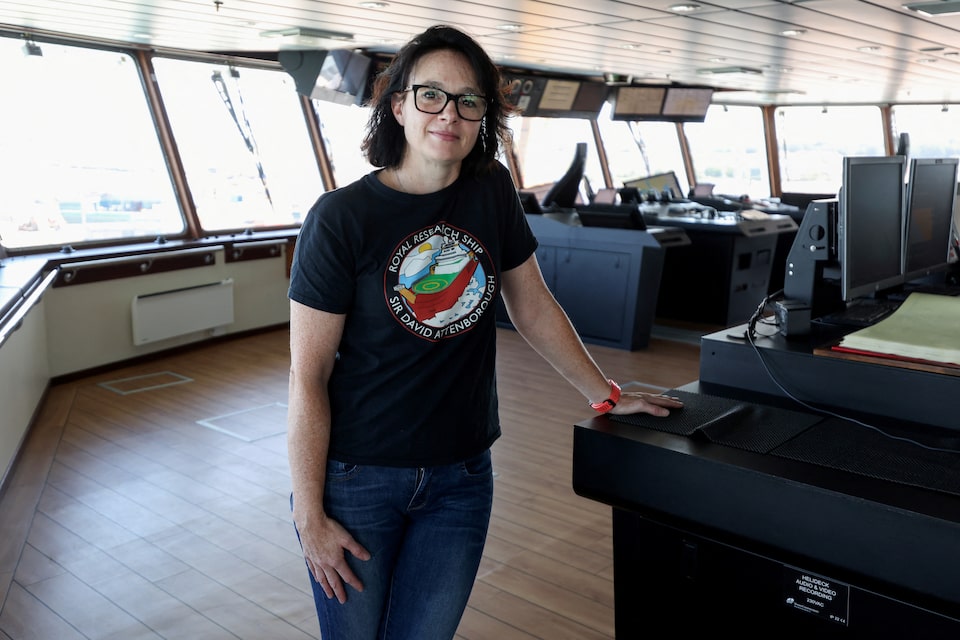
Dr Kelly Hogan, marine geophysicist, British Antarctic Survey, poses aboard the RRS Sir David Attenborough during a tour of the vessel ahead of a mission to Greenland to study how warming affects the ice sheet and improve forecasts of its impact on the Atlantic, in Harwich, Britain.

Captain Matt Neill, master of the RRS Sir David Attenborough ahead of a mission to Greenland to study how warming affects the ice sheet and improve forecasts of its impact on the Atlantic, in Harwich, Britain.
Sam Smith, an Operations Engineer, alongside Auto Sub Boaty McBoatface aboard the RRS Sir David Attenborough ahead of a mission to Greenland to study how warming affects the ice sheet and improve forecasts of its impact on the Atlantic, in Harwich, Britain.
Sam Smith, an Operations Engineer, alongside Auto Sub Boaty McBoatface aboard the RRS Sir David Attenborough ahead of a mission to Greenland to study how warming affects the ice sheet and improve forecasts of its impact on the Atlantic, in Harwich, Britain.
The RRS Sir David Attenborough remains docked in the port of Harwich ahead of a mission to Greenland to study how global warming is affecting the ice sheet and to improve forecasts of its impact on the Atlantic, in Harwich, Britain.
Martim Mas e Braga and Yoram Terleth from the British Antarctic Survey work with a fixed-wing drone on the heli-deck of the RRS Sir David Attenborough moored in Harwich Port ahead of a mission to Greenland to study how warming affects the ice sheet and improve forecasts of its impact on the Atlantic, in Harwich, Britain.
Sam Smith, an Operations Engineer, alongside Autosub Boaty McBoatface aboard the RRS Sir David Attenborough ahead of a mission to Greenland to study how warming affects the ice sheet and improve forecasts of its impact on the Atlantic, in Harwich, Britain.
Captain Matt Neill, master of the RRS Sir David Attenborough ahead of a mission to Greenland to study how warming affects the ice sheet and improve forecasts of its impact on the Atlantic, in Harwich, Britain.
HARWICH, England, July 15 (Reuters) – An international team of around 80 scientists and crew will set sail on polar research ship the RSS David Attenborough for Greenland this week to investigate whether the island’s rapidly melting glaciers could disrupt a major Atlantic Ocean current system and with it Europe’s climate.
The five- to six-week mission departs Britain after the country and Western Europe just experienced the warmest June months on record, disrupting power supplies, shutting schools and causing excess deaths.
“The heat waves in the UK and in Europe the last few months have really driven home that it’s difficult for us to adapt to even quite small changes in our climate,” Kelly Hogan, a marine geophysicist at the British Antarctic Survey which is leading the mission, told Reuters in an interview on board the vessel.
The expedition is part of a £20 million project called GIANT – Greenland Ice sheet to AtlaNtic Tipping points – which seeks to understand how the glaciers melt and break into the ocean and the impact this has.
Scientists are concerned that the melting freshwater could disrupt a system of rotating ocean current that helps to regulate Europe’s climate, which could lead to more extreme weather and rising sea levels.
Ship Captain Matt Neill, who made his first trip to Antarctica as a cadet with BAS in 2011, said he has already witnessed first hand the impact of the world’s changing climate.
“Lots of the glaciers are all receding very very quickly, and much more than you would think… So it’s even more important than than ever during these very dynamic times that we are out there and gathering the data and improving the models,” he said.
BOATY MCBOATFACE
Officially the ship is named after the veteran naturalist Attenborough, but to many Britons it will always be known as “Boaty McBoatface”, after that suggestion topped a public poll to name the vessel in 2016.
The name has instead been given to a high tech submersible on the vessel which will dive 1500 metres below the glacier mélange – a mixture of sea ice and snow that builds up where the glacier meets the sea – mapping its geometry and how it influences the glacier.
“It’s going to be collecting a lot of data that’s never really been collected before,” Sam Smith, operations engineer at the National Oceanography Centre, said.
Data collected from the mission will feed into next-generation climate models and an early-warning system for glacier collapse.
Reporting By Susanna Twidale; Editing by Chizu Nomiyama.