
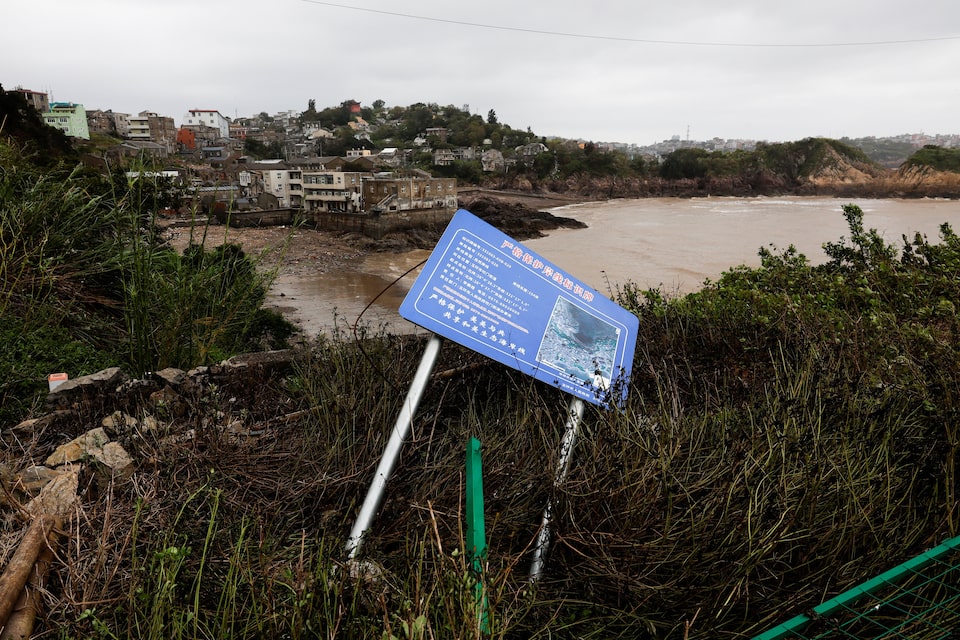
A toppled information sign in the aftermath of Typhoon Bavi in the coastal village of Dongsha, Taizhou, Zhejiang province, China.
 A toppled metal structure after strong winds brought by Typhoon Bavi near Wenzhou, Zhejiang province, China.
 A person rides an electric scooter through a flooded road after heavy rain brought by Typhoon Bavi in Wenzhou, Zhejiang province, China.
 A person sits beside a collapsed wall in the aftermath of Typhoon Bavi in the coastal village of Dongsha, Taizhou, Zhejiang province, China.
HONG KONG, July 13 (Reuters) – Severe flooding in China’s northern Hebei province and northeastern Liaoning province submerged roads and swept away cars, while people swam and paddle-boarded along neighbourhood streets, videos on social media showed.
Water levels rose to more than two metres on roads in Kuancheng, a county in Hebei, according to a resident’s account that was broadcast by local official media.
Kuancheng is home to around 240,000 people and is located on the banks of the Luan River.
Several cars were filmed crashing into each other in Kuancheng as they bobbed up and down a waterlogged road before being carried away by the strength of the current.
The floods came after Typhoon Bavi, the most powerful storm to strike mainland China this year, brought heavy rain to the eastern coast and violent winds to the area’s densely populated cities, testing the country’s ability to cope with extreme weather.
Authorities warned the storm would dump torrential rain across the provinces of Jilin, Liaoning, Hebei, Shandong, Jiangsu, and Anhui, exacerbating flood risks in areas that had already been soaked by earlier downpours.
Around 1,800 villagers in Kuancheng were stranded, state broadcaster CCTV reported, while authorities said that relocating and resettling residents was their top priority. In Liaoning, authorities raised the red alert for flash floods, warning of very high risks.
“During a red alert for heavy rain, all work stoppages, business closures, and gatherings must be fully implemented,” Hebei authorities said in a statement on WeChat.
Videos on RedNote, known in China as Xiaohongshu, showed a person swimming backstroke down a road, which had rows of parked cars with only the tops of the vehicles visible above the water. Another clip on RedNote showed someone standing on a paddleboard to navigate the flooded streets.
Some areas in northeastern China will experience thunderstorms or hailstorms of Force 8 or above, CCTV reported, citing the country’s Central Meteorological Observatory.
“In some areas of central and northern Jiangsu, thunderstorm winds of level 10 or above will occur, with maximum winds reaching force 11 or above, and tornadoes may occur locally,” it said. Level 11 winds can reach up to 117 kilometres per hour.
Reporting by the Beijing newsroom and Tiffany Le: Writing by Farah Master.