
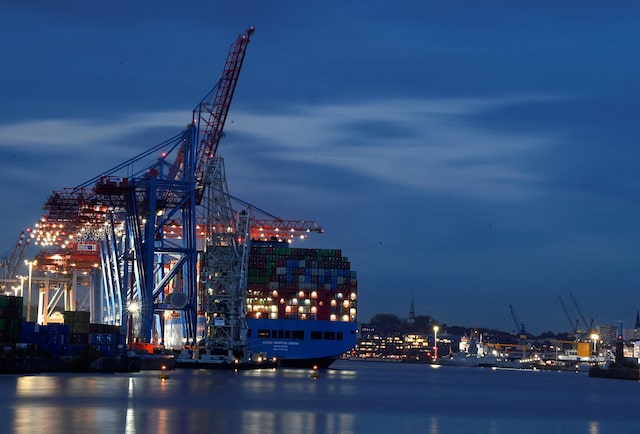
BERLIN, July 8 (Reuters) – Germany could benefit from planned U.S. port fees on merchant ships built in China, with its exports to the United States potentially rising by around 2% compared with a scenario without fees, according to a study by the German Institute for Economic Research (DIW) seen by Reuters on Wednesday.
The reason is that German freight fleets rely less on Chinese-built vessels than those of some competitors, allowing German exporters to gain market share, the study found.
The U.S. government plans to introduce the fees from November in an effort to curb China’s dominance in shipbuilding, citing national security concerns. The charges would be based on where a vessel was built, rather than whose goods it carries.
DIW said the measures would primarily hurt the U.S. itself, estimating that U.S. imports and exports would fall by 0.2% and 0.3%, respectively.
“The mechanism is simple,” DIW economist Sonali Chowdhry said. “The fees raise the cost of intermediate inputs, U.S. manufacturers lose competitiveness, and weaker economic activity also weighs on demand for foreign goods.”
Within the EU, Finland, Denmark and Poland would be hit hardest, with exports to the U.S. falling by 5.0%, 4.4% and 3.0%, respectively.
Emerging economies such as Costa Rica, Vietnam and Pakistan could see U.S.-bound exports slump by nearly 9%, while South Korea could gain about 2%.
Reporting by Rene Wagner and Maria Martinez Editing by Linda Pasquini.