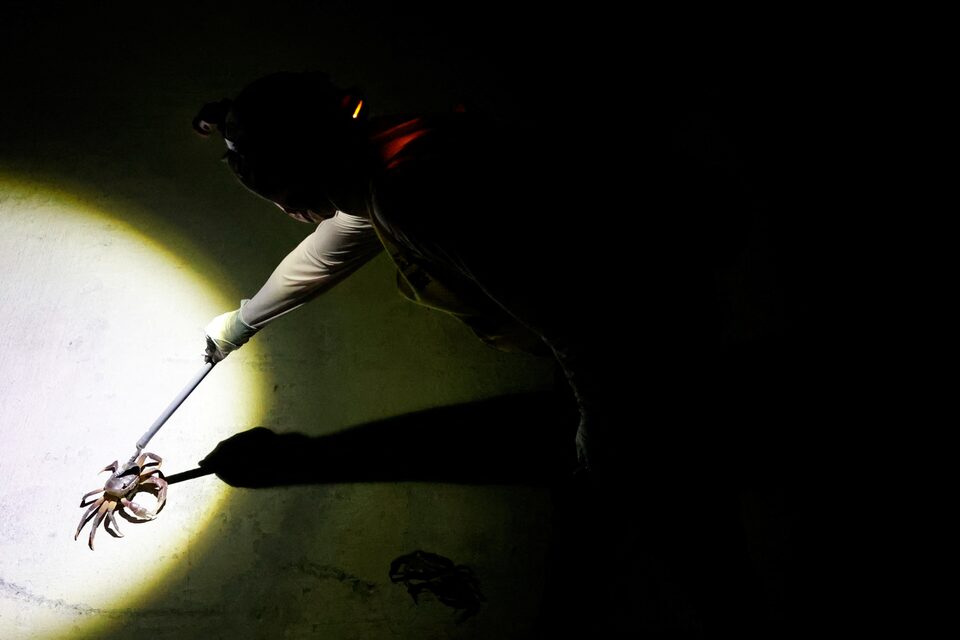
A volunteer marks a mangrove land crab during the annual breeding season, as part of a monitoring effort to estimate population numbers and track their migration to the sea to spawn, at Taijiang National Park in Tainan, Taiwan.

Volunteers gather before setting up roadblocks and documenting mangrove land crab populations during the annual breeding season at Taijiang National Park in Tainan, Taiwan. The park imposes temporary traffic controls to help protect crabs migrating across roads to reach the sea to spawn.

A barrier restricts pedestrian access during the annual mangrove land crab breeding season, in Taijiang National Park in Tainan, Taiwan.
TAINAN, Taiwan, July 8 (Reuters) – Road closures and bamboo bridges have helped protect Taiwan’s largest terrestrial crab species during breeding season when they return to the sea to lay eggs.
Taijiang National Park in the southern Taiwan city of Tainan is the mangrove land crab’s most important habitat and has the island’s largest population.
During the July-to-September breeding season, female crabs come down to the sea to release their eggs, but because their migration route crosses roads, it leaves them vulnerable to being run over.
Taijiang National Park Director Chen Jun-shan said the road closures and bamboo bridges have helped reduce roadkill and contributed to a rise in observed crab numbers from more than 5,000 annually in earlier years to more than 10,000 last year.
“As for the mangrove land crab, it can return all of these nutrient sources back into the land, allowing the coastal forest to become more abundant,” Chen said. “So if you protect the land crabs, the entire coastal forest belt can be protected.”
While the environment got short shrift during Taiwan’s rapid industrialisation from the 1960s to 1980s, it is now a priority for the government, with a network of protected areas and national parks across the island drawing visitors.
The Tainan park is also home to black-faced spoonbill birds, a species listed as “vulnerable” by the International Union for Conservation of Nature and Natural Resources, but which has bounced back from near extinction.
Reporting by Ann Wang and Fabian Hamacher; Writing by Ben Blanchard; Editing by Cynthia Osterman.